
What happens when you take 1930s pulp science fiction and let it absolutely rip?
I was supposed to be working on my thesis proposal. Dr. Patel had sent me three increasingly concerned emails about my timeline. Instead, I'm sitting in my apartment at 2 AM surrounded by empty Mountain Dew cans, listening to Doc Smith describe Richard Seaton casually inventing faster-than-light travel like it's Tuesday. Look, sometimes you need to understand the roots of the genre tree before you can appreciate the branches. That's my excuse and I'm sticking to it.
The Grandfather of Space Opera Doesn't Care About Your Physics Degree
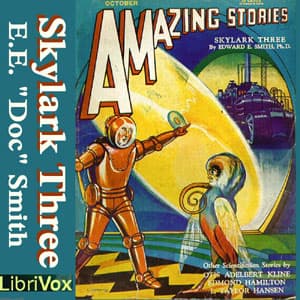
Skylark Three is 1930 science fiction, and it absolutely refuses to apologize for that. Doc Smith was writing about galactic civilizations, thought-controlled spaceships, and dimension-hopping adventures when most sci-fi was still worried about whether we'd ever get to the Moon. The scope here is genuinely bonkers—Seaton and his crew aren't just fighting DuQuesne (the villain from book one who's basically if Lex Luthor was also a chemist), they're dealing with the Fenachrone, an alien race so convinced of their own superiority that they're planning to exterminate every other intelligent species in the galaxy. Just... casually. As one does.
The magic system here—okay, it's "science" but let's be real, it's magic—is chef's kiss. Smith just invents whatever technology the plot needs and explains it with such confident technobabble that you kind of just go with it. Need to communicate instantly across light-years? Here's a "zone of force." Need to destroy a planet? Boom, "X-plosive." Need your brain to work faster? Just hook it up to this machine that amplifies thought. The internal consistency is... loose. But the ambition? Sanderson-level world-building, just with 1930s sensibilities about what "world-building" means.
Richard Kilmer and the LibriVox Question
Here's the thing about this audiobook—it's a LibriVox recording, which means volunteer narrator, which means your mileage may vary wildly. Kilmer reads with steady competence. He's not doing the Steven Pacey thing where every character has a distinct voice that lives rent-free in your head forever. Seaton sounds pretty much like DuQuesne sounds pretty much like the Fenachrone emperor. What Kilmer does have is endurance and clarity. Ten hours of 1930s prose with all its "Hithertos" and "Whereupons" and he never stumbles.
The production is clean—no weird audio artifacts or background noise that I noticed—but it's definitely a "reading" rather than a "performance." If you're used to modern audiobook production with full casts and sound effects, this will feel stripped down. But honestly? For pulp sci-fi from 1930, the straightforward approach kind of works. You're here for the ideas, not the character study.
Pacing Like a Rocket Ship With No Brakes
This thing MOVES. Smith was writing for pulp magazines where you had to hook readers immediately and keep them hooked, and it shows. There's basically no downtime. Seaton invents something, they fly somewhere, they fight someone, they invent something else, repeat for ten hours. If you can't handle info-dumps, this isn't for you. Smith will stop the action dead to explain exactly how the new faster-than-light drive works, complete with made-up physics that sounds plausible if you squint.
My D&D group would love this, honestly. The power scaling is absolutely unhinged in the best way—every time you think Seaton has peaked, he just casually levels up again. It's progression fantasy before progression fantasy was a thing. By the end, our heroes are operating on a scale that makes most modern space opera look quaint.
The Dated Stuff (Because We Gotta Talk About It)
Look, it's 1930. The female characters are... there. Margaret Seaton exists primarily to be rescued and to admire her husband's genius. The prose occasionally gets purple enough to match my thesis advisor's disappointed emails. And there's a kind of casual American exceptionalism baked into the whole thing—of course the American scientist is the smartest being in the galaxy. Of course.
Smith wrestled with similar scope and similar blind spots in Triplanetary, which predates even this one and somehow manages to be even more gleefully unhinged about it.But if you can contextualize it as a historical artifact—the thing that inspired basically every space opera that came after—it's genuinely fun. This is the primordial soup from which Star Wars and Star Trek and Babylon 5 eventually crawled.
Natural 20 or Pass?
Is this a must-listen? No. Is it worth your time if you're a genre nerd who wants to understand where space opera came from? Absolutely. The LibriVox production is serviceable, the story is a wild ride, and at ten hours, it's not asking for a massive commitment. I'd recommend 1.25x speed—the pacing is already fast, but Kilmer's steady delivery can handle the boost.
Perfect for: genre historians, anyone who's ever argued about hard vs soft sci-fi, people who think modern space opera is too restrained. Skip if: you need deep characterization, you can't handle dated gender dynamics, or you require your physics to actually work.
Now if you'll excuse me, I have a thesis proposal to definitely not work on.