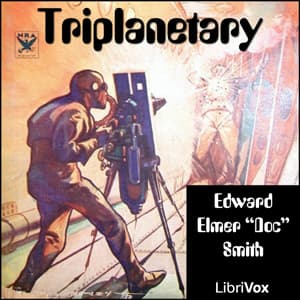

Doc Smith invented space opera the way someone invents a new programming language - by just doing it, ignoring what came before, and letting everyone else figure out the conventions later.
I started Triplanetary at 5:47 AM on a Tuesday, wedged between a guy manspreading into my seat and someone's massive backpack. By the time we hit Millbrae, I was watching aliens called the Eddorians plot the destruction of all civilization across eons of cosmic time. The cognitive whiplash was kind of perfect.
The Grandfather of Every Space Battle You've Ever Loved
Look, this book was written in 1948. The science is bonkers. The gender dynamics are... of their era (women literally exist to "ignite love at a glance" - the description isn't kidding). But here's the thing: every massive fleet battle in modern sci-fi? Every planet-killing weapon? Every ancient alien civilization manipulating humanity from the shadows? It started here. This is basically the ur-text of space opera, just without any modern polish. For a more polished take on genre foundations, Alice in Wonderland shows how classic stories can get reimagined with theatrical flair.
Smith was a chemical engineer with a PhD, and you can tell - not because the science is accurate (it absolutely isn't), but because he approaches world-building with the systematic enthusiasm of someone who really, really wants to explain how his fictional tech works. The electromagnetic spectrum becomes this infinitely malleable thing that can create shields, weapons, tractor beams, whatever the plot needs. Speed of light? Cute suggestion, but no.
The pacing is relentless. We jump from the fall of Atlantis to Rome to World War I to interstellar conflict, all in service of this massive cosmic chess game between the Arisians (good ancient aliens) and Eddorians (bad ancient aliens). It's ambitious in a way that modern editors would probably murder with red ink.
Mark F. Smith Carries the Torch
Here's where I got lucky - Mark F. Smith (no relation to the author, presumably) narrates this LibriVox recording like he genuinely loves the material. His reading is expressive without being theatrical, which is exactly what you need for prose that's already turned up to eleven. When characters start monologuing about the fate of civilization, he commits fully without making it campy.
The man's pacing is solid. He knows when to let Smith's (the author's) breathless action sequences roll and when to slow down for the cosmic exposition dumps. For a free LibriVox production, the audio quality is clean - no weird room echo, no jarring cuts between sessions.
That said, this is single-narrator work, so don't expect distinct character voices. The dialogue-heavy sections can blur together a bit, especially when multiple scientists are debating space physics. I occasionally lost track of who was speaking during the Triplanetary Patrol scenes. Not a dealbreaker, but worth knowing.
The Era Problem (And Why It Might Not Matter)
I need to be honest: some of this has aged like milk left on the Caltrain platform in August. The love interest scenes are painfully dated - women exist to be rescued and admired, full stop. There are some "bloodthirsty" moments that feel jarring by modern standards, casual violence that would get flagged in contemporary publishing.
But I'd argue that's actually part of the value here. You're listening to a historical artifact. This is the primordial soup from which Asimov, Herbert, and eventually Banks and Leckie emerged. Understanding where space opera came from - including its blind spots - makes you appreciate how far the genre has traveled.
At 6 hours 27 minutes, it's a reasonable commitment. I finished it in four commutes, and the episodic structure (jumping between eras) actually works well for interrupted listening. Each section has its own mini-arc.
Who Should Listen (And Who Should Skip)
If you're the kind of person who reads foundational texts to understand a genre's DNA - the way you might read K&R to understand C even though you'd never write code that way now - this is worth your time. The ROI on this audiobook is basically a free education in where space opera conventions originated.
If you want polished modern sci-fi with nuanced characters and progressive values, this will frustrate you. That's not a criticism of either preference, just reality.
Mark F. Smith's narration elevates what could be a slog into something genuinely engaging. He's doing volunteer work here (LibriVox is all public domain recordings), and he's doing it with the care of someone who wants you to love this weird old book as much as he does.
The Commute-Worthiness Calculation
Bottom Line: Worth your commute if you care about genre history. This is the Big Bang of space opera - chaotic, foundational, and kind of impossible to look at directly without special equipment. The narration is solid, the audio is clean, and at six hours, it won't overstay its welcome. Just... maybe don't expect the female characters to do anything except inspire men to greater heroics. We've come a long way.