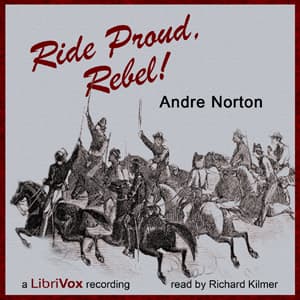

Denise and I were doing our Saturday lakefront walk - one of those late autumn mornings where Chicago decides to remind you that winter is coming and you'd better enjoy this while you can - and I had this playing through my earbuds while she listened to her own thing. About forty minutes in, during a skirmish scene somewhere in Kentucky, a cyclist nearly clipped me because I'd drifted toward the bike lane. That's when I knew the book had me. Not because it was thrilling exactly, but because Andre Norton had quietly pulled me into the saddle with Drew Rennie and I'd forgotten I was walking at all.
Andre Norton Wrote a Western That Happens to Be a Civil War Novel
Here's the thing about Ride Proud, Rebel! that I didn't expect: Andre Norton, queen of science fiction and fantasy, wrote what is essentially a Western disguised as Civil War historical fiction. And she did it with the kind of lean, unsentimental prose that would make Zane Grey nod approvingly. This reminds me of what Hemingway said about writing - the dignity of movement of an iceberg is due to only one-eighth of it being above water. Norton keeps so much below the surface here. Drew Rennie doesn't monologue about his feelings regarding his grandfather's cruelty or his mother's runaway marriage. He just rides. He scouts. He survives. And you piece together the emotional wreckage from the small moments - the way he watches Boyd stumble through his first real brush with military discipline, the guarded way he handles questions about home.
The structure follows Morgan's cavalry and later Forrest's command through the last gasps of the Confederacy, and Norton doesn't romanticize it. There's no Lost Cause mythology here, which frankly surprised me for a book published in 1961. What you get instead is the grinding reality of men on horseback running out of supplies, running out of hope, but not quite running out of stubbornness. The relationship between Drew and his fifteen-year-old cousin Boyd carries real weight - Boyd is headstrong in that specific way that teenagers are headstrong, where bravery and stupidity share a very thin border. My students would recognize that energy immediately. (They'd hate that I said that.)
The addition of Anson Kirby as the Texan friend rounds out the trio nicely. Norton uses Kirby to pull the story's center of gravity westward, and by the final act you can feel the narrative leaning toward Texas and open land the way a compass needle finds north. It's clever structural work. The Civil War isn't just ending - the West is beginning.
Richard Kilmer Reads Like a Man Who's Actually Been on a Horse
Richard Kilmer's narration is steady and unadorned, which is exactly what this book needs. He doesn't try to turn Drew into a brooding hero or Boyd into comic relief. There's a particular quality to his reading - almost laconic, like a man telling you a story around a campfire who trusts you to keep up without dramatic emphasis. The narrator understands that pause is punctuation, and Kilmer uses silence well, especially in the aftermath of combat scenes where Norton's prose goes quiet.
I'll be honest - there's not a huge range of vocal characterization here. You won't always know who's speaking from voice alone, and in scenes with multiple soldiers talking, you have to rely on context. But I'd argue that fits. These are young men ground down by the same war, wearing the same rags, eating the same nothing. They're not supposed to sound dramatically different. Kilmer's approach is workmanlike in the best sense - clear, consistent, and respectful of the text.
At seven and a half hours, it's the right length. Norton didn't pad this. No lengthy philosophical digressions, no overwrought battle descriptions that go on for chapters. She gets in, she moves, she gets out. I listened at 1.0x because the prose deserves to be savored, but I could see someone going to 1.25x without losing anything essential.
Who This Is For (And Who Should Keep Riding)
If you loved The Red Badge of Courage or Charles Frazier's Cold Mountain, this is their spiritual successor in miniature - less literary ambition, sure, but the same unflinching look at war from ground level. I kept a similar headspace going after I finished this one and landed on Chase, which scratches a comparable itch for lean historical momentum - though it didn't quite stick the landing the way Norton does here. Fans of Norton's sci-fi who haven't explored her historical work will find the same clean worldbuilding instincts applied to 1860s America instead of distant planets.
Skip it if you need deep character psychology or romantic subplots. Norton isn't interested in either. And if you're looking for a balanced both-sides Civil War novel, this isn't that - you're riding Confederate, full stop, though Norton keeps the politics muted in favor of survival.
The Book I'll Recommend to My Students Who Say History Is Boring
Seven and a half hours. That's all Norton asks for. And what she gives back is a quiet, honest story about young men trying to find out who they are while everything around them falls apart. It's not flashy. It won't change your life. But I finished it on that lakefront walk and immediately thought about the boys in my third-period class who think the Civil War is just dates and generals. This is the book that could change that for them - war as lived experience, not textbook summary. Worth pausing the faculty meeting for? Absolutely. Worth a credit? Pretty close. It's a solid listen, just not one that demands you drop everything right now.