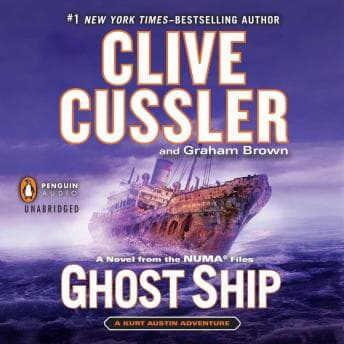

Cussler books are the literary equivalent of a summer action blockbuster — you don't go in expecting Sanderson-level world-building, and that's perfectly okay.
I picked up Ghost Ship during a marathon coding session at 2 AM, the kind where you've been staring at procedural terrain generation for six hours and your brain needs something that moves fast and doesn't ask you to track seventeen competing magic systems. And yeah, this delivered exactly that. Kurt Austin wakes up with scrambled memories after a rescue-gone-wrong on a sinking yacht, and the hook is genuinely clever: did he watch people drown, or was the boat empty? The unreliable memory angle is a nice wrinkle for a series that usually runs on pure forward momentum.
When Your Brain Needs a Break From Sanderlanche
Look, I spend most of my audiobook hours deep in secondary worlds with hard magic systems and thousand-page epics. But sometimes you just need a globe-trotting adventure where a guy punches bad guys in Monaco, infiltrates North Korea, and ends up on the coast of Madagascar — all in twelve hours. The NUMA Files series scratches that itch the way a one-shot D&D session does when nobody wants to prep for the full campaign. You get in, you get your action set pieces, you get out.
The plot threads here — state-sponsored cybercrime, vanishing scientists, human trafficking networks — weave together in that classic Cussler way where everything connects by the third act. It's not going to surprise you structurally. Kurt and Joe Zavala follow the breadcrumbs, get into impossible situations, escape through ingenuity and stubbornness. Graham Brown's co-writing gives the dialogue a slightly sharper edge than some of the later solo Cussler entries, and the memory subplot adds genuine stakes because for once, Kurt doesn't fully trust himself. That's new territory for a character who's usually operating at peak confidence.
The progression is satisfying — the mystery of what actually happened on that yacht unravels in pieces, and each new location peels back another layer. The North Korea sequence in particular has this claustrophobic tension that I wasn't expecting from a series I associate with open-water adventures.
Scott Brick Does the Heavy Lifting
Scott Brick is a workhorse narrator, and he's a solid fit for this kind of material. His delivery is clean and measured — he gives the action scenes real urgency without going over the top, and he keeps the quieter investigative chapters from dragging. Where I'd ding the performance slightly is in character differentiation. In a book with this many international players — Koreans, Europeans, Americans — I wanted more vocal distinction between characters. Brick tends to stay in a similar register for most of the cast, and there were moments during dialogue-heavy scenes where I had to rewind to figure out who was talking. He's no Steven Pacey (but honestly, who is), and if you're coming from audiobooks with really theatrical narration, the delivery here feels more like a skilled newscaster than an actor.
That said, his pacing instincts are excellent. The man knows when to speed up and when to let a beat land. The opening rescue sequence had me pausing my IDE and just listening, which is the highest compliment I can pay an action audiobook.
Who's Rolling Initiative on This One
If you're already a NUMA Files fan, this is one of the stronger entries. If you've never read Cussler, this actually works as an entry point — the memory angle means Kurt is rediscovering things alongside you, which is a nice onboarding trick even if that's not the intention.
This is perfect road trip material or background for grinding through repetitive tasks (looking at you, thesis formatting). It's not the kind of book that rewards deep analytical listening. It's the kind that makes a twelve-hour drive feel like four.
Skip this if you need deep character work or if you're allergic to the globe-trotting action-adventure formula. There's a version of this story that really digs into the trauma of unreliable memory, and this isn't that book. Secret Next Door actually leans harder into that psychological unease if that's the itch you're trying to scratch. It uses the concept as a plot engine, not a psychological study. That's fine. Not every sword needs to be Valyrian steel.
Roll a Perception Check and Move On
I read this instead of writing my thesis. (Dr. Patel, if you're somehow reading Audiobooks4soul.com, no you didn't.) It's a solid, propulsive adventure audiobook with a neat hook and a dependable narrator. Not life-changing, but I had a good time, and sometimes that's enough. Worth a credit if you're in the mood for it. Worth a library hold if you're not sure.