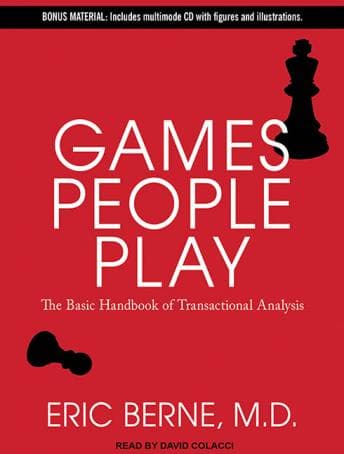

This book is basically the original codebase that every modern self-help psychology book forked from.
I grabbed this one during a Sunday meal-prep session - chopping vegetables, half paying attention - and within twenty minutes I'd stopped chopping entirely because Berne's framework for categorizing human interactions hit me like a well-documented API spec for social behavior. Parent, Adult, Child ego states? That's basically a state machine for human conversation. And once you see it, you can't unsee it.
The 1964 Codebase That Still Compiles
Here's the thing about Games People Play: it was written sixty years ago, and roughly 70% of it holds up shockingly well. Berne's core insight - that people run predictable, unconscious interaction patterns he calls "games" - is genuinely useful. The game called "Why Don't You - Yes But" (where someone asks for advice but rejects every suggestion because they actually want validation, not solutions) made me physically cringe because I recognized it from my last three one-on-ones with a junior engineer. And "If It Weren't For You" - the couples game where one partner secretly relies on the other's restrictions as an excuse not to pursue their own ambitions - yeah, Kevin and I had a very uncomfortable conversation after that chapter.
Berne catalogs dozens of these games with clinical precision: the setup, the roles, the payoff. Each one gets a formula-style breakdown (like, literally, he writes them as transactions). It's structured almost like a reference manual, which is both its strength and its weakness. Some games are instantly recognizable - "Ain't It Awful" is basically every Slack rant channel. Others feel dated in their specifics (the gender dynamics in the "sexual games" section are... very 1964), but the underlying patterns still map to modern behavior if you're willing to do the translation work yourself.
The first third covering transactional analysis theory is where the real value lives. The middle section cataloging all the games is useful but starts to blur together. The final section on autonomy and intimacy as the alternative to game-playing is actually the most interesting part conceptually, but Berne rushes through it - classic case of the denouement getting shortchanged.
David Colacci and the Dryness Problem
Okay, so. The narration. This is where opinions diverge hard and I'm honestly somewhere in the middle. Colacci brings a certain warmth and composure to what is fundamentally an academic text from the Kennedy era. He doesn't try to make it something it isn't. But - and this is a real but - the delivery is steady. Very steady. Unwaveringly steady. At 6:15 AM on the Caltrain, this steadiness nearly put me under multiple times during the game catalog sections where Berne is listing transaction after transaction.
I bumped to 1.5x pretty early and that helped. At 1.75x the academic tone actually becomes more listenable because the pacing starts to feel more like a brisk lecture than a bedtime story. Colacci doesn't do character voices or dramatic shifts (nor should he, really - this isn't that kind of book), but his tone stays professional enough that you trust the material. He's reading you a textbook, and he's doing it competently. Just don't expect Ray Porter-level engagement.
Who Should Clone This Repo (And Who Should Read the README Instead)
Perfect for: anyone in management, therapy, or who's ever wondered why their family dinners follow the exact same argument pattern every single holiday. If you like systems thinking applied to human behavior - if you're the kind of person who reads about cognitive biases for fun - this is foundational material. Thinking, Fast and Slow pairs remarkably well with this one if you want the modern neuroscience scaffolding around the same core idea that humans are running on autopilot more often than we'd like to admit.
Skip for: anyone wanting modern, accessible psychology writing. If you've already read Brené Brown or the more recent attachment theory stuff, you've consumed the downstream forks and might find the original source code clunky. The outdated gender assumptions will annoy you (they annoyed me), and the catalog format gets repetitive in audio.
The ROI on this audiobook is decent but uneven. The first two hours and the last hour are genuinely valuable. The middle three hours are reference material that works better in print where you can skim.
Ship It or Shelve It
At 6 hours 36 minutes, this is a two-commute-day listen at 1.5x. I'm glad I listened to it - the Parent/Adult/Child framework alone has already changed how I debug interpersonal issues at work and at home. But this is a book where the ideas are a 4.5 and the audiobook experience is a 3. The format doesn't love audio. The narration is polarizing. And a third of the content is a catalog you'll retain better by reading.
Still. When Kevin started doing his passive-aggressive thing about whose turn it was to clean the kitchen last night, I looked at him and said "that's a game and the name is 'Look How Hard I've Tried.'" He did not appreciate the analysis. But I was right, and Eric Berne gave me the vocabulary for it. That's worth something.