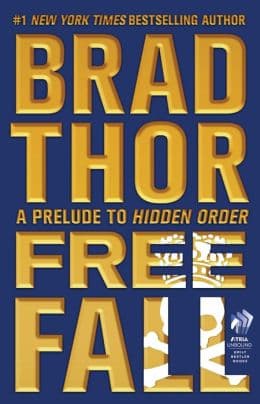

Okay, I have a bone to pick with the publishing industry's obsession with "preludes." You know what a 35-minute prelude really is? It's a trailer. A really long trailer that you pay for. And I say this as someone who just listened to Free Fall while chopping onions for a chana masala that took longer to prep than this entire audiobook. The onions made me cry more than the story did, but let's get into it.
Scot Harvath Gets a Snack-Sized Mission (and That's the Problem)
Here's the thing about Brad Thor's Scot Harvath - he's an interesting psychological specimen. Former Navy SEAL turned covert operative, the kind of guy whose attachment style my therapist would have a field day with. In Free Fall, we get a quick hit of Harvath doing Harvath things: espionage, danger, the works. But at 35 minutes, you're essentially getting a character sketch rather than a character study. I found myself asking: why does Harvath really keep throwing himself into these situations? And then the book ended before I could get anywhere meaningful with that question.
The protagonist exhibits classic action-hero compartmentalization - emotions locked down, mission parameters front and center. Which is fine for a full-length thriller where you get the slow cracks in that armor. But in a prelude? You get the armor and nothing else. It's like reading only the first chapter of an Agatha Christie and being told to buy the rest separately. Poirot would never stand for this. The same frustration hit me with Tom Clancy Chain of Command, where the stakes at least had room to breathe across a full runtime.
What Free Fall does accomplish is scene-setting for Hidden Order. If you're already deep in the Harvath series - this is book 11.5, which is a number that shouldn't exist but here we are - you get a quick pulse check on where your guy is at. The stakes feel manufactured for the format, though. There's no room for the kind of slow-burn tension that makes thrillers actually thrilling. It's more like a fast-burn... sparkler.
Armand Schultz: The Voice That Divides a Fandom
This is a fascinating case study in listener perception. Schultz has been the voice of Harvath across multiple books, so he knows this character's psychological landscape. His voice has a certain weight to it - authoritative, a bit gravel-edged, the kind of voice you'd trust to narrate your evacuation instructions during a crisis. He differentiates characters through tonal shifts rather than dramatic accent work, which for a 35-minute listen is honestly the right call. You don't need a full theatrical production for something this short.
But here's where it gets interesting: the listener reviews are genuinely split. Some people describe Schultz as captivating and expressive. Others - and I'm not making this up - called him "dull and lacking interest in the read." Same narrator. Same book. Completely opposite reactions.
The research actually shows this happens more often than you'd think with audiobook narration. Listener engagement depends heavily on expectations. If you came in wanting high-octane, Jason-Statham-energy narration for your espionage thriller, Schultz's more measured approach might register as flat. If you appreciate a narrator who trusts the material and doesn't oversell every line, you'll like him. I fall somewhere in the middle - he's competent and consistent, but the short runtime doesn't give him enough material to really build momentum. By the time his performance finds its groove, we're in the final minutes.
The 35-Minute Question Nobody Wants to Ask
Let's be honest about what this is. Free Fall exists to get you to buy Hidden Order. It's a marketing strategy wearing a dust jacket. And psychologically, it works - the Zeigarnik effect tells us that incomplete tasks stick in our minds. You finish this prelude feeling like something was started but not resolved, and your brain itches to close that loop. Brad Thor or his publisher understands human nature on this front, whether intentionally or not.
Does that make it bad? Not exactly. It makes it incomplete by design. The writing is efficient, the scenario is serviceable, and if you're already invested in the series, it scratches an itch for about the length of a commute across the Mass Ave bridge.
But if you're new to Harvath? Psychologically, this doesn't track as an entry point. You get no meaningful backstory, no character development arc, no reason to care about this person beyond "he's good at dangerous things." Start with the actual novels. Lightning Rod is actually the rare thriller that does earn its place as a genuine entry point - the character work is there from page one. Come back to this when you're already hooked and need your fix between books.
Who Gets Value Here (and Who's Wasting 35 Minutes)
Existing Harvath fans who want a quick bridge between books - sure, this works. Listen during a short errand, treat it like a deleted scene on a DVD. Anyone else? Save your credit. This is a side dish being sold as a meal, and no amount of solid narration can disguise that.
My Case Notes
I don't regret the 35 minutes. My chana masala turned out great, and Schultz's voice was decent company in my kitchen. But I do wish the publishing world would stop pretending that preludes are standalone experiences. They're not. They're appetizers. And this one left me neither full nor particularly hungry for more - just vaguely aware that a meal exists somewhere else, at full price.