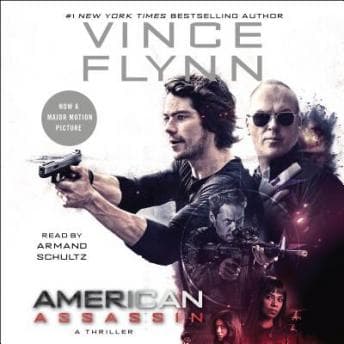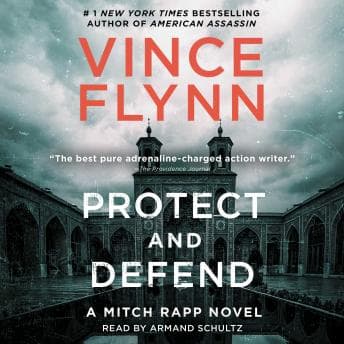

I was making dal makhani at 10 PM on a Tuesday — the kind of elaborate, unnecessary cooking I do when my brain won't shut off — and I needed something that required zero intellectual investment from me. Something where the good guys are good, the bad guys are bad, and nobody's wrestling with existential ambiguity. The last time I found myself in that particular headspace, I ended up with Spy Camp queued up — another genre entry that knows exactly what it is and commits to it without apology. Vince Flynn's Protect and Defend delivered exactly that. Which is both the compliment and the critique.
Here's the setup: Israel takes out Iran's nuclear program, Iran's president wants American blood, and Mitch Rapp — CIA counterterrorism operative and the kind of man who solves problems by being the most dangerous person in the room — has twenty-four hours to prevent catastrophe. The geopolitical chess pieces move fast. Almost too fast.
Mitch Rapp: The Man Who Doesn't Need a Therapist (and That's the Problem)
I found myself asking: why does Mitch Rapp really work as a character? He shouldn't. He's competent to the point of near-omniscience, emotionally controlled to a degree that would make any psychologist suspicious, and rarely wrong about anything that matters. The protagonist exhibits classic hypercompetence syndrome — he's basically a wish-fulfillment figure for anyone who's ever wanted to cut through bureaucratic nonsense and just handle it.
And yet. There's something satisfying about him, the same way there's something satisfying about watching a surgeon who's very good at their job. Flynn understood that readers don't always need a flawed protagonist — sometimes they need a capable one operating in a system full of flawed people around him. The tension isn't "will Rapp succeed?" It's "how much collateral damage will the incompetent politicians cause before Rapp gets there?"
Psychologically, this doesn't quite track for me as a fully realized human being. Rapp processes trauma and threat with the emotional range of a Swiss Army knife — functional, efficient, pointed. But Flynn wasn't writing a character study. He was writing a power fantasy grounded in just enough procedural realism to feel credible. And honestly? While I was stirring my dal and half-listening, that was enough.
The Abridged Problem — Five Hours and Fifty-Five Minutes of Missing Context
Here's where I have to be honest about something that bothered me. This is the abridged version. Under six hours for a full Vince Flynn political thriller means somebody took a machete to the plot, and you can feel the cuts. Some listeners called the book "rushed and one-dimensional," and I suspect the abridgment is doing a lot of that heavy lifting. Characters get introduced and then you're supposed to care about them three scenes later without the connective tissue that makes that caring organic. The back-channel meeting between CIA director Irene Kennedy and her Iranian counterpart — which should be the psychological heart of the book, the moment where two intelligence professionals are navigating trust and betrayal across enemy lines — feels like it happens in fast-forward.
Someone criticized Flynn as "badly in need of editor, dictionary, thesaurus, proofreader" and — look, I don't know if that's fair to the unabridged text or if the abridgment amplified existing weaknesses. But the writing does occasionally lean on geopolitical shorthand rather than earned complexity. Iran bad. Israel complicated but allied. America noble but hamstrung by politics. The Hezbollah mastermind is menacing in the way that thriller villains are menacing — competent, cruel, and conveniently one step behind Rapp when it counts.
Armand Schultz Earns His Paycheck
Armand Schultz does solid, professional work here. He's got the right energy for this kind of material — authoritative without being theatrical, steady enough to keep the pacing tight during action sequences. He handles both the heroes and the villains with distinct enough weight that you're never confused about who's talking, which is critical in a book juggling this many characters across multiple continents. I wouldn't call it a career-defining performance, but it's the kind of narration that serves the material well and doesn't get in its own way. For an abridged thriller you're listening to while cooking? That's exactly what you need.
Who Gets the Most Out of This
If you're already a Mitch Rapp fan, you know what you're getting and you'll enjoy it. If you want a quick, adrenaline-forward listen for a workout or commute — something that moves and doesn't ask you to sit with uncomfortable moral ambiguity — this works. If you're the kind of person who needs psychologically complex characters with realistic motivations (hi, that's me on my best days), you'll find this a bit thin. And I'd strongly recommend seeking out the unabridged version if it exists, because six hours isn't enough room for Flynn's geopolitical plotting to breathe.
My Clinical Assessment
This is a fascinating case study in what readers actually want from thrillers versus what critics think they should want. Flynn's audience doesn't come for character complexity — they come for competence, clarity, and the fantasy that somewhere out there, one very dangerous patriot is keeping the world from falling apart. The abridged format hurts the experience, and the character psychology is surface-level at best. But Schultz delivers it clean, and sometimes — while your dal is simmering and your brain needs a break — surface-level is exactly the right depth.