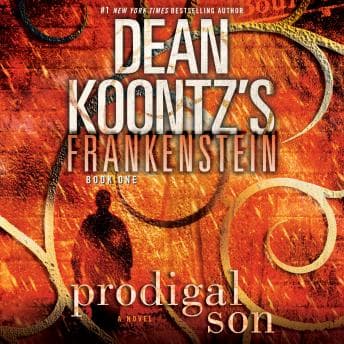

"He is Deucalion, a tattooed man of mysterious origin." That line from early in the audiobook stopped me mid-chop — I was dicing onions for a chana masala that was already threatening to burn — because it set up something I genuinely didn't expect from a Dean Koontz novel: a psychological premise worth taking seriously.
Here's the thing. I came into Frankenstein: Prodigal Son expecting pulp. What I got was pulp with a surprisingly coherent psychological architecture underneath it, and I found myself asking: why does this work when it really shouldn't?
Victor Helios and the God Complex That Actually Tracks
Koontz does something clever with Victor — formerly Frankenstein, now reinvented as a New Orleans biotech titan. The protagonist exhibits classic narcissistic personality disorder markers, but not the lazy Hollywood kind. Victor doesn't just want to play God; he's genuinely bored by the ethical implications of his work. He's moved past guilt entirely. The research actually shows that sustained grandiosity without corrective feedback — which, you know, immortality would pretty much guarantee — leads to exactly the kind of affective flattening Koontz gives him. Victor's coldness toward his "wife" Erika (a created being he treats as furniture with a pulse) is chilling precisely because it's psychologically consistent. He doesn't hate her. She simply doesn't register as a person to him.
Deucalion is the more interesting case study, though. A creature who's had two centuries to develop theory of mind, to study humans, to build something like empathy from scratch. The idea that a being assembled from corpses could become more human than his maker through sheer exposure to suffering? This is a fascinating case study in whether identity is nature or narrative. Koontz doesn't push it as far as I'd want — this is still genre fiction, not a philosophy seminar — but the bones are there.
Carson O'Connor and Michael Maddison, the detective pair, are less psychologically interesting but serve their function. Carson's got the standard-issue tough-woman-cop trauma backstory, and Michael's the loyal partner with a crush he won't act on. Fine. Functional. My therapist would have thoughts about Carson's avoidant attachment style, but the book doesn't seem interested in exploring it.
Christopher Lane's Louisiana — Beautiful Accent, Blurry Faces
So here's where I got frustrated. Christopher Lane has a genuinely gorgeous voice. His Louisiana accents are spot-on — the way he softens vowels for the New Orleans characters, the slight drawl that never tips into caricature. His pacing is excellent, his tone atmospheric. "Remarkable tone, timbre, cadence, and pacing" is how one listener put it, and yeah, that's accurate.
But — and this is a significant but — I kept losing track of who was talking. Lane doesn't differentiate characters enough through pitch or vocal quality. In a book with this many POV characters (Victor, Deucalion, Carson, Michael, the serial killer Allwine, various created beings), that's a real problem. There were stretches, particularly in dialogue-heavy scenes between Carson and Michael, where I had to rewind and re-listen because I genuinely couldn't tell who said what. One reviewer noted it was "too difficult to listen to this audiobook without referencing the hard copy," and while I wouldn't go quite that far, I understand the complaint. If an audiobook requires you to also own the print version, that's... not a successful audiobook.
I was jogging through Cambridge when this became most apparent — the ambient noise plus Lane's similar vocal registers for different characters meant I missed key exchanges. This is not a background-listening book. Not a commute book. Not a "fold laundry while half-listening" book. You need to sit with it.
The Serial Killer Problem
Psychologically, the weakest element is the serial killer subplot. Allwine — one of Victor's creations — kills humans and harvests their organs because he wants to understand what makes them feel. On paper? Fascinating premise. In execution? Koontz rushes through the interiority that would make this land. We're told Allwine is searching for the secret of human emotion, but we don't spend enough time inside his fractured cognition to feel the desperation. Compare this to, say, how Thomas Harris builds Buffalo Bill's psychology in Silence of the Lambs — every detail of that character's behavior maps to a coherent (if horrifying) internal logic. Allwine feels more like a plot device with a scalpel.
That said, the broader concept — an entire race of created beings, some breaking down, some questioning their maker — is genuinely compelling. It's Koontz asking what happens when you mass-produce consciousness without giving it meaning. The research actually shows that purposelessness is one of the strongest predictors of psychological disintegration, and that's exactly what's happening to Victor's creations. Psychologically, this tracks. Power of the Dog explores similar territory — what happens when systems strip meaning from the people caught inside them — though through cartel violence rather than biotech horror.
Who This Is For (and Who Should Run)
If you love high-concept horror with a psychological spine, and you're willing to listen in a quiet room with actual focus, this is worth your time. If you need distinct character voices to follow a multi-POV thriller — and honestly, that's a reasonable need — you might want the print version instead. I had much better luck with character differentiation in Back of Beyond, where the narrator made each POV feel genuinely distinct. Or at minimum, slow the playback down and give it your full attention.
Skip it if unreliable character motivations bother you, because while the main players are psychologically grounded, the supporting cast can feel like chess pieces.
My Clinical Notes
This is a 3.5-star audiobook trapped inside what could've been a 4.5-star concept. Koontz understands something real about what it means to be human — that it's not about biology but about the stories we build around our suffering. Lane's narration is beautiful in isolation and frustrating in practice. I'll probably read the sequel in print. And my chana masala burned, by the way. Worth it, mostly.