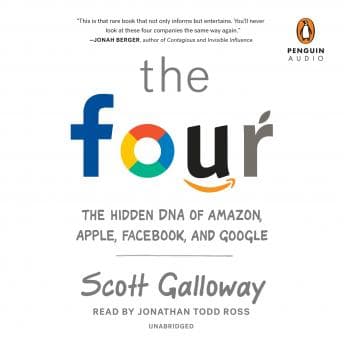

Everyone and their MBA study group has an opinion about Big Tech. I've sat through pitch decks where founders casually say "we're the Uber of X" and board meetings where executives genuinely believe they can out-Amazon Amazon. So when Scott Galloway's The Four landed in my queue, I expected another breathless love letter to Silicon Valley dressed up as analysis. What I got instead was something closer to an autopsy report — clinical, occasionally brutal, and weirdly entertaining.
Here's the bottom line: the first four hours of this book are genuinely excellent business analysis. The last four? You'll feel the padding.
A Professor Who Actually Ran Companies (You Can Tell)
Galloway's framework is what separates this from the typical "Big Tech is amazing/terrifying" genre. He maps each company to a fundamental human instinct — Google as God (we ask it everything, confess our searches), Amazon as our consumptive gut, Apple as our desire for luxury signaling, Facebook as our need for love and connection. It's reductive, sure. But it's the kind of reductive that makes you see patterns you missed.
The man has actual operator experience. He's built companies, failed at companies, sat on the NYT board. When he breaks down how Amazon essentially gets a pass from Wall Street for never turning a profit for years while any other retailer would've been crucified — that's not academic theory. That's pattern recognition from someone who's watched capital markets punish and reward in real time. Cialdini maps the psychological machinery underneath that kind of influence with equal rigor in Influence, New and Expanded — different domain, same cold-eyed clarity about why humans respond the way they do. I've seen this exact dynamic play out with three different startups I've consulted for. They all thought they could play the "growth over profit" card. Spoiler: you're not Jeff Bezos.
The section on Apple as a luxury brand rather than a tech company is probably the sharpest insight in the whole book. Galloway argues Apple's real innovation isn't the iPhone — it's convincing the middle class they deserve a $1,200 status symbol and then making them feel smart about it. My parents charged $4.50 to press a shirt and never once called it "artisanal garment restoration." There's a lesson there that Galloway would appreciate.
When the Professor Won't Stop Professing
Here's where Jenny would say I'm being harsh. Jenny is right. But the second half of this book loses its edge. Galloway shifts from dissecting the Four to broader career advice and predictions about which company will hit a trillion dollars first (spoiler from 2024: they all did). The "how to succeed in a world dominated by the Four" chapters feel like they were bolted on by an editor who said "we need actionable takeaways."
The f-bombs and irreverent tone — which work brilliantly in the first half when he's dismantling corporate mythology — start feeling like a shtick by hour six. It's like a stand-up comic who kills in the first thirty minutes and then keeps going for another hour because the venue paid for ninety.
I was reorganizing my home office at 11 PM — Jenny's version of "aggressively efficient" is apparently "you're not allowed to stack consulting decks on the dining table anymore" — and found myself zoning out during the career advice sections. Not because Jonathan Todd Ross wasn't delivering. He was. Ross channels Galloway's brassy, professorial energy well — that mix of "I'm smarter than you but I'll make you laugh about it" that works in a lecture hall. But even a good narrator can't save content that's running on fumes.
The 2017 Problem (And Why It Still Mostly Works)
This book dropped in 2017, and some of the specifics have aged. Facebook's reputation has cratered further than Galloway predicted. Google's ad monopoly is under real legal threat now. Amazon's labor practices have become a mainstream political issue. But the underlying frameworks — why these companies hooked into our psychology, how they exploit regulatory gaps, what makes them nearly impossible to unseat — that analysis holds up surprisingly well.
The key takeaway is worth the listen. The other 7 hours? Not so much. American Icon is what this kind of corporate analysis looks like when it never loses the thread — Hoffman keeps the granular operator detail Galloway delivers in his best chapters all the way to the end. Chapters on each individual company (roughly the first half) are tight, data-rich, and genuinely insightful. Skip to chapter 5 if you already know your Big Tech basics. Thank me later.
Who Gets an ROI on This Credit
If you're a founder trying to understand platform economics, a mid-career professional wondering why these companies keep winning, or just someone who wants a smarter take than "tech bad" or "tech good" — the first half alone justifies the listen. If you've already consumed Galloway's YouTube lectures or read his blog, you'll recognize maybe 40% of the material. At 8.5 hours, it's not the worst offender in the padding department, but at 2.0x speed I still felt the drag after the midpoint.
Business books should be taxed by the hour for every minute they waste your time. This one owes you about three hours back. But the five hours that land? They land hard.








![Steve Jobs [unabridged audiobook] audiobook cover](/_next/image?url=https%3A%2F%2Fcovers.audiobooks.com%2Fimages%2Fcovers%2Ffull%2F9788499923406.jpg&w=1920&q=75)