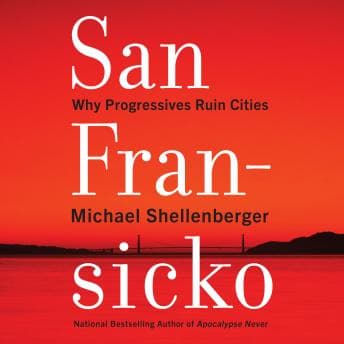

This is the book I wanted to argue with the most this year. And that's actually a compliment.
I was doing meal prep on a Sunday — Jenny was at her sister's, house was quiet — and I put this on expecting the typical policy-book structure: here's the problem, here's who to blame, here's my solution that conveniently maps to my ideology. Shellenberger delivers roughly two-thirds of that formula, but the first two-thirds are genuinely strong. The last part is where I started arguing with my cutting board.
The Dry Cleaning Test
Here's the thing about growing up in Koreatown watching your parents work themselves into the ground: you develop a very low tolerance for people romanticizing poverty or treating dysfunction as identity. Shellenberger's central thesis — that progressive cities moved from tolerating homelessness and addiction to actively enabling them — hits different when you grew up three blocks from Skid Row adjacent neighborhoods. My parents didn't have progressive vocabulary. They had pragmatism. "If the machine is broken, you fix the machine. You don't write a poem about the machine's lived experience."
Shellenberger's strongest chapters are the ones where he traces the policy genealogy. He walks through how Housing First became dogma in San Francisco despite mixed evidence, how the decriminalization of public camping and open drug use created feedback loops that made the streets worse, not better. He names names — specific supervisors, specific nonprofit leaders, specific budget line items. The section on how the homeless-industrial complex in SF generates billions in spending with deteriorating outcomes? That's the kind of receipts-based argument I wish more policy books would make. I found the same evidence-first approach in Apocalypse Never, his climate book. This is what my parents did instinctively — follow the money, ask who benefits from the status quo — but now it has a TED talk.
Jonathan Todd Ross narrates with clean, factual delivery. No dramatic inflection, no vocal editorializing. For a book that's inherently political, this was the right call. Ross delivers that same calm authority in Mutant Project, another science-policy title I found worth the credit. He reads statistics and policy citations the same way he reads Shellenberger's personal anecdotes — steady, clear, professional. It's not a performance that'll win any style points, but for 11 hours of policy argument, you want a narrator who trusts you to form your own reactions.
Where the Argument Gets Sloppy
Around the midpoint, Shellenberger starts doing the thing that frustrates me about a lot of contrarian policy books: he conflates correlation with causation when it suits his thesis and demands rigorous evidence from everyone else. His comparison of San Francisco's approach to drug addiction with European models (particularly the Netherlands and Portugal) is genuinely useful — he spends real time on the differences between decriminalization-with-mandatory-treatment versus decriminalization-with-no-consequences. Good stuff.
But when he pivots to his broader "victim ideology" framework, the argument gets mushy. He's essentially saying that progressive culture creates a permission structure for self-destruction by over-identifying people as victims. There's a real insight buried in there — I've seen this play out with startup founders who blame "the market" for their own execution failures — but Shellenberger stretches it into a grand unified theory that can't bear the weight. Not every bad policy outcome traces back to a single philosophical error. Sometimes it's just bureaucratic incompetence and misaligned incentives. My 2.0x speed couldn't save the chapters where he repeats this thesis for the fourth time with slightly different examples.
I've seen this fail at three different companies — not the homelessness policy, obviously, but the approach of identifying the correct problem and then oversimplifying the solution to fit a narrative. Shellenberger correctly diagnoses that enabling addiction isn't compassion. He's less convincing when he implies that the answer is mostly just "more accountability" without grappling with why accountability-based models also have high failure rates.
Who Gets ROI Here
If you're in any kind of urban policy, nonprofit management, or city government work — worth your time. Even if you disagree with half of it, the data compilation alone is useful. If you're a conservative looking for ammunition, you'll love it, but you'll miss the places where Shellenberger's argument actually challenges conservative assumptions too (he's not anti-housing, he's not anti-spending, he's anti-spending-without-accountability).
If you want a balanced, both-sides analysis — this isn't that. Jenny would say I'm being harsh. Jenny is right. But I'd rather have a book with a clear perspective and some blind spots than a wishy-washy policy overview that says nothing.
Skip to chapter 5 if you already know the basic landscape of West Coast homelessness. Thank me later. The early chapters are scene-setting that anyone who's walked through the Tenderloin or driven through Portland already understands viscerally.
Bottom Line on the Balance Sheet
The key takeaway is worth the listen. The other 7 hours? Not so much. Shellenberger has maybe 5 hours of sharp, data-backed argument padded with repetition and ideological throat-clearing. At 1.5x this is a solid commute companion for a week. At 2.0x it's a weekend project. The narration is functional and clean — Ross doesn't get in the way, which is exactly what this material needs. Not a must-buy, but if urban policy is your thing, it's a solid credit spend.