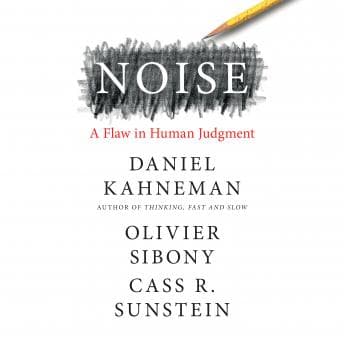

Look, I have a bone to pick with this book. Not because it's bad—it's genuinely excellent—but because now I can't stop seeing noise everywhere. My department's tenure review process? Noise. The inconsistent feedback I give students depending on whether I've had coffee? Noise. The fact that I rated that last thriller three stars on a Tuesday but would've given it four on a Friday? You guessed it. Noise.
Kahneman and his co-authors have essentially ruined my ability to trust any judgment ever again, including my own. Thanks for that.
The Concept That Rewired My Brain
Here's the thing: the central insight is deceptively simple. We all know about bias—it's the darling of behavioral economics, the thing everyone talks about at dinner parties when they want to sound smart. But noise? The random variability in judgments that should be identical? That's the neglected sibling, and Kahneman, Sibony, and Sunstein make a compelling case that it's causing just as much damage.
The examples hit hard. Two judges in the same courthouse handing down wildly different sentences for the same crime. Doctors giving different diagnoses to identical patients. Insurance underwriters whose assessments vary by 55% when they should be nearly identical. (Fifty-five percent! My therapist would have thoughts about the anxiety that statistic induced.)
What makes this fascinating as a case study in human cognition is that noise is invisible in a way bias isn't. Bias has a direction—you can spot it, name it, fight it. Noise is just... chaos. And organizations are terrible at seeing it because they're not looking.
Where the Academic Meets the Accessible
I'll be honest—I was nervous going in. Thinking, Fast and Slow is one of those books I recommend to everyone but secretly know most people abandon halfway through. Dense doesn't begin to cover it. So when I started this during my morning jogs through Cambridge (yes, I'm that person now, listening to behavioral economics while dodging undergrads on bikes), I braced for a slog.
But it's... actually pretty accessible? The research is rigorous—these are serious scholars doing serious work—but the writing doesn't feel like a journal article. They use case studies, real-world examples, and enough narrative structure to keep you engaged. Is it as gripping as Thinking, Fast and Slow at its best? Honestly, no. Some sections drag, particularly when they get into the weeds of statistical methodology. I found myself zoning out during a few of the more technical passages about noise audits.
The payoff is worth it, though. The practical suggestions for reducing noise in decision-making are genuinely useful. As someone who sits on hiring committees and reviews student work, I walked away with concrete strategies. That's rare for a psychology book—usually you get the diagnosis without the prescription.
Jonathan Todd Ross Does the Heavy Lifting
The narration deserves credit here. Jonathan Todd Ross has this clear, easygoing style that makes the complex stuff digestible. He's not trying to be dramatic or inject false excitement into statistical analysis (thank god). He just... explains things well. The pacing gives you room to think, which you need with material like this.
I couldn't find much about Ross's other work online, but based on this performance, he's exactly what dense nonfiction needs: a steady, intelligent presence that doesn't get in the way of the ideas. No vocal pyrotechnics, no unnecessary emphasis. Just clarity.
The production includes a downloadable PDF with figures, which—look, I didn't use it because I was running, but I appreciate that it exists. Some of the data visualization really does need to be seen rather than described.
Who Needs This (And Who Should Skip It)
This is a book for people who make decisions professionally. Doctors, judges, managers, HR professionals, anyone who evaluates others or makes high-stakes calls. I saw similar high-stakes decision-making dynamics play out in Friday Night Lights: A Town, A Team, And A Dream, where coaches and community leaders made judgment calls under immense pressure—though admittedly with less statistical rigor and more Texas football. If you're in one of those roles and you haven't thought about noise, you need this book. Full stop.
It's also great for psychology nerds like me who want to understand why human judgment fails in ways we don't expect. The research is solid, the implications are significant, and it'll give you plenty to think about.
Skip it if you're looking for something fast-paced or narrative-driven. It's a thirteen-hour commitment, and while it's more accessible than Kahneman's previous work, it's still academic nonfiction. You need to be in the mood for learning, not escaping. I listened at 1.25x speed during commutes and it worked perfectly—gave me time to process without dragging.
The Uncomfortable Truth You'll Have to Sit With
The protagonist here—human judgment itself—exhibits classic overconfidence patterns. We think we're consistent. We're not. And that's the uncomfortable truth this book forces you to confront.