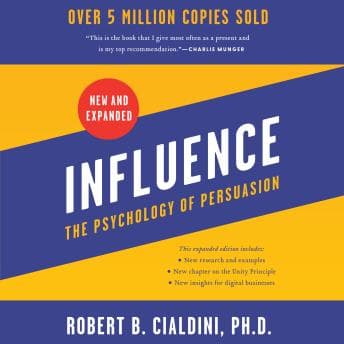

Twenty hours. This book is twenty hours long. I'm going to let that sink in because that's the first thing you need to know about Influence, New and Expanded.
Here's the thing - I've recommended the original Cialdini to probably fifty startup founders over the years. It's one of maybe three business books I consider genuinely essential. The six principles of persuasion? My parents used every single one running their dry cleaning business in Koreatown. They just didn't have fancy names for them. When Mrs. Kim got a discount because she'd been a loyal customer for ten years, that was reciprocity and commitment working together. When my dad mentioned that "everyone in the building" used their service, that was social proof. No PhD required.
So when the expanded edition dropped with a seventh principle - Unity - I had to listen. And yes, I finished it. At 2.0x speed, which brought it down to a manageable ten hours.
Why Cialdini Reading His Own Work Actually Works
Look, author-narrated business books are usually a mistake. CEOs and academics rarely have the vocal training to carry eight-plus hours. Cialdini is the exception that proves the rule. His delivery is clear, authoritative, and - this is key - he sounds like he's teaching a graduate seminar rather than reading off a teleprompter. You can hear the decades of research behind every example.
But. (There's always a but.)
The man narrates like he's being paid by the minute. I'm not exaggerating when I say 2.0x is mandatory. At normal speed, the pauses between sentences feel like he's waiting for you to take notes. Which, fair, maybe you should be. But for those of us listening during a commute or while doing dishes, the pacing at 1.0x is genuinely painful.
The Seventh Principle Was Worth the Wait
Unity - the new addition - is about shared identity. We're more easily influenced by people we perceive as "one of us." Family, tribe, in-group. It sounds obvious when I say it, but Cialdini backs it with research that made me rethink three client engagements on the spot.
This is what separates Cialdini from the LinkedIn thought-leader crowd. Every principle comes with peer-reviewed studies, not just vibes and anecdotes. The ethics chapter at the end? Actually persuasive. (Yes, I caught the irony.) He makes a genuine moral case for using these techniques responsibly, and it doesn't feel like corporate liability protection.
The expanded examples are solid too. Updated for the social media era without feeling desperate to be relevant. He's not trying to explain TikTok to you - he's showing how the same psychological levers work across platforms and decades.
Where It Drags (And It Does Drag)
Twenty hours means there's padding. Some examples get belabored past the point of usefulness. I found myself zoning out during a few extended case studies that could've been cut in half. The core insights? Maybe six hours of material. The rest is reinforcement, which some listeners need and others don't.
If you've read the original, chapters on reciprocity, scarcity, and social proof will feel familiar. Not redundant - the new research adds value - but don't expect revelations. The real meat for returning readers is Unity and the updated applications.
Also: the PDF supplement is mentioned but honestly, I never downloaded it. If you're the type who needs visual frameworks, maybe grab it. I retained plenty without it.
The ROI Calculation
Bottom line: this is still the foundational text on persuasion psychology. If you haven't read or listened to any version of Influence, start here. The expanded edition is the definitive version.
If you've already absorbed the original, the question is whether Unity plus updated examples justifies twenty hours. My answer: yes, but be strategic. Speed it up, skip to the Unity chapter first, then backfill the updated sections on principles you use most.
Who Should Listen (And Who Should Skip)
Anyone in sales, marketing, or leadership who hasn't read Cialdini - this is your starting point. Skip it if you've already internalized the original and don't have patience for twenty hours of reinforcement, even at 2.0x.
I've seen these principles fail when applied mechanically - founders who read the book and then transparently manipulate customers. That's not the point. The same mechanical application problem shows up in 5 Love Languages - people treat the framework like a checklist instead of a diagnostic tool. Cialdini's framework is diagnostic as much as prescriptive. Understanding why you're susceptible to certain pitches is half the value.
My parents never read this book. They figured it out through trial and error over thirty years. You can shortcut that timeline significantly. Just bump up the playback speed.