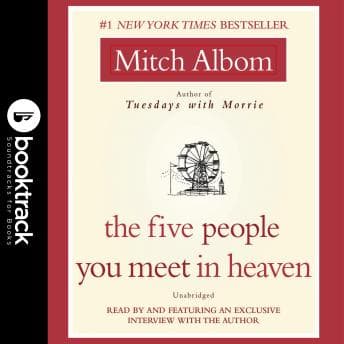

Denise and I were walking the lakefront last Sunday evening — one of those late-spring Chicago nights where the sky turns that impossible shade of pink over the water and you start thinking about big questions you normally avoid. She was a few steps ahead, and I had my earbuds in, and by the time Eddie met his third person in heaven, I'd stopped walking entirely. Just standing there on the path near Montrose Harbor, staring at the lake like a man who'd lost something.
This is a book that will make you feel things you didn't sign up for. Fair warning.
The Author Tells You What to Feel — And You Feel It Anyway
Let me get this out of the way: Mitch Albom breaks about every rule I teach my juniors in creative writing. "Show, don't tell"? Albom tells. He tells you Eddie is broken. He tells you the war damaged him. He tells you what each heavenly encounter means before you've had a chance to sit with it yourself. One of the most accurate criticisms I've seen is that Albom apparently never heard of the show-don't-tell rule when it comes to character reactions, and — look, that's fair. It's a valid literary complaint.
But here's the thing. This reminds me of what Hemingway said about prose being architecture, not interior decoration. Albom isn't building a cathedral here. He's building a front porch. And sometimes you just need to sit on the porch.
At four hours and thirty-nine minutes, the book knows exactly what it is. It's not trying to be Faulkner. It's not trying to be Morrison. It's a parable dressed up as a novel, structured around five encounters that each reveal a hidden connection in Eddie's seemingly wasted life — the Blue Man who died because a young Eddie ran into traffic, the Captain who made an impossible wartime choice, Ruby for whom the pier was named. Each encounter peels back a layer, and Albom doesn't trust you to peel it yourself. He peels it for you and holds it up to the light.
My students would hate this. I kind of loved it.
Erik Singer and the Violins That Won't Leave You Alone
Now. This is the Booktrack Edition, which means you're getting Erik Singer's narration plus a continuous musical score playing underneath. And I need to talk about both, because they're doing very different things.
Singer reads with a steady, unhurried warmth that fits Eddie's blue-collar weariness. He doesn't do vocal fireworks — there's no dramatic shift between characters that makes you forget you're listening to one person. But there's a quiet emotional intelligence to his pacing. The narrator understands that pause is punctuation. When Eddie arrives in heaven and the disorientation sets in, Singer lets the silence do work before the music fills in behind him. That restraint matters.
The music, though. The music is where this edition becomes a choose-your-own-adventure in taste. The score swells with strings during the emotional peaks — violins, specifically, rising right when Albom is already telling you "this is the sad part." If you're the kind of listener who wants the book to trust you, this will feel like being nudged in the ribs during a funeral. I found myself aware of the manipulation even as it was working on me. The tempo genuinely does match the narrative rhythm — calmer during Eddie's childhood memories, more urgent during the war sequences — and it never drowns out Singer's voice. But it's always there. Always.
For some people, this will feel like watching a movie with your ears. For others, it'll feel like emotional helicopter parenting. I landed somewhere in the middle — appreciated the craft of the production, occasionally wished someone would just let the words breathe on their own.
Who This Is Really For
If you want literary complexity, layers of ambiguity, prose that demands rereading — skip this. Read Lincoln in the Bardo instead. But if you've ever stared at a ceiling at 2 AM wondering if the small choices of your life added up to anything, if the people you hurt and helped even remember you, if your ordinary Tuesday-through-Saturday existence mattered at all — this book will find the bruise and press on it. I found a similar kind of pressing in Heart of the Buddha's Teaching — different tradition, different vocabulary, but the same stubborn insistence that suffering is pointing at something rather than just happening to you.
It's especially potent if you've lost someone. Or if you're getting older and the question "why was I here?" has started to feel less philosophical and more urgent. I'm fifty-three. I've been teaching the same books to different kids for twenty years. Some nights, grading the same five-paragraph essays about symbolism in Gatsby, I feel a lot like Eddie fixing the same rides. Albom wrote this book for people like me, and I'm not too proud to admit it got to me.
The prose deserves to be savored at 1.0x. It's simple prose, yes — but the simplicity is the point. These are meant to be plain truths delivered plainly.
The Assignment I'd Give My Students (But They'd Never Do)
Listen to this in one sitting. It's short enough. Then sit with the question it asks — not "what happens after we die" but "what if your life already mattered and you just couldn't see it?" The book doesn't earn that question through literary brilliance. It earns it through sincerity so aggressive it almost dares you to be cynical.
I was cynical for about the first hour. By hour three, standing on the lakefront path while Denise doubled back to find me, I wasn't.
Worth pausing the faculty meeting for. Especially if you get the version without the violins. But even with them — yeah. Even with them.