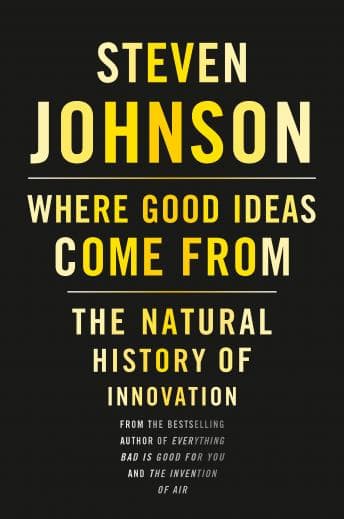

Everyone keeps telling me this book changed how they think about innovation. LinkedIn posts. TED talk summaries. Startup founders who've read the dust jacket and now won't shut up about "the adjacent possible." So I finally queued it up on a Saturday morning while reorganizing my home office - Jenny was out, I had coffee, and seven hours to kill before dinner with her parents.
Here's the thing: I came in skeptical and left... mostly converted. Not fully. But mostly.
The Adjacent Possible Is Just My Parents' Supply Closet
Steven Johnson's central framework is that innovation doesn't happen in eureka moments. It happens in environments - what he calls "liquid networks" where ideas can collide, recombine, and mutate. He borrows from biology, urban planning, and the history of science to argue that the lone genius narrative is mostly fiction. Darwin didn't have a flash of insight. He had a slow hunch that marinated for months in his notebooks.
And look - this is what my parents did instinctively. Now it has a TED talk. They didn't "innovate" their dry cleaning business through some Silicon Valley design sprint. They talked to other Korean business owners at church. They watched what the laundromat two blocks over was doing. They kept a mental inventory of what was possible given what they already had - which is literally Johnson's "adjacent possible" concept, just without the fancy evolutionary biology metaphors. Sarah Smarsh captures that same instinct in Heartland - the way working-class families navigate constraints through a kind of inherited pragmatic genius that nobody bothers to theorize about.
The book's strongest stretch is when Johnson traces how coral reefs and cities share structural properties that enable innovation. Dense, interconnected, messy environments where different organisms (or people, or ideas) bump into each other. He makes the case that the coffeehouse culture of the Enlightenment did more for science than any university laboratory. That's a genuinely interesting argument, and Johnson writes it cleanly enough that even at 2.0x I caught myself nodding along.
Where the Graphs Go to Die
Here's where the audiobook format hurts. Johnson has this section on quadrants - mapping innovations along axes of individual vs. networked and market vs. non-market. It's clearly designed as a visual framework. Without the actual graph in front of you, Erik Singer is basically narrating coordinates into the void. "Upper right quadrant" means nothing when you're staring at the inside of a coffee mug.
This is my biggest gripe. The book has maybe 5-6 moments where Johnson references visual data, diagrams, or spatial relationships that simply don't translate to audio. If you're listening, you'll feel yourself drift during these sections. Not Singer's fault - the man reads with clean, measured pacing and solid emphasis on the right words. He's not flashy, but he's professional. Easy to listen to for hours without fatigue, which is about the best compliment I can give a nonfiction narrator.
But no narrator can save you from a quadrant you can't see.
7 Hours, 3 Hours of Actual Signal
Bottom line: Johnson has about four genuinely powerful concepts here - the adjacent possible, liquid networks, slow hunches, and exaptation (repurposing existing innovations for new uses). Each one is well-argued with historical examples that stick. Tim Berners-Lee building the web from existing protocols. YouTube starting as a dating site. GPS emerging from a physicist tracking Sputnik's signal drift.
The problem is the padding. Johnson repeats his core ideas across different historical examples that start to feel interchangeable by hour five. Yes, I understand that Darwin's notebooks functioned as a slow hunch incubator. You showed me that with three examples already. The fourth isn't adding ROI to my listening time.
Skip to chapter 5. Thank me later. That's where exaptation lives, and it's the freshest concept in the book - the idea that innovations get repurposed in ways their creators never intended. It's the chapter that actually changed how I advise startups on product-market fit.
The Efficiency Memo
Who needs this: First-time founders who think innovation requires a lightning bolt. Anyone building a team and wondering why their brainstorming sessions produce garbage. People who want a biological framework for why open-source collaboration works.
Who should skip: If you've already read Johnson's other work, you've heard 60% of this. If you need tactical, step-by-step advice on how to actually build innovative teams, this isn't it - it's theory with historical proof, not a playbook. And if visual frameworks matter to you, buy the print copy instead.
My 2.0x speed couldn't save this one from feeling about two hours too long. But the ideas that land? They land hard enough that I've referenced them in three client calls since finishing. That's the test. Not whether a book sounds smart while you're listening, but whether it changes what comes out of your mouth on Monday morning.
Jenny would say I'm being harsh. Jenny is right. It's a good book. It's just not a great audiobook. There's a difference, and seven hours of your life is worth knowing which one you're getting.