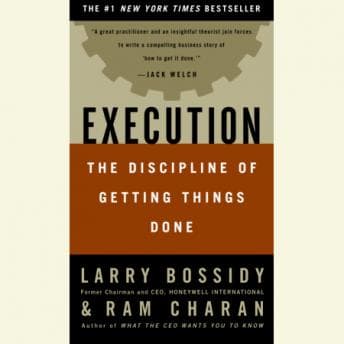

I was on a client call last Tuesday - one of those 'why is nothing getting done' emergency sessions with a Series B startup - when I realized I'd basically been paraphrasing this book for 45 minutes. That's when I knew Bossidy and Charan had gotten into my head. Whether that's a good thing depends on how much you value your time.
Here's the bottom line: This book has maybe 2.5 hours of genuinely useful content stretched across 8 hours. The core thesis - that execution is a discipline, not a collection of tactics, and that it requires linking people, strategy, and operations - is solid. Actually, it's more than solid. It's the thing my parents did running their dry cleaning business without ever reading a single management book. They just called it 'doing the work.'
The Framework That Actually Delivers
I've sat through enough strategy sessions to know that most companies fail not because they have bad ideas, but because they can't translate those ideas into reality. Bossidy's experience at AlliedSignal (31 consecutive quarters of 13%+ EPS growth - that's not luck) gives him credibility that most business authors don't have. When he talks about personally checking references for key hires, about never delegating the people process, about building a culture of intellectual honesty - this isn't theory. This is what separates companies that execute from companies that just talk about executing.
The three core processes framework - people, strategy, operations - is genuinely useful. I've used it with clients. It works. The emphasis on 'robust dialogue' and avoiding 'social operating mechanisms' that let bad news hide? That's real. I've seen companies die because nobody would tell the CEO the truth.
The Audiobook Problem
Here's where it gets complicated. John Bedford Lloyd does a professional job narrating - clear, authoritative, the kind of voice you'd expect for a serious business book. No complaints there. But then Bossidy and Charan jump in with their own commentary throughout, and... ugh. I get what they were going for. Adding authenticity, personal touches, that sort of thing. But they're not professional narrators, and the interruptions break the flow. It's like watching a documentary where the director keeps stepping in front of the camera.
I listened at 2.0x (obviously), and even then, the repetition got to me. The book makes its core points in the first third, then proceeds to make them again. And again. With slightly different examples. I found myself zoning out during my morning runs, which is not great for a book about staying focused on execution.
Who Gets ROI Here (And Who Doesn't)
Required listening if you're a new manager or executive who's never been exposed to these ideas. The emphasis on leaders being deeply involved in operations rather than just setting vision and walking away - that's counter to a lot of the 'delegate everything' advice floating around LinkedIn. And it's correct. My parents never 'delegated' quality control at the dry cleaners. They checked every shirt themselves.
But if you've been in management for a decade, if you've read Good to Great and Built to Last and the other classics, you'll find a lot of familiar territory here. Same goes for Cashvertising - useful frameworks, but you've probably internalized most of it already if you've been doing this work. The insights are valid but not revolutionary. Skip to the chapters on the people process (chapter 5-ish) and the section on linking strategy to operations. The rest is padding.
The P&L on Your 8 Hours
I'm being harsh. Jenny would say I'm being harsh. Jenny is right. This book has earned its #1 bestseller status for a reason - it crystallizes something that a lot of business books dance around. Execution isn't glamorous. It's not a 'vision thing.' It's showing up every day and doing the work of connecting what you say you're going to do with what actually happens.
But as an audiobook experience? It's a slog. The 8-hour runtime could easily be 4. The author interruptions are distracting. And the repetition - look, I understand that business books repeat things for emphasis, but there's a line.
One hour of framework is worth the listen. The other seven? Diminishing returns. If you're going to commit, do it at 1.5x minimum, and give yourself permission to skip ahead when the déjà vu sets in. The framework is solid. The delivery needs an editor.