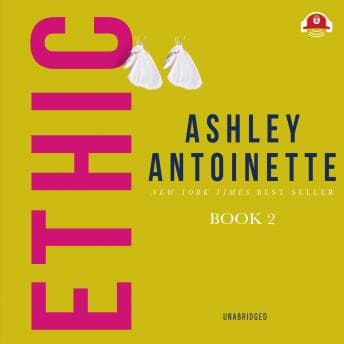

Can a person love someone who destroyed the thing they loved most? Not theoretically - not as some philosophy seminar hypothetical I'd pose to my juniors before they zone out - but actually, viscerally, in the marrow-deep way that Ashley Antoinette is asking here?
That's the question sitting at the center of Ethic II, and it's the reason I was still listening at 1:47 AM on a Tuesday with a stack of ungraded persuasive essays staring at me from across the kitchen table.
The Weight Antoinette Puts on Forgiveness
Let me set the context for anyone who hasn't read the first installment. Ezra "Ethic" Okafor is a man whose hands have done terrible things, and Alani is the woman who knows exactly what those hands have done - specifically, how they've torn apart her world. Book two picks up in the wreckage of that revelation, and Antoinette doesn't let anyone off easy. This isn't a romance where the dark past is hinted at and then hand-waved away by chapter twelve. The killing that separates them isn't backstory decoration. It's the load-bearing wall of the entire narrative, and Antoinette keeps leaning on it until you feel the structure creak.
What struck me - and this is where I have to give Antoinette real credit - is how she refuses to simplify the moral equation. Ethic isn't reduced to a villain. Alani isn't reduced to a victim who just needs to "get over it." The book sits in that excruciating middle space where you understand why forgiveness feels impossible and simultaneously feel yourself rooting for it anyway. One listener put it perfectly: "I couldn't help but root for them, for their happiness, for everything to be ok." That's not cheap sentimentality. That's craft. Antoinette earns that emotional pull by making you sit with the ugliness first.
This reminds me of what Hemingway said about writing - that the dignity of movement of an iceberg is due to only one-eighth of it being above water. Antoinette's prose operates differently than Hemingway's spare minimalism, obviously. She's lush where he's lean. But she shares that instinct for keeping the real devastation below the surface, letting characters circle around their pain before confronting it.
Nicole Small Carries Nine Hours Without Flinching
Nine hours is a significant commitment for what is essentially a two-person emotional war, and Nicole Small doesn't buckle under the weight. Her read is steady where it needs to be steady and raw where rawness is required. There's a particular quality to how she handles Alani's sections - a tightness in the delivery, almost breathless at points, that communicates the character's barely-held-together composure without overselling it. The narrator understands that pause is punctuation. Small uses silence the way a good jazz musician uses rests - not as absence, but as emphasis.
I'll be honest: I don't have enough data on specific accent work or character differentiation to break down every voice choice she makes. What I can tell you is that the emotional register never felt false. When Ethic is spiraling - trying to parent Morgan through her own reckless love story, trying to reach Bella when he can barely reach himself - Small's delivery drops into something quieter, almost defeated. It's not dramatic. It's just... tired. And that felt right for a man who's failing and knows it.
My one reservation is that the single-narrator format means the transitions between Morgan's storyline and Ethic's central conflict occasionally blur. Not a dealbreaker. But there were moments where I had to rewind because I'd lost track of whose head I was in. (This could also be a 1:47 AM problem. Hard to say.)
Who This Is For - And Who Should Know What They're Walking Into
If you loved the first Ethic, you already know whether you're listening to this. The consensus seems to be that book two meets or exceeds the first, and I'd agree - Antoinette deepens the emotional stakes without losing narrative momentum. If you loved Ugly Love by Colleen Hoover but wished it had sharper teeth and higher stakes, this is its spiritual successor in a different register entirely. Antoinette writes with a rawness that doesn't flinch from violence, explicit sexuality, or language. Content warnings are warranted and real. Ashley Antoinette's other work operates in the same unsparing register — I talked about that tonal intensity in my review of Cartel 4: Diamonds Are Forever, which shares that refusal to soften the world it's depicting.
My students would hate this. I love it. Not because it's literary in the way my grad school professors would've recognized, but because Antoinette is doing something genuinely difficult - writing a love story where the central obstacle isn't miscommunication or bad timing but actual, irreversible harm. And she's asking whether love can survive that. The prose deserves to be savored, not rushed. Keep it at 1.0x.
Worth Losing Sleep Over
Denise found me at the kitchen table with my eyes closed and my earbuds in and asked if I was grading or sleeping. Neither, I told her. I was listening to a woman decide whether to forgive the unforgivable. She poured herself a glass of wine and sat down across from me. Didn't ask me to explain. That's the kind of book this is - you don't explain it. You just sit with it.