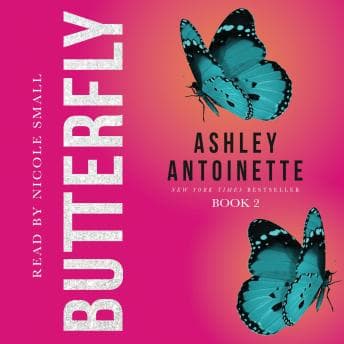

"Run away from the boy that gives you butterflies, he's going to break your heart."
I heard that line early in the audiobook and had to pause my walk along the lakefront. Because that's not just advice—that's thesis statement. That's Ashley Antoinette telling you exactly what kind of emotional territory you're about to enter, and honestly? I respect that kind of authorial honesty.
Look, I'll be upfront: this isn't my usual territory. I spend most of my listening hours with Faulkner and Middlemarch and whatever dead author my 47 podcast listeners want me to analyze next. But here's the thing about teaching high school English for twenty years—you learn that great storytelling transcends genre boundaries. And Morgan Atkins' story? It's got the bones of classic tragedy. Girl torn between duty and desire, between the safe choice and the dangerous one. Shakespeare would recognize this plot. He'd probably add more sword fights, but he'd recognize it.
Nicole Small Understands That Pause Is Punctuation
I'm picky about narrators. Occupational hazard. When you spend your life teaching kids that words matter, that the author chose every syllable for a reason, you develop opinions about how those words should be spoken. Nicole Small gets it.
She's got this warm, melodic quality that pulls you into Morgan's headspace without ever feeling like she's performing. And the character voices—genuinely distinct. You know who's speaking before the dialogue tag catches up. Some listeners apparently found the single-narrator-multiple-characters thing distracting. I didn't. Maybe because I've sat through too many audiobooks where everyone sounds like the same person with a slightly different accent. Small gives each character their own rhythm, their own energy.
One listener quote I found said she "makes you want to keep listening," and that's exactly right. There were faculty meetings—sorry, Principal Martinez—where I absolutely should have been paying attention to budget allocations, but Morgan's mess of a love life was way more compelling. (Don't tell anyone.)
The Slow Burn That Catches Fire
Here's where my English teacher brain kicks in. What Antoinette does really well is the tension between what Morgan wants and what she knows she should want. The comfortable life. The respectable man. The luxury. And then the ghost from her past shows up and suddenly all that stability feels like a cage.
It's not subtle. Antoinette isn't trying to be subtle. She's writing emotional intensity the way some authors write action sequences—relentless, breathless, designed to keep you turning pages. Or in this case, keep you walking past your usual turnaround point because you need to know what happens next.
The pacing works. Eight and a half hours felt right for this story—enough time to build the relationships, enough time to feel the weight of Morgan's choices, but not so long that the drama starts to feel manufactured. Some listeners mentioned wanting more background detail, and I get that. But honestly, I appreciated that Antoinette trusts her readers to fill in gaps. She's not holding your hand through every emotional beat.
My students would probably call this "messy." They'd mean it as a compliment. Morgan makes bad decisions. She knows they're bad decisions while she's making them. That's not a flaw in the writing—that's the point. This reminds me of what we talk about in class when we read Anna Karenina (the abridged version, because teenagers). Sometimes the most honest character work shows people choosing wrong because wrong feels right in the moment. That same kind of messy, emotionally honest storytelling is what drew me to Last Thing He Told Me: A Novel—different genre, same willingness to let characters be complicated.
Who Should Queue This Up (And Who Should Skip)
If you're a fan of urban fiction and contemporary romance, you probably already know Ashley Antoinette's work. This is apparently the start of a whole series, and I can see why—Morgan's story clearly has more chapters to go.
But here's my honest take: if you need your protagonists to make smart, defensible choices, this might frustrate you. If emotionally intense storytelling exhausts you, maybe sample first. And if you're sensitive to one narrator voicing multiple characters, that's a legitimate concern—though I think Small handles it well.
For everyone else? Especially if you want something that'll make an eight-hour drive or a week of commutes disappear? This works. It's engaging in that can't-stop-listening way that good audiobooks should be.
Mr. Williams Closes His Gradebook
I listened at 1.0x because—and my students mock me for this constantly—the author chose those words. The narrator chose those pauses. I'm going to hear them properly. But I suspect most people could bump it up a bit without losing the emotional impact.
Worth pausing the faculty meeting for. Definitely worth the lakefront walk running long. Denise asked why I was so quiet at dinner after finishing it. I said I was thinking about butterflies and bad decisions. She assumed I was grading papers again. Close enough.