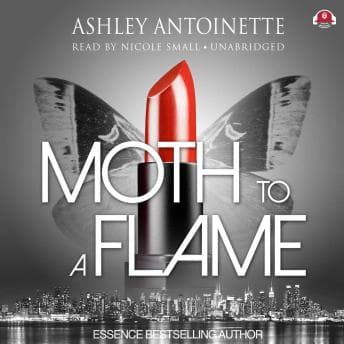

Denise and I were doing our Saturday lakefront walk — one of those late October mornings where Chicago decides it's already January — and she had her own podcast going in one ear while I had Nicole Small in both of mine. About forty minutes in, a gunshot sound effect cracked through my earbuds so suddenly that I flinched hard enough for Denise to pull out her earbud and ask if I was having a stroke. I was not. I was listening to Moth to a Flame, and the book had just decided to remind me that Flint, Michigan doesn't play.
Let me be upfront: this is not my usual lane. I spend most of my listening hours with Austen and Morrison and the occasional Hemingway reread I pretend is for lesson planning. But I teach in Chicago. I have students who hand me Ashley Antoinette books with that look — the one that says read this and then tell me the classics matter more. So I listened. And I need to sit with what I heard.
The Coldest Winter Ever's Younger, Angrier Sister
People compare this to Sister Souljah's work, and I get it — the DNA is there. Daddy's girl, sheltered from the empire that funds her sheltered life, falls for exactly the wrong man. But where Winter Santiaga had swagger and delusion, Raven Atkins has something quieter and more devastating: genuine sweetness that gets systematically dismantled. Ashley Antoinette isn't writing a cautionary tale about a girl who should've known better. She's writing about a girl who couldn't have known better, because Benjamin Atkins kept her so insulated from his world that she had no immune system for the streets when they finally found her.
That's a sharp observation about overprotection, and Antoinette earns it. The early chapters where Raven chooses Mizan feel exactly like every bad decision I've watched my juniors and seniors make — not stupid, just young. Puppy love logic. The kind where you'd rather be wrong together than safe alone.
But then the book turns. And it turns hard.
When Hugs Become Hospital Visits
I won't sugarcoat this. The domestic violence in this book is unflinching. Antoinette doesn't let you look away. There's a progression — the first time Mizan's temper shows, you can almost hear Raven rationalizing it in real time. By the time hugs and kisses have fully become bloody lips and black eyes, the book has trapped you in the same psychological cage Raven's in. You know she should leave. She knows she should leave. And the book makes you understand, viscerally, why she doesn't.
This is why I told my student I'd listen. Because that mechanism — the moth-to-a-flame pull of an abusive relationship — is something literature is supposed to help us understand. Antoinette writes it with the kind of emotional precision that I'd call literary if the gatekeepers of that word weren't so precious about genre.
Now. There's a caveat I can't ignore. Multiple listeners have flagged that the audiobook version is missing passages that exist in the print edition. Whole chunks of story apparently got cut or dropped somewhere in production. I noticed at least one transition that felt abrupt — a scene shift that seemed to skip connective tissue — and now I'm wondering if that's why. For a book this tightly wound around Raven's psychology, missing passages isn't a minor issue. It's like removing pages from the middle of a therapy session.
Nicole Small Knows When to Whisper
Nicole Small's narration is restrained in the right places. She doesn't melodramatize the abuse scenes — she lowers the temperature, lets the words carry the weight. That's smart. A narrator who leans too hard into the violence would make this exploitative. Small makes it intimate and terrible, which is what Antoinette intended.
The sound effects are another matter. Those gunshots I mentioned? They're effective — genuinely startling, which I suppose is the point. But they're jarring in a way that breaks the listening trance. In a book that's otherwise driven by emotional tension rather than action-movie pacing, a sudden sound effect feels like someone banging pots while you're reading poetry. Your mileage may vary. Denise thought I was ridiculous for jumping. She's not wrong.
Who This Is For (and Who Should Brace Themselves)
If you read urban fiction — if you grew up on Ashley & JaQuavis, on Wahida Clark, on the Triple Crown era — this is essential. It's one of Antoinette's strongest solo outings, and at eight hours and change, it doesn't overstay.
If you're coming from literary fiction like I did, come with respect and an open mind. The prose isn't Toni Morrison, but the emotional architecture is serious work. My students would love this. Some of them already do.
But please hear me: the content warnings are real. Violence, abuse, drug trade, and an ending that doesn't hand you comfort. If you're sensitive to depictions of domestic violence, this book will be hard. It's supposed to be.
I'd also recommend grabbing the ebook alongside the audio to fill in whatever gaps the production left behind. You shouldn't have to, but here we are.
The Lesson Plan I Won't Submit to Principal Martinez
This book does something I try to teach my students every single day — it makes you feel complicit in a character's choices by making you understand them. That's what good fiction does, regardless of what shelf the bookstore puts it on. The prose deserves to be savored, even when — especially when — it hurts.
The missing passages and occasional jarring sound effects keep this from being the definitive version of the story. But Nicole Small's performance and Antoinette's unflinching honesty about what happens when love becomes a trap? Worth pausing the faculty meeting for.