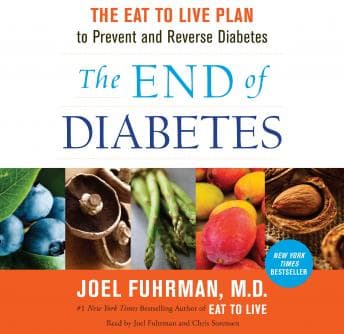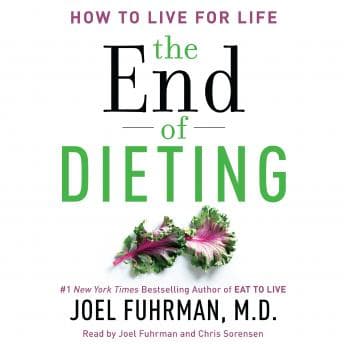

I was meal-prepping on a Sunday afternoon — chicken breast, brown rice, broccoli, the boring trifecta — when I started this one. Jenny had just left a copy of Fuhrman's Eat to Live on the kitchen counter with a Post-it that said "maybe?" So I figured I'd give the audiobook version of his follow-up a shot while I chopped vegetables. Six hours later, I had rethought about half of what was in my Tupperware containers.
Your Parents' Doctor Wrote a Diet Book (But It's Not Really a Diet Book)
Bottom line: Fuhrman's core argument is simple and, honestly, pretty hard to argue with. Eat nutrient-dense food — greens, beans, onions, mushrooms, berries, seeds (he calls it G-BOMBS, which sounds like a military acronym) — and your body stops craving garbage. Stop counting calories. Stop white-knuckling through restriction. Just eat the right stuff in volume, and weight loss becomes a side effect of not being malnourished anymore.
This is what my parents did instinctively. Now it has a TED talk. My mom didn't know what a "nutritarian" was, but her dinner table was 80% vegetables, some fish, rice on the side. No one in our family was overweight. No one was "dieting." They just ate real food because that's what Korean grocery stores sold in 1990s Koreatown. Fuhrman basically wrote 6 hours of audiobook to arrive at the conclusion that the standard American diet is garbage and that eating plants won't kill you. Revolutionary.
But here's where he earns his keep: the science sections. He walks through the relationship between micronutrient density and satiety with enough clinical backing that even my most skeptical founder clients — the ones who swear by keto or carnivore or whatever Joe Rogan said last week — would have to pause. The toxic hunger concept is genuinely useful. The idea that what most people experience as hunger is actually withdrawal symptoms from processed food? That clicked for me. I've felt that 3pm crash after a bagel lunch. Fuhrman names it, explains the mechanism, and moves on. Efficient.
Chris Sorensen Sounds Like He's Disappointed In Your Lunch
Okay, the narration. Chris Sorensen reads this with an energy that I can only describe as "your doctor is concerned but also slightly judging you." Some listeners call it condescending. I get it. There's this particular inflection he uses when reading Fuhrman's statistics about processed food — a downward tone, almost a sigh — that makes you feel like you've personally let him down by eating a donut this morning.
Fuhrman himself narrates portions too, which creates an odd dynamic. His sections feel more conversational, like a passionate uncle at Thanksgiving explaining why you should eat more kale. Sorensen's sections feel like the PowerPoint that follows. The contrast is jarring at times. Not deal-breaking, but you notice it.
My 2.0x speed couldn't save this one from some middle-section bloat. Chapters 3 through 6 are where Fuhrman rehashes ground he's covered in previous books — the anti-dieting manifesto, the problems with Atkins, the problems with Weight Watchers. If you've read Eat to Live, you can skip to chapter 5. Thank me later. The truly new material — the behavioral framework, the addiction model for processed food — lives in the back half.
The epilogue is worth sticking around for. Fuhrman drops the clinical tone and gets genuinely personal about readiness for change. It's the one moment where the audiobook feels like it's talking to you instead of at you. That shift from lecturing to genuine connection reminded me of what James Allen pulls off in Above Life's Turmoil — different subject entirely, but the same rare moment where an author stops performing authority and just talks to you like a human.
Where the Consulting Brain Gets Itchy
Here's my problem with Fuhrman, and I say this as someone who mostly agrees with him: he presents nutritarianism as the answer with the certainty of a man who has never had a client push back in a board meeting. There's no acknowledgment of food deserts, economic constraints, or the reality that eating G-BOMBS daily costs more than ramen. My parents ate well because Korean food happens to be vegetable-heavy and they ran a business in an area with good produce markets. That's not everyone's reality.
I've seen this fail at three different companies when I've tried to implement wellness programs. You can't just tell people to eat better. You have to address the system around them — access, time, cost, culture. Fuhrman barely touches this. It's the consulting equivalent of delivering a strategy deck with no implementation plan.
At under 6 hours, the runtime is at least respectful. The key takeaway is worth the listen. The other 3 hours of rehashed anti-diet-industry rhetoric? Not so much. But for someone who's never encountered Fuhrman's work before, this is a solid entry point — just know that the narrator might make you feel like you're being scolded.
Who Gets the ROI
If you've been cycling through fad diets and want someone to explain why they keep failing — with actual science, not Instagram motivation — this delivers. If you've already read Eat to Live, you're paying for about 2 hours of new material padded into 6. If Sorensen's tone bothers you, grab the print version instead. Jenny would say I'm being harsh. Jenny is right. But she also agreed about the narrator.