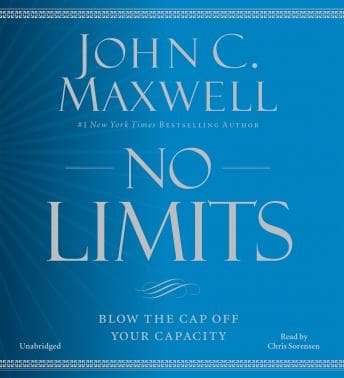

**Bottom Line:** The content is solid Maxwell material, but the narration actively works against you absorbing it. Wait for a sale or read the print version.
Look, I wanted to love this. John Maxwell is basically the grandfather of leadership content—the guy's sold 24 million books for a reason. And I've listened to enough of his stuff to know the man delivers actionable frameworks that actually stick. So when I queued up No Limits for my Monday morning commute, I expected the usual: practical wisdom, decent ROI on my 10 hours, maybe some new mental models to chew on.
What I got instead was a lesson in how narration can absolutely tank an audiobook experience.
The Chris Sorensen Problem
I'm going to be blunt here because I respect your time (and mine, which I spent on this): Chris Sorensen's delivery is... rough. And I don't say this lightly—I've listened to business books at 1.75x narrated by people who clearly resented being in the booth. This is different. It's not incompetent, it's just flat. The kind of monotone that makes your brain check out somewhere around hour two, even with caffeine assistance.
The worst part? Maxwell himself is a genuinely engaging speaker. I've heard him at conferences (well, clips on YouTube, but still). The guy has energy, cadence, the pauses that make you lean in. Sorensen reads like he's working through a teleprompter at a corporate training video shoot. Every sentence lands with the same weight, which means nothing lands with any weight at all.
I bumped it to 1.5x. Then 1.75x. At 2x it became almost listenable—the speed forced some artificial momentum. But that's a band-aid on a broken leg.
What's Actually in the Box (And It Deserves Better)
Here's what frustrates me: the book itself is genuinely useful. Maxwell breaks down 17 core capacities—things like energy management, creativity, leadership, intentionality—and gives you concrete frameworks for expanding each one. The structure is clean: short chapters, reflection questions at the end of each section, practical application lists.
This is basically Atomic Habits but for personal capacity instead of behavior change. Though if you want something that actually challenges capitalist productivity frameworks instead of reinforcing them, Capital: A Critical Analysis of Capitalist Production takes the opposite approach—dense as hell, but worth it. Same DNA here: identify the constraint, understand the mechanism, apply small changes systematically. Maxwell's been doing this since before Caltrain existed, so the frameworks feel battle-tested rather than trendy.
The chapters on intentionality and character hit particularly hard for me. There's this section where he talks about the gap between who you are and who you want to be—and how that gap is actually a feature, not a bug. It's the tension that drives growth. That's the kind of reframe I can actually use when I'm debugging my own mental models at 6 AM.
But—and this is a significant but—the book also feels repetitive if you've read other Maxwell titles. Some listeners have called it redundant, and I get it. If you've been through The 21 Irrefutable Laws of Leadership or Developing the Leader Within You, you'll recognize a lot of the stories and frameworks here. They're repackaged, not reinvented.
The ROI Calculation
So let's do the math. 10 hours of your life. Solid content but not groundbreaking if you're Maxwell-familiar. Narration that actively fights your attention span. At full credit price? The ROI doesn't work.
If you're new to Maxwell, this is actually a decent entry point—the 17 capacities framework is comprehensive and practical. But I'd honestly recommend the print or Kindle version. Let your own internal voice do the narration. It'll be better than Sorensen's. If you're already in the Maxwell ecosystem, skip this one entirely or wait for a 2-for-1 sale. You're not missing anything you haven't encountered in different packaging.
Best Paired With Mindless Tasks
I finished this over maybe 5 commutes, but I retained less than I usually do. The flat narration meant my brain kept drifting to work problems, which—okay, maybe that's on me. But a good narrator pulls you back. Sorensen doesn't.
If you're determined to listen, pair it with something mindless—data entry, gym cardio, folding laundry. Don't try to absorb this during your focused morning commute. You'll just end up replaying chapters.
System Status: Narrator Is the Bottleneck
Maxwell's content: solid, if familiar. Could've been a blog post? No, actually—there's enough depth here to justify the length. But could've been a better audiobook? Absolutely. The narrator is the bottleneck in this system, and no amount of speed adjustment fully patches it.
Kevin would tell me I'm being too harsh. But Kevin also doesn't have to optimize his commute listening like it's a production system. Some of us have standards.