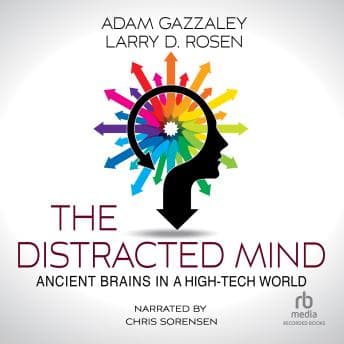

"Your brain is not built for the twenty-first century." That line hit me around the two-hour mark, and I actually paused it - something I almost never do - because it's one of those rare statements in a science book that felt like a tactical briefing rather than academic fluff. Gazzaley and Rosen are essentially saying: your brain is running ancient hardware, and the modern information environment is an adversary it was never designed to fight.
I was listening to this one during a long solo drive from Austin to a client site in Houston. Three hours of I-10, Ranger asleep in the back seat, and a book about why my brain can't stop checking my phone. The irony wasn't lost on me when I caught myself reaching for it at a gas stop mid-chapter.
Ancient Wetware vs. Modern Threat Environment
Let me cut to the chase - the core argument here is solid. Gazzaley, the neuroscientist, lays out how our prefrontal cortex evolved for goal-setting in a world of physical threats and seasonal food sources, not infinite scroll feeds and notification badges. Rosen, the psychologist, brings the behavioral data showing just how badly we're losing this fight. They break down concepts like "interference" - both internal (your own wandering mind) and external (that buzz in your pocket) - and how both erode what they call our "cognitive control."
What I appreciated is the structure. They don't just say "phones bad." They spend the first half building a legitimate neuroscience foundation - how working memory functions, why multitasking is basically a myth your brain tells itself, and the evolutionary reasons we're wired to seek new information even when it actively hurts our current task. The foraging theory section was particularly interesting. Our brains treat information the same way our ancestors treated food sources - always scanning for the next patch, always calculating whether to stay or move on. That clicked for me. I've watched analysts in my firm do exactly this - bouncing between threat reports, email, Slack - and now I have a framework for why.
The second half pivots to countermeasures, which is where it gets practical. Some of it is stuff you've heard - meditation, exercise, nature exposure. But they back it with specific studies rather than vague wellness advice, and they get into technology-based interventions like cognitive training games (Gazzaley actually developed one called NeuroRacer) and even pharmacological approaches. Not all of it convinced me, but they're honest about what's proven and what's still speculative. I've seen too many pop-science books oversell their solutions. These two mostly resist that temptation. The Bhagavad Gita: Treatise of Self-help had the opposite problem - ancient wisdom packaged with more ambition than the material could quite support.
The Narration Problem - And It Is a Problem
Here's where this mission runs into trouble. Chris Sorensen's narration is... functional. Clear diction, yes. You won't miss a word. But the delivery has all the warmth of a PowerPoint briefing read aloud by someone who drew the short straw. There's a flatness to it that works against material that's already dense. When the authors describe a teenager's anxiety spiral triggered by a 10-minute phone separation - a genuinely striking study - Sorensen reads it with the same energy as the methodology section. Everything lands at the same altitude.
I bumped it to 1.25x about 40 minutes in, which actually helped. At normal speed, the monotone compounds the density and you start drifting - which is brutally ironic for a book about attention. At 1.25x, the pace feels more natural and your brain has less room to wander. Still, I caught myself rewinding a few times during the heavier neuroscience chapters. That's partly the content, partly the delivery.
Someone in the reviews said "content is good, narration is murder," and that's harsh but not entirely wrong. It's not unlistenable. It's just... beige.
Who Needs This Intel
If you manage people - military, corporate, whatever - this book gives you a real framework for understanding why your team can't focus. I'm already thinking about how to incorporate some of the interference concepts into the training briefs I give clients. If you're a parent dealing with screen-addicted kids, the developmental sections are worth the listen alone. And if you're someone who picks up your phone 80 times a day and wonders why you can't finish a single task, well - the diagnosis is in here.
But if you want to be entertained while you learn, the print version might serve you better. The narrator doesn't ruin the book, but he doesn't elevate it either. And at nearly 11 hours, that's a lot of beige.
Mission Debrief
Worth your time? Here's the debrief: the content earns a solid recommendation. Two researchers who clearly know their lanes, writing with enough rigor to be credible and enough accessibility to be useful. The audiobook format just doesn't do it full justice. I'd say stream it through your library app, save the credit for something with a narrator who actually has a pulse. The information in here changed how I structure my own workday - and that's not nothing. Ranger slept through the whole thing, but he sleeps through everything that doesn't involve squirrels.






![Steve Jobs [unabridged audiobook] audiobook cover](/_next/image?url=https%3A%2F%2Fcovers.audiobooks.com%2Fimages%2Fcovers%2Ffull%2F9788499923406.jpg&w=1920&q=75)