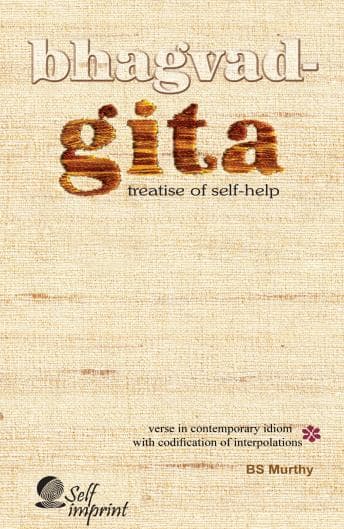

Look, I grew up with the Gita on my grandmother's nightstand—this faded orange copy she'd read every morning before anyone else was awake. So when I see someone calling their version a "Treatise of Self-help," my academic hackles go up immediately. Is this going to be the Gita filtered through some LinkedIn influencer lens? (My dissertation committee would have thoughts.)
But here's the thing. BS Murthy is doing something genuinely interesting here, even if it's not what I expected.
What Murthy Is Actually Trying to Do
The premise is bold: strip out 110 verses that Murthy considers later interpolations—additions that muddied the original text over centuries. As someone who studies how narratives shape identity, I find this fascinating. He's essentially performing textual archaeology, trying to excavate what he believes is the "real" Gita beneath layers of commentary and addition.
Does it work? Partially. The rhythmic English verses flow nicely—there's a meditative quality to listening that I genuinely appreciated during my morning jogs through Cambridge. At just over an hour, it's designed for absorption rather than study. You're meant to let the philosophy wash over you, not dissect it.
The problem is that Murthy narrates his own work, and while his delivery is clear and has a pleasant rhythmic quality, there's a certain... flatness? I couldn't find much criticism of his narration specifically, but I noticed my attention drifting during longer philosophical passages. He understands the material intimately—obviously—but intimate understanding doesn't always translate to compelling performance.
The Self-Help Angle (Here's Where I Get Conflicted)
As a behavioral psychologist, I'm professionally skeptical of anything labeled "self-help." But the Gita genuinely IS a self-help text in the truest sense—it's literally Arjuna having an existential crisis on a battlefield and Krishna walking him through it. The research actually shows that narrative frameworks for understanding suffering are incredibly effective therapeutic tools. I've seen this same principle at work in History of Prostitution—how reframing historical narratives can completely shift our understanding of human behavior and suffering. The Gita has been doing cognitive reframing for millennia.
Murthy's contemporary idiom makes this accessible. He's not trying to be scholarly. He's trying to be useful. And for someone encountering these ideas for the first time, that accessibility matters.
But—and this is a significant but—the lack of commentary is a real limitation. Some listeners have noted that the verses-as-idioms approach leaves you without context. If you don't already know why Arjuna is freaking out, or the significance of dharma in this context, you might feel lost. It's like watching a therapy session without understanding the patient's history.
Who Should Listen (And Who Should Skip)
I found myself asking: who benefits most from this version? Not scholars. Not people wanting deep textual analysis. Not even people new to the Gita who need hand-holding.
This is for people who already have some familiarity with the text and want a meditative, poetic experience. It's for the morning commute when you want philosophy without effort. It's for falling asleep to something meaningful but not demanding. (My therapist would approve of that use case, actually.) Skip it if you need context and explanation—the profound insights can slip past without landing if you're not already grounded in the material.
It's also genuinely interesting for anyone curious about textual criticism—what happens when you strip away what one scholar considers inauthentic? The resulting text feels leaner, more focused. Whether you agree with Murthy's editorial choices is another matter entirely.
Final Assessment, Over My Second Coffee
I'm giving this a qualified recommendation. The production is clean, the verses flow well, and there's real value in having a portable, accessible Gita you can absorb in a single focused session. Murthy's project—restoring what he sees as the original—is intellectually interesting even if you're skeptical of his conclusions.
But if you're looking for the Gita to actually help you understand your life? You might need more than this offers. The lack of explanation means the profound insights can slip past without landing. It's like reading poetry in a language you half-understand—beautiful, but not quite transformative.
For my money, I'd sample this first. See if Murthy's rhythmic delivery works for you. If it does, it's a lovely companion for contemplative moments. If you find yourself wanting more context, more depth, more why—there are better options for that.
Still. My grandmother would have appreciated someone trying to get back to the source. That counts for something.








![Steve Jobs [unabridged audiobook] audiobook cover](/_next/image?url=https%3A%2F%2Fcovers.audiobooks.com%2Fimages%2Fcovers%2Ffull%2F9788499923406.jpg&w=1920&q=75)