
Look, I need to rant about something first: 23 hours and 10 minutes. That's nearly 10 round-trip Caltrain commutes. That's a commitment. And for a quest narrative that is essentially "escort NPC from Point A to Point B while demons try to kill you" — Terry Brooks really made me feel every mile of that journey. Not always in a good way.
But here's the thing. I listened to most of this during a week where Kevin was out of town and I was stress-cooking my way through a batch of kimchi jjigae at midnight because our deploy pipeline was being cursed. And something about Scott Brick's steady, almost hypnotic narration paired with the slow simmer of broth just... worked. This book has a rhythm to it. It's not fast. It's a long walk through enchanted forests with occasional bursts of desperate magic. And at 1AM with my hands smelling like gochugaru, I was genuinely invested in whether Wil Ohmsford could figure out how to use the damn Elfstones before everything went sideways.
The Tolkien Fork That Actually Compiled
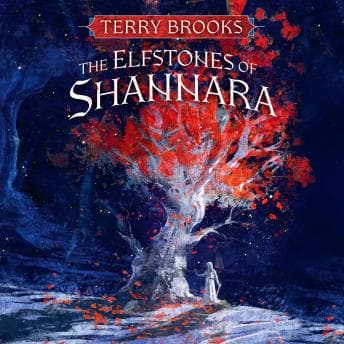
Okay yes, the first Shannara book (Sword) was basically a Tolkien clone — everyone knows this, Brooks probably knows this, my cat probably knows this. But Elfstones is where Brooks actually ships his own product. The Ellcrys — this ancient tree that's basically a biological firewall keeping demons out of the world — is dying, and its seeds need to be carried to a place called the Bloodfire to be reborn. It's a race against entropy, which, as someone who watches distributed systems degrade in real time, hit differently than I expected.
The Wil and Amberle dynamic is interesting but also frustrating. Amberle starts with real agency — she's the Chosen, she has a purpose, she pushes back against the elven establishment. But as the quest progresses, she gets increasingly sidelined emotionally while Wil fumbles with the Elfstones like a junior engineer who got handed root access and doesn't know what to do with it. The female-lead-losing-agency problem is one I kept thinking about in relation to Days of Blood & Starlight, where Laini Taylor makes a point of doing the opposite — her protagonist's diminishment is the whole psychological engine of the book, not an accident. The moments where he actually activates them are genuinely tense — there's a desperation to those scenes that Brooks writes well. But the romance between them felt like it was bolted on from a requirements doc nobody questioned.
The B-plot with Allanon and the defense of the Elven stronghold against the demon horde is where the real momentum lives. It's pure siege warfare and it rips. Brooks handles large-scale battle with a clarity that kept me oriented even at 6AM on a packed southbound train. I always knew who was where and what was at stake.
Scott Brick: The Reliable Load Balancer
Scott Brick is a polarizing narrator and I get it. His voice has this particular... density to it. It's like a bass note that never quite resolves. For 23 hours, that can either feel like a warm blanket or like being trapped in a room with a cello that won't stop.
For me, it mostly worked. His pacing matches the book's deliberate tempo, and his emotional delivery during the Elfstones activation scenes genuinely ramps up in a way that made me grip my phone on the train like a weirdo. But — and this is a real issue — his character differentiation is minimal. Wil, Allanon, and the various elven characters all live in the same vocal register with only subtle tonal shifts. By hour 15, I was sometimes relying on context clues to figure out who was speaking. It's not a dealbreaker, but if you're used to narrators who give you instant audio cues for each character (Ray Porter would never), you'll notice the gap.
No production issues, no weird audio artifacts, no random volume spikes. Clean recording. Just one guy and a very long story.
Who Gets On This Train and Who Waits for the Next One
Perfect for: Long commutes, road trips, anyone who grew up on 80s/90s fantasy and wants a nostalgia hit that's better than they remember. If you liked Sword of Shannara but thought "this needs to be less derivative and more its own thing," this is the payoff.
Skip for: Anyone who needs fast pacing or snappy dialogue. This is slow-burn epic fantasy with a capital S. If you bounce off Tolkien-adjacent worldbuilding or need distinct character voices to stay engaged during audio, this will test your patience. Also not great for half-asleep 6AM listening — there are stretches in the middle where the quest slows to a crawl and you need to be paying attention to track the geography.
The ROI on this audiobook is decent but not exceptional. 23 hours is a big time investment and there's probably 15 hours of truly engaging content wrapped in 8 hours of travelogue. At 1.25x it tightens up considerably — I'd actually recommend that speed for most of the journey sections, then dropping back to 1x for the battle sequences and Elfstones scenes.
Ship It, But Pin the Version
TL;DR: Worth your commute if you have a long one and patience for classic fantasy pacing. This is Brooks at his most confident, telling a story that's genuinely his own, with a narrator who's steady if not spectacular. Timeless sits in a similar lane — classic fantasy IP finally hitting its stride after a shaky start, competent narration, reliable comfort listening for long stretches of Caltrain. It's not going to change your life, but it'll reliably fill a week of commutes. And that Ellcrys concept — a living system failing, a desperate reboot mission — stuck with me longer than I expected. Some things hit different when you spend your days keeping systems alive.