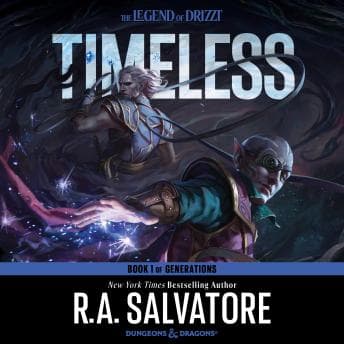
"The warrior I was shaped by the warrior I killed."
That line hit me somewhere around hour four, and I had to pause the audiobook just to sit with it. I was reorganizing the fantasy section at the library - yes, during a night shift, yes, alone - and suddenly Zaknafein's whole existence made sense in a way that decades of Drizzt books hadn't quite articulated.
Look, I've been reading R.A. Salvatore since I was hiding fantasy novels from my parents who thought D&D was a gateway to actual demon worship. (It wasn't. Though Lolth would probably appreciate the confusion.) So when he announced a prequel trilogy going back to show us the weapon master who shaped everything Drizzt would become, I was... cautious. Prequels can feel like homework. Origin stories can drain the mystery out of characters we love.
But Timeless does something smarter than that.
The City of Spiders Through Fresh Eyes
Victor Bevine commits. That's rare in epic fantasy narration, where you often get someone reading words rather than inhabiting a world. But Bevine does something genuinely impressive - he makes the drow sound alien without making them incomprehensible. Every scheming matron has her own cadence. Every political threat carries weight. The constant danger of Menzoberranzan society comes through in how he voices even casual conversations.
I listened to chunks of this during late-night shelving. Just me, the stacks, and the Underdark. Perfect atmosphere. The battle sequences - and there are many - actually held my attention instead of becoming background noise. Bevine conveys urgency without screaming, which is harder than it sounds. When Zaknafein fights, you feel the precision. When Jarlaxle schemes, you hear the smile in his voice.
The character differentiation is genuinely impressive. One listener nailed it when they said Bevine "finds a distinct voice and accent for each character and projects riveting emotions into each scene." That's not hyperbole. When the story jumps between past and present timelines, between Zaknafein's rise and Drizzt's current struggles, the transitions feel natural rather than jarring.
Legacy and the Weight of Where You Come From
Here's what got me about this book - it's really asking whether we can escape the worst parts of our origins. Zaknafein was raised in a society that rewards cruelty and punishes compassion. He became the greatest weapon master Menzoberranzan had ever seen. But he also became Drizzt's father. And that tension - between what the Underdark made him and what he chose to be - that's the beating heart of this story.
Salvatore cuts between centuries-old flashbacks and present-day consequences. We watch Zaknafein's rise, his unlikely friendship with Jarlaxle, his entanglement with Matron Malice. Meanwhile, in the present, a resurrected Zaknafein has to reconcile his ingrained prejudices with his son's surface-world companions. (Yes, resurrection. It's D&D. People come back.)
The Zaknafein-Jarlaxle friendship is genuinely one of my favorite things here. Jarlaxle has always been a scene-stealer - mercenary, opportunist, somehow always three steps ahead - but seeing how that bond formed, watching two people find something like trust in a society designed to prevent it? That's character work that earns its emotional payoff. Readers who loved the political maneuvering in The Way of Kings will find similar depth here, though Salvatore's approach is more intimate than Sanderson's sprawling scope.
Who This Works For (And Who Should Skip)
Surprisingly, this actually works as an entry point to the Forgotten Realms. Salvatore clearly designed it to welcome newcomers while rewarding longtime fans. The Underdark gets explained without feeling like an info dump. The drow political structure is complex but followable. If you dig dark fantasy with layered politics and earned father-son drama, this is your listen. If you need standalone stories that wrap up cleanly, or if dense fantasy naming conventions make your eyes glaze over, you might want to look elsewhere.
I want to be honest about the names, though - they can be a lot. Menzoberranzan. Jarlaxle. Zaknafein. Matron Malice. Your brain will adjust, but the first hour might feel like a vocabulary test. Bevine pronounces everything consistently, which helps enormously, but don't expect to catch every name on first listen.
If you're sensitive to fantasy violence, heads up. This is drow society. There are assassinations, betrayals, and combat sequences that don't shy away from consequences. It's not gratuitous, but it's not sanitized either. The darkness serves the story rather than existing for shock value.
Some readers noted this feels like setup for the rest of the trilogy, and... yeah, fair. The present-day sections sometimes read more like prologue than complete narrative.
Would I Listen Again?
Finished this at 2 AM, which seems appropriate for a book about a city that never sees sunlight. Bevine's narration elevated material that could have felt like fan service into something genuinely compelling. Is it the best Drizzt book ever written? Probably not. But it's doing something different - giving us context for a character we thought we knew, while setting up conflicts that feel earned rather than manufactured.
My podcast listeners are going to love this. Especially the ones who've been following Drizzt since the beginning. There's something satisfying about finally understanding where all that moral complexity came from. Where that internal battle between nature and choice originated.
I'll be starting the next one tonight. Same library. Same late shift. Same shadows that feel a little deeper than they should.