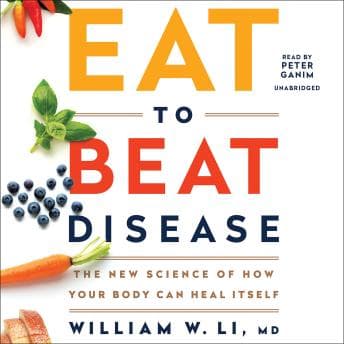

Fourteen hours is a long time to spend with a book about food, and I say this as someone who just spent three hours making lamb biryani from scratch on a Sunday afternoon while listening to Dr. William Li explain why the San Marzano tomatoes in my pantry might be protecting my DNA.
Here's the thing. I picked this up because I'm a psychology researcher, not a nutritionist, and I was genuinely curious about the behavioral framing. How do you get people to change what they eat? What's the motivational architecture? And Li does something interesting that most diet books don't — he doesn't lead with restriction. He leads with addition. Psychologically, this tracks. The research actually shows that approach-oriented goals ("eat more of X") produce better long-term adherence than avoidance-oriented ones ("never eat Y again"). Li either knows this literature or stumbled into it, but either way, the framework is smart. The behavioral architecture here actually reminded me of something Bernard Roth does in Achievement Habit — reframing the entire motivational structure before you even realize you've been persuaded.
Five Defense Systems Walk Into a Kitchen
The central conceit is that your body has five health defense systems — Angiogenesis, Regeneration, Microbiome, DNA Protection, and Immunity — and that specific foods can activate each one. Li walks through each system with a level of detail that borders on exhaustive. And I mean that literally. By the time he's cataloguing over 200 foods and their mechanisms of action, you're deep into hour eight and wondering if you should've taken notes. (I didn't. I was stirring dal.)
What I found myself asking: why does Li structure the book this way — systems first, food lists second? It's a persuasion strategy. He's building the case before making the ask. You learn why angiogenesis matters to tumor growth before he tells you that drinking jasmine tea or eating dark chocolate might help regulate it. It's the nutrition equivalent of showing your work in a math class. Respect.
But here's where my research brain started flagging things. Li cites studies — lots of them — but the audiobook format makes it impossible to evaluate the quality of those citations in real time. Was that a randomized controlled trial with 5,000 participants or a petri dish experiment? He doesn't always distinguish clearly, and at 1x speed, the studies start blurring together like highway mile markers. I found myself wishing for a printed reference section I could actually scrutinize.
The Specificity Problem (And Why It Almost Lost Me Around Hour Ten)
Li gets granular. Very granular. He'll tell you that Pacific oysters are better than Atlantic ones for certain microbiome benefits, or that Jarlsberg cheese specifically — not just any Swiss — has particular properties worth noting. This is either incredibly useful or incredibly overwhelming depending on your tolerance for lists. Around the section on cheeses and their varying health properties, I genuinely felt like I was sitting through a particularly enthusiastic lecture where the professor has clearly fascinating data but has lost the thread of what the audience can absorb.
The book could've been eight hours. Maybe nine. There are stretches in the middle where Li is essentially restating his framework with slight variations, and I caught myself zoning out during my morning jogs through Cambridge, which is not great when you're also trying not to get hit by a cyclist on the Charles River path. The pacing issue isn't fatal, but it's real.
Peter Ganim Does His Best With a Mountain of Data
Ganim narrates with a steady, conversational warmth that helps enormously when you're processing what amounts to a textbook's worth of nutritional science. His pacing is measured — he doesn't rush the denser passages, which I appreciated. There's a slight New York edge to his delivery that occasionally pulled me out of the "friendly doctor explaining things" vibe Li is clearly going for, but it's minor. The bigger challenge is structural: no narrator alive can make a 15-minute food list sound riveting, and there are moments where Ganim is essentially reading what would be a sidebar or table in the print edition. That's not his fault. That's an adaptation problem.
Who Should (And Shouldn't) Queue This Up
If you're someone who wants a science-backed reason to feel good about your grocery list rather than another book telling you what to eliminate, this is genuinely useful. The "eat more, not less" framing is psychologically sound and refreshing. If you're already deep into nutritional science — you've read Greger, you've read Gundry, you know your way around a PubMed search — you'll find some of this redundant.
And if you're like me and you process health books through a behavioral psychology lens, you'll appreciate the motivational structure even while wanting more rigor in the study citations. My therapist would have thoughts about my habit of analyzing persuasion tactics in self-help books instead of just following the advice. She'd be right.
My Prescription: Worth the Time, Not All at Once
I wouldn't listen to this in one shot. Break it up. Treat each defense system like a standalone episode. Speed it up to 1.25x during the food lists — you'll still catch the important details. And maybe keep a notes app open, because you will not remember which specific variety of tomato does what by the time you're at the grocery store. The science is genuinely interesting when Li stays at the "why" level. It's the "how much and which brand" level where the audiobook format strains under its own ambition.