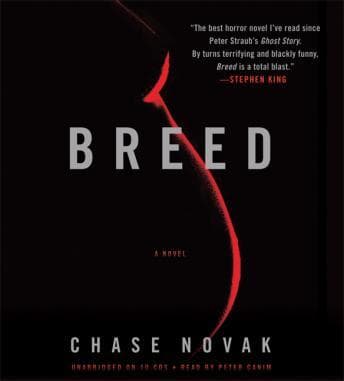

So here's the thing everyone tells you about Breed: it's Rosemary's Baby on the Upper East Side. And sure, I get the comparison. Rich couple, desperate for a child, makes a terrible bargain. But that framing actually undersells what Scott Spencer — writing here under the pseudonym Chase Novak — is doing. This isn't just a horror homage. It's a slow, queasy meditation on what privilege will justify, what parenthood costs, and what happens when the biological imperative to reproduce becomes something monstrous. Literally monstrous.
I finished this one at about 12:30 AM on a Tuesday, grading a stack of sophomore essays on Lord of the Flies that were, frankly, less disturbing than what was happening in my earbuds. Denise had already gone to bed. The apartment was dark. And Peter Ganim was in my ear describing the sounds coming from Alex and Leslie Twisden's bedroom while their ten-year-old twins sat locked in their rooms, listening. Not ideal conditions for sleep. Perfect conditions for horror.
The Fertility Clinic at the End of the World
Spencer makes a fascinating structural choice here. The first act — Alex and Leslie's descent into fertility obsession, culminating in that nightmarish trip to Slovenia for a procedure that reads like body horror by way of Kafka — is genuinely unnerving. You feel the desperation calcifying into something reckless. These are people with money, connections, the best doctors on the Upper East Side, and none of it is enough. So they go to a clinic in Eastern Europe where the treatment works but leaves them... changed. Spencer doesn't rush through this. He lets you sit with the Twisdens' mania, their rationalizations, the way wealth insulates you from the voice in your head screaming this is wrong.
Then the book jumps forward ten years, and suddenly we're with Adam and Alice, their children, and the tone shifts from psychological dread to something closer to a dark fairy tale. Kids locked in their rooms at night. Parents who are becoming something feral. This reminds me of what Hemingway said about writing — the dignity of movement of an iceberg is due to only one-eighth being above water. Spencer keeps most of the horror submerged for a long time. The children know something is wrong but can't articulate it, which is maybe the most realistic thing about the whole book.
Peter Ganim and the Sound of Dread
Ganim's narration is interesting because he's doing a lot of heavy lifting with a pretty restrained instrument. His voice is deep, measured — the kind of voice that sounds trustworthy even when it's describing terrible things. His European accents for the Slovenian clinic scenes land well enough, and the multicultural texture of his New York voices — the doormen, the neighbors, the school officials — gives the Upper East Side setting that specific lived-in quality. His Leslie is brittle and anxious without tipping into caricature. His Adam and Alice sound genuinely young and scared.
But here's what really works: the narrator understands that pause is punctuation. During the scenes where the children are lying in bed hearing their parents through the walls — those awful, ambiguous sounds of movement and appetite — Ganim lets the silence do its work. He doesn't rush through the dread. He sits in it. For a horror audiobook, that restraint is more effective than any vocal theatrics.
Where some listeners apparently wanted a different approach — and I've seen the complaints — I think the omniscient narration style actually serves the material. Spencer is writing a novel of ideas dressed in genre clothing. You need a narrator who can handle both the literary register and the horror set pieces. Ganim does. Not perfectly, but capably.
What Spencer Is Really Saying (and Where He Loses the Thread)
Let's talk about what the author is really saying. Breed is about the monstrousness of entitlement — specifically, the belief that wanting something badly enough entitles you to it, consequences be damned. The Twisdens aren't villains. They're desperate parents who make an irreversible choice. And then their children inherit the fallout. (As a teacher who's watched twenty years of kids dealing with their parents' choices, that part hit different.)
But — and this is where I have to be honest — the ending doesn't earn the buildup. It arrives too fast, like Spencer ran out of runway. You spend ten hours in this slowly tightening atmosphere and then the resolution feels compressed, almost hasty. The prose deserves to be savored for most of the book, and then suddenly you're being rushed through the exit. My students would say the ending got "speed-run." They wouldn't be wrong.
The POV also gets a little wobbly in the back half. There are moments where the perspective shifts feel unmotivated, like Spencer is reaching for information the current viewpoint character can't access. It doesn't ruin the experience, but it bumps you out of the dream.
Who Gets the Assignment, Who Gets the Pass
If you loved Rosemary's Baby or Shirley Jackson's particular brand of domestic horror — the kind where the house itself feels like it's watching — this is its spiritual successor, at least for the first two-thirds. It's smart, atmospheric horror that trusts its audience to be patient. But if you need a clean ending, a resolution that matches the ambition of the setup, you might walk away frustrated. Worth pausing the faculty meeting for, but maybe not the best faculty meeting you've ever skipped. My review of Ten Tiny Breaths covers a book that also builds slowly toward an emotional reckoning that doesn't quite stick the landing — different genre entirely, but that same feeling of a setup outrunning its resolution.