
"Respond, don't react."
That line hit me somewhere around hour 3, standing on the Caltrain platform at 6:47 AM, watching my train pull away without me because I'd been too locked into this audiobook to notice it arriving. Which is ironic, right? A book about paying attention to your body's signals, and here I am missing basic environmental cues because I'm so absorbed in the science of why I miss basic environmental cues.
The Anti-Goggins Manifesto
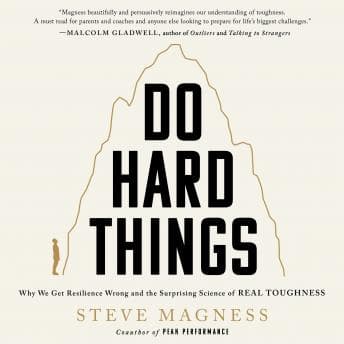
Let me save you some time: if you've built your mental toughness model on David Goggins screaming at you to stay hard, Steve Magness is here to politely but firmly explain why that approach has a shelf life. This is basically Peak Performance (which Magness co-wrote) but for resilience specifically, and it's a stronger book for having a tighter scope.
Magness's core argument is that real toughness isn't about suppressing discomfort — it's about creating space between stimulus and response so you can actually choose what to do next. He breaks this into four pillars, and unlike most self-help frameworks that feel like they were designed by a PM who needed exactly four quadrants for a slide deck, these actually build on each other in a way that makes structural sense.
The military examples are where this really clicks. Magness talks about how the old-school "break them down" model of military training (think R. Lee Ermey in Full Metal Jacket) actually produces worse outcomes than approaches that build genuine psychological flexibility. He pulls from Navy SEAL research showing that the candidates who survive BUD/S aren't the ones who white-knuckle through pain — they're the ones who can modulate their internal response to it. That distinction matters, and Magness is good at making it concrete rather than hand-wavy.
The sports psychology sections are strong too, which makes sense given Magness coaches Olympic runners. He's got this great breakdown of how elite athletes process fatigue differently — not by ignoring it (the tough-guy approach) but by accurately assessing it and then choosing to continue. It's a subtle but important difference, and it maps surprisingly well onto debugging production systems at 2 AM when your body is screaming "sleep" but you know the fix is close.
Where The Science Holds Up (And Where It's Stretched)
The neuroscience backbone here is solid. Magness draws from interoception research — how your brain interprets signals from your body — and he does a good job connecting it to practical applications without oversimplifying. The section on how our brains construct fatigue as a prediction rather than a pure measurement of physical state? Genuinely useful mental model. I've been thinking about it during long runs.
But here's where I dock points: this is an 8-hour-54-minute book that could've been about 6 hours. The middle section drags. There's a stretch around hours 5-6 where Magness is circling the same ideas about mindfulness and emotional regulation, pulling from slightly different research studies but basically making the same point from three angles. I hit 1.75x for that section and didn't feel like I missed anything. Classic non-fiction padding — you've got a strong thesis, solid evidence, but your publisher wants a certain page count.
Also, while Magness is careful with the science, he occasionally leans on the "studies show" crutch without enough context about effect sizes or replication status. SuperFreakonomics spoiled me on this front — Levitt and Dubner are ruthless about showing their work, which raised my bar for how pop-science authors handle data. This is a minor complaint — he's better than 90% of pop-science authors on this front — but if you're the type who reads methodology sections for fun (hi, that's me), you'll notice.
Mike Chamberlain Does The Heavy Lifting
Mike Chamberlain's narration is the right fit here. He's got this youthful, energetic delivery that keeps what could be a dry academic exercise feeling like a conversation with a smart coach. He sounds genuinely interested in the material, which matters a lot when you're trying to stay engaged through the slower middle sections at 6 AM. He's no Ray Porter (who is?), but he's solidly good — clear enunciation, good pacing on the science-heavy paragraphs, and he doesn't do that annoying thing where narrators slow down dramatically for "important" quotes.
No sound effects, no music, just clean single-narrator delivery. Exactly what you want for a book like this.
Who Should Queue This Up
Perfect for: Anyone who's read Goggins or Jocko Willink and thought "this can't be the whole picture." Athletes, managers, anyone in a high-stress job who wants a more sustainable model of mental toughness than just grinding harder. If you liked Peak Performance, this is the sequel it deserved.
Skip for: If you want actionable tactics on page one. Magness takes his time building the framework before getting to applications. Also skip if you're looking for a rah-rah motivation book — this is analytical, not inspirational.
The ROI Calculation
TL;DR: Worth your commute. The ROI on this audiobook is high if you subtract the padded middle — maybe 6 hours of genuinely useful content in an ~9 hour package. I finished it in 4 commutes at 1.5x (1.75x for the slow bits), and I've already applied the "respond don't react" framework to two on-call incidents and one argument with Kevin about whose turn it was to do dishes. Worked for the incidents. Jury's still out on the dishes.