
"I just want to be a person."
Somewhere around the second hour, Tyler Miller says something close to that — not a grand declaration, just this quiet, exhausted admission — and I had to stop walking. Denise kept going for about twenty paces before she noticed I wasn't beside her anymore. Lake Michigan didn't care. It just kept doing its thing. But I stood there on the lakefront path thinking about every boy I've watched sit in my classroom for twenty years, the ones who fade into the drywall, the ones whose silence we mistake for contentment.
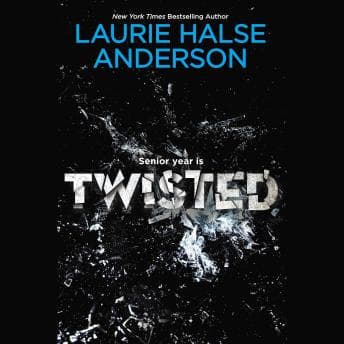
Laurie Halse Anderson wrote Speak about a girl's silence. Twisted is about a boy's noise — the wrong kind, the performative kind, the kind that masks the fact that Tyler doesn't know who he is and nobody's bothered to ask.
The Weight Room Didn't Fix What Was Broken
Here's what Anderson does that most YA authors fumble: she gives Tyler a physical transformation — scrawny kid does manual labor all summer, comes back looking like a different person — and then systematically proves how meaningless that change is. His body is different. Everything else is exactly the same. His father still treats him like a disappointment. The school still sees him as the kid who vandalized the building. Bethany Milbury notices him now, sure, but that attention is a lit fuse, not a gift.
The party scene — where Tyler does the decent, chivalrous thing and it blows up in his face — is Anderson at her sharpest. She's not interested in after-school-special morality. She's interested in the specific cruelty of being a teenage boy who tries to do right and gets punished for it anyway. Tyler's reward for basic decency is accusation, isolation, and the slow collapse of his already fragile family life. My students would hate this. I love it.
And let's talk about what Anderson is really saying about Tyler's father. This isn't a cartoon villain dad. Bill Miller is a middle-management guy terrified of his own boss, and he takes that terror home and presses it into his son like a brand. The scenes where Tyler tries to have a conversation with his father and gets back corporate-speak deflection — those hit differently when you're a grown man listening. I recognized that dynamic. Not from my own life, but from parent-teacher conferences where I've watched fathers talk past their sons like they're reading quarterly reports.
Chamberlain Gets the Voice Inside Tyler's Head
Mike Chamberlain does something specific and smart here: he plays Tyler's internal monologue at a slightly different register than his spoken dialogue. When Tyler's talking to people, there's this performative edge — a little too loud, a little too casual. When we're inside his head, Chamberlain drops into something quieter, more ragged. That gap between how Tyler presents and how Tyler feels? Chamberlain lives in that gap.
The darker passages — and there are dark passages, the kind that involve a loaded gun and a boy doing math about whether anyone would notice — Chamberlain doesn't melodramatize. He reads those scenes with a flatness that's more terrifying than any dramatic performance would be. Because that's how it actually sounds in a teenager's head. Not theatrical. Just... still. The narrator understands that pause is punctuation.
I'll say this: Chamberlain doesn't do wildly differentiated voices for the supporting cast. Bethany, Tyler's mother, his sister Hannah — they're rendered more through tone and pace than distinct character voices. It works because this is Tyler's story told from deep inside Tyler's skull. Everyone else is filtered through his perception. But if you need your audiobooks to sound like a full radio play, you should know that going in.
Six Hours That Earn Their Content Warnings
At six and a half hours, this is a focused listen. Anderson doesn't pad. She doesn't wander. Every scene is load-bearing. The pacing moves like a school year — stretches of monotony punctuated by moments that change everything. This reminds me of what Hemingway said about writing — the iceberg theory. What's under the surface of Tyler's narration is always heavier than what's on top.
Content warnings are real here: teen suicide ideation, an abusive family dynamic, bullying, sexual content, and the particular violence of being a young man in a culture that has no idea what to do with young men. Anderson published this in 2007. It reads like it was written yesterday. That should probably worry us.
Who Needs to Hear This
If you loved Speak, this is its spiritual successor — same author, same unflinching honesty, different wound. Honestly, I kept thinking about the loneliness at the center of Emily of New Moon — a different era, a very different kind of kid, but that same ache of being misread by every adult in the room. If you teach teenagers, or parent them, or were ever one who felt invisible, this book has something to say to you. If you want a comfortable listen — skip it. This one leaves marks.
Parents: listen to this before your kids do. Not to gatekeep. To prepare yourself for the conversation after.
The Lesson Plan I'd Never Get Approved
I finished Twisted in the parking lot before third period on a Tuesday, and I sat in my car for five minutes staring at the steering wheel. Then I walked into a classroom full of seventeen-year-olds and wondered — not for the first time, but harder than usual — which of them is Tyler Miller right now. Which of them is performing a version of fine while doing the math Chamberlain read so quietly.
The prose deserves to be savored. Anderson writes with the precision of someone who knows exactly how much weight a teenager can carry before the structure fails. And Chamberlain reads it like he knows too.
Worth pausing the faculty meeting for. Worth pausing everything for.