
I heard that line about monotony collapsing time somewhere around the second hour of this book while jogging along the Charles River, and I nearly stopped dead on the pavement. (My therapist says I need to stop over-analyzing metaphors while my heart rate is up, but she's not the one trying to publish papers on narrative identity, is she?)
That one sentence basically sums up why our lives feel like a blur of Zoom calls and takeout containers. We don't remember the routine. We remember the weird. And Joshua Foer's Moonwalking with Einstein is, fundamentally, a celebration of the weird.
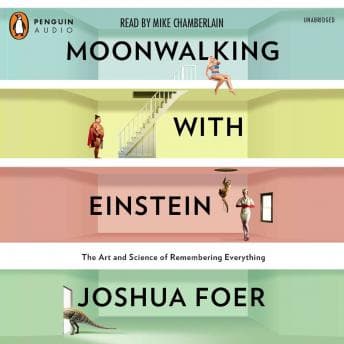
Here's the setup: Foer, a journalist, goes to cover the U.S. Memory Championship—which I didn't know was a thing, but apparently it is—and decides to train for a year to see if he can win it. It's a classic "Hero's Journey" structure, but instead of a sword, the protagonist wields a deck of cards and a very strange mental image of Cookie Monster.
Memory Palaces and Why I Still Forgot My Keys
As someone who studies psychology, I'm usually skeptical of anything that smells like "brain training" self-help. The research on that stuff is often... let's just say, shaky. But Foer isn't selling snake oil here. He's exploring the "Method of Loci"—the Memory Palace technique.
It's fascinating stuff. The idea is that our brains are wired for spatial navigation, not for memorizing grocery lists. So if you want to remember a shopping list, you don't repeat "milk, eggs, bread." You imagine a gallon of milk exploding in your childhood foyer, eggs rolling down the stairs, and a loaf of bread sleeping in your bathtub.
The psychology tracks. We remember the visceral, the violent, and the lewd. (Freud would have a field day with some of the mnemonic devices these mental athletes use. Seriously, it gets weird.)
Foer does a solid job of weaving the history of memory—back when people actually had to remember things because they didn't have iPhones—with his own training montage. It's smart, it's geeky, and it forces you to confront how much we've outsourced our cognition to Google.
Mike Chamberlain's Enthusiastic Camp Counselor Energy
Let's talk about the narration. Mike Chamberlain has this very specific gee-whiz tone that actually works perfectly for Foer's voice. Chamberlain brings that same earnest energy to Why We Get Fat, though the subject matter there is considerably less whimsical. Foer writes with wide-eyed curiosity, and Chamberlain leans all the way into it.
He sounds genuinely excited about memorizing binary digits. That's a hard sell, but I bought it.
However—and this is a big however—the accents. Yikes. When Foer quotes people from different backgrounds, Chamberlain tries to do the voices. It... doesn't always land. There were moments where I physically cringed. Not a dealbreaker, but it pulls you out of the immersion. It's like watching a really good lecture where the professor suddenly decides to do bad improv. Stick to the journalism, Mike. You're good at that.
Where the Narrative Loses Its Thread
Here's the thing about non-fiction memoirs: they often suffer from the "soggy middle." Moonwalking isn't immune.
There are sections where Foer goes deep—way too deep—into the history or the technicalities of specific memory feats. I found myself zoning out while cooking dinner, realizing I'd missed ten minutes of explanation about card memorization systems. My brain wanted more of the character study (what compels a person to spend hours memorizing random numbers?) and a little less of the technical manual.
Who's This For?
If you're into psychology, weird subcultures, or just want to know why you can't remember your nephew's birthday but can recite lyrics from 1998, this is worth the listen. Skip it if you need tight pacing or have zero patience for historical tangents—you'll be reaching for that 1.5x button constantly.
One More Thing Before Office Hours
Did this book transform me into a mental athlete? No. I still have to check my calendar to see when my next faculty meeting is. (And honestly, I'm fine with that.)
But it did make me look at my own mind differently. It's a reminder that memory isn't just a hard drive—it's a creative act. We construct our pasts. Just maybe speed it up to 1.25x during the history lessons.