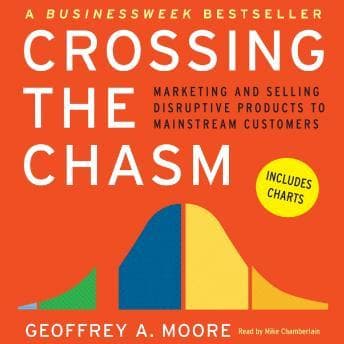

Everyone told me this was the marketing bible. The foundational text. The one book every tech founder needs to read before they're allowed to pitch a VC. So I finally queued it up during a red-eye to Denver—client emergency, no sleep, perfect conditions for absorbing wisdom about technology adoption lifecycles.
Here's the thing: they were right. And also kind of wrong.
The Framework That Actually Earns Its Reputation
Moore's central insight—that there's a dangerous gap between early adopters and the mainstream market, and that most tech companies die in that gap—is genuinely brilliant. I've watched this exact failure pattern at three different startups I've consulted for. Company gets initial traction with the enthusiasts, assumes the momentum will carry them to mass adoption, and then... crickets. The chasm swallows them whole.
The Technology Adoption Life Cycle isn't just theory. It's what my parents did instinctively when they expanded their dry cleaning business—they didn't try to serve all of Koreatown at once. They dominated one block, became the reference, then expanded. Moore gives this a name and a strategy. The "bowling pin" approach to market segments? I've literally drawn this on whiteboards for clients who paid me a lot of money to explain what this book does in about 45 minutes.
Mike Chamberlain's narration has this natural enthusiasm that makes the dense strategic content more digestible. His conversational delivery fits the material—you're not being lectured at, you're being walked through a framework by someone who seems genuinely interested in whether you get it.
The Dated Examples Problem (And Why It Matters Less Than You'd Think)
Let me be straight with you: this audiobook is an older edition. The examples are from the 80s and 90s. You'll hear about companies and products that your younger colleagues have never encountered. If you're expecting case studies about TikTok's growth strategy or AI startup positioning, close this tab and look elsewhere.
But here's what the one-star reviewers miss: the principles are timeless. The specific examples of Silicon Graphics and Documentum are dated, sure. But the underlying logic of why pragmatist buyers behave differently from visionaries? That hasn't changed. I was applying Moore's framework to a SaaS client's go-to-market strategy last month. The technology was 2024; the buyer psychology was exactly what Moore described in the 90s.
Skip to the chapters on the "whole product" concept and target customer characterization. Those sections alone justify the listen. The rest? Background noise while you're doing email.
Who Gets Value Here (And Who Doesn't)
If you're in B2B tech marketing, product management, or startup strategy—this is required reading. Period. The vocabulary alone (pragmatists vs. visionaries, the bowling alley, the tornado) gives you a common language with anyone who's been in tech for more than five years.
If you're looking for tactical marketing tips or social media growth hacks, this isn't it. Moore is operating at the strategic level. He's teaching you how to think about market positioning, not how to write better LinkedIn posts.
And if you've already read the physical book? The audiobook doesn't add much. Chamberlain is solid—apparently he's won several AudioFile Earphones Awards, which tracks—but there's no production magic here. Straightforward narration of straightforward business writing.
The ROI Calculation
Bottom line: the core 45 minutes of insight here is worth more than most full business books. The problem is you're getting it packaged in nearly 10 hours of 90s tech nostalgia and repetitive examples. At 2.0x speed, that's still almost 5 hours of your life.
My recommendation? Listen to it once, take notes on the framework, and you'll never need to revisit it. The concepts become part of how you think about markets. That's the sign of a genuinely useful business book—it changes your mental models, not just your bookshelf. Dare to Lead does something similar for leadership—it rewires how you think about vulnerability in professional settings.
Jenny would say I'm being harsh about the dated examples. Jenny is right. But I'm also right that Moore could've made this point in half the time. The key takeaway is worth the listen. The other 7 hours? Not so much.
Still—this is one of maybe ten business books I'd call genuinely essential. Just go in knowing what you're getting: timeless strategy wrapped in a time capsule.