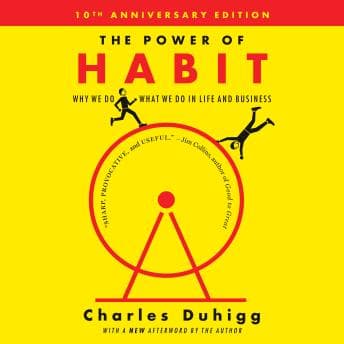

Bottom Line: Worth your commute. This is basically "habit science for humans" wrapped in genuinely interesting stories. The ROI on this audiobook is solid - you'll actually remember the concepts because Duhigg is a storyteller first, scientist-explainer second.
Okay, so I finally got around to this one after it sat in my Audible library for literally two years. (Yes, I'm that person with 47 unlistened books. Don't @ me.) Started it on a particularly brutal Monday morning commute - 6:15 AM, standing room only, some guy's backpack jabbing my ribs - and honestly? Perfect conditions to test whether a business book can hold my attention when I'm running on four hours of sleep and spite.
It held.
The "Could've Been a Blog Post" Test
Look, here's the thing about business books: 90% of them have about 45 minutes of actual content stretched across 8 hours of filler. I've listened to enough of these to develop a sixth sense for padding. The Power of Habit... mostly passes. Mostly.
Duhigg structures everything around stories - the NFL, Procter & Gamble, Alcoa's safety transformation, the civil rights movement - and the science gets woven in naturally. It's not "here's a study, here's another study, here's a third study proving the same point." It's more like... narrative journalism that happens to teach you something. The cue-routine-reward framework is simple enough that I was explaining it to Kevin over dinner after day two. (He pretended to be interested. Good boyfriend.)
Around hour 7 or 8, I did bump my speed up to 1.75x. Some of the organizational habit chapters drag a bit - the Target pregnancy prediction story is fascinating, but the Starbucks training section felt like it could've been tighter. Not a dealbreaker, just... you know. Business book syndrome creeping in.
Mike Chamberlain's Warm, Steady Delivery
I didn't know Mike Chamberlain before this. He's no Ray Porter (but then again, who is?), but he's got this warm, steady thing going that works really well for nonfiction. His voice has that "smart friend explaining something at a dinner party" quality. Never robotic, never monotone - way harder to pull off than it sounds for an 11-hour nonfiction book.
The pacing is solid. He knows when to slow down for the important bits and when to keep things moving. The production is clean - no weird background noise, no jarring edits. I could follow everything even on the packed train with someone's podcast bleeding through their earbuds next to me.
One minor gripe: when he reads direct quotations, it sometimes gets a little... theatrical? Like he's doing a voice for the person being quoted, but it doesn't quite land. It's not terrible, just occasionally pulled me out of the flow. The civil rights segments in particular - I wanted a bit more gravity there, and he smooths over some moments that probably deserved sharper edges. But honestly, this is nitpicking. For 95% of the book, he nails it.
Cue-Routine-Reward: Does the Science Hold Up?
As someone who debugs distributed systems for a living, I'm naturally skeptical of pop science books that oversimplify. Duhigg doesn't do that - or at least, not egregiously. He's upfront about what's established science versus what's still being researched. The habit loop concept (cue → routine → reward) is backed by solid neuroscience, and he explains it without dumbing it down or making it feel like a TED talk.
What I appreciated: he doesn't promise magic. This isn't "change your habits in 21 days!" garbage. Unlike the oversimplified advice in Get Sh*t Done, Duhigg actually respects your intelligence. He's honest that habit change is hard, that it requires identifying your cues and rewards, that willpower is a limited resource. The framework is practical without being prescriptive.
What I wanted more of: actual step-by-step implementation. The book is heavy on the "why habits work" and lighter on the "here's exactly how to change yours." There's an appendix that helps, but I finished wanting a companion workbook or something. Maybe that's just me being an engineer who wants everything in a checklist.
Perfect For: Train, Gym. Skip For: Deep Work.
This is ideal commute material. Complex enough to keep you engaged, but not so dense that you'll miss crucial info if you zone out for 30 seconds while someone's having a loud phone conversation about their divorce. (True story. Happened around hour 4. Still followed the book fine.)
I finished this in about 5 commutes plus one Sunday afternoon doing laundry. At 1.5x speed for most of it, 1.75x for the slower chapters. Totally doable.
Best for: Anyone interested in behavioral psychology, business folks who want to understand organizational change, or people who've ever wondered why they can't stop checking their phone every 3 minutes. (It's me. I'm people.)
Skip if: You want a dense academic treatise, or you're looking for a quick tactical guide. This is more "understand the system" than "hack the system." If you're looking for the "hack" approach with financial shortcuts, Rich Dad Poor Dad is more that vibe—though honestly, I found it way less rigorous.
Final verdict? Solid listen. Not life-changing, but genuinely useful - I've already caught myself identifying cue-routine-reward loops in my own behavior. And any business book that doesn't make me want to throw my phone out the train window is a win in my book.
Now if you'll excuse me, I need to go work on my "checking Slack at 11 PM" habit. The cue is apparently "existing." Still working on that one.