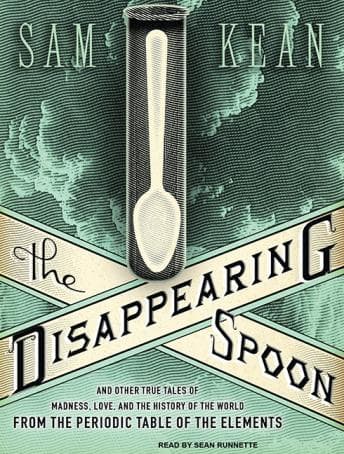

Look, I wasn't expecting to spend 12 hours learning about elements I haven't thought about since high school chemistry. But here I am, stuck on I-35 during Austin rush hour, genuinely fascinated by why tellurium caused one of history's weirdest gold rushes. That's the thing about Sam Kean's approach - he takes the periodic table, something most of us wrote off as boring memorization, and turns it into a collection of war stories, mad scientist tales, and genuine "wait, what?" moments.
When Science Becomes War Stories
Kean structures this thing brilliantly. Each element becomes a doorway into human obsession, political maneuvering, and occasionally pure insanity. Marie Curie glowing in closets to impress (and intimidate) colleagues' wives. Lewis and Clark leaving a trail of mercury poisoning across America that we can still detect today. Gandhi's beef with iodine. These aren't dry textbook facts - they're the kind of stories you'd tell over beers if you happened to know them.
The Great Influenza pulls off the same trick—turning scientific details into human drama that actually sticks with you.
The book hits different for anyone who's spent time in environments where small details matter. Understanding how elements behave under pressure, how they interact, how they've shaped conflicts - there's tactical value in that knowledge, even if you're not consciously looking for it. Kean connects cadmium to Godzilla, for crying out loud. The man knows how to make chemistry feel like an intelligence briefing.
But here's where I'll be straight with you: the middle sections drag. Once you get past the initial rush of fascinating discoveries, some chapters feel like Kean is checking boxes on the periodic table rather than chasing the best stories. The technical density increases, and even with Kean's accessible writing style, there are stretches where you're pushing through rather than being pulled along.
Sean Runnette Keeps You in the Fight
Sean Runnette's narration is exactly what this material needs. The man pronounces every obscure element name, every German scientist, every chemical compound without stumbling. That sounds basic, but trust me - nothing kills a science audiobook faster than a narrator who hesitates on terminology. Runnette sounds like he actually understands what he's reading, which makes a massive difference.
His tone walks this line between authoritative and approachable. He's not lecturing you; he's briefing you. There's dry wit in Kean's writing, and Runnette catches it without overselling. When the material gets dense, his clear delivery keeps you oriented. When Kean drops something genuinely surprising, Runnette's pacing lets it land.
The limitation isn't Runnette's fault - it's the material. There's only so much emotional range you can bring to explaining electron shells and atomic weights. He does what he can, but some sections feel like a really good documentary rather than something that grabs you by the collar. Ranger fell asleep during the noble gases chapter. Can't blame him.
Who Should Listen (And Who Should Skip)
For anyone who likes understanding how the world actually works - the chemistry behind wars, economies, medical breakthroughs, and human stupidity - this is worth your time. If you're looking for narrative drive, a single throughline, or something that builds toward a payoff, skip it. This is a lecture series, not a mission.
SITREP
If you're curious about science but don't want a textbook, this delivers. Kean makes you smarter without making you feel stupid, which is harder than it sounds. The stories are genuinely surprising, the connections between elements and history are well-researched, and the audiobook format works because Runnette handles the technical material with precision.
Know what you're signing up for, though. There's no building tension, no climax. It's more like a really excellent lecture series from a professor who knows how to tell stories. Some chapters will have you rewinding to catch details; others will fade into background noise while you're focused on traffic.
I listened at 1.25x, which felt right for the pacing. Runnette's delivery is deliberate enough that speeding up doesn't lose anything, and it keeps the momentum through the slower sections.
It's not a mission-critical listen, but it's solid intelligence gathering disguised as entertainment. Kean did his homework, Runnette delivers it clean, and you'll come out knowing things that'll make you interesting at dinner parties.
Just don't expect explosions. (Okay, there are a few explosions. Scientists blow things up more often than you'd think.)







![Steve Jobs [unabridged audiobook] audiobook cover](/_next/image?url=https%3A%2F%2Fcovers.audiobooks.com%2Fimages%2Fcovers%2Ffull%2F9788499923406.jpg&w=1920&q=75)