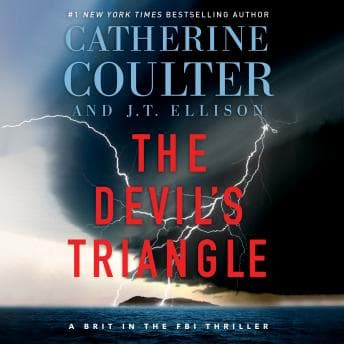

Weather control as a weapon, a thief calling from Venice, and a race that ends in the Bermuda Triangle. Devil's Triangle wants to be a lot of things, and psychologically speaking, it doesn't quite know what it is.
I was halfway through a Sunday dal makhani — the kind that requires four hours of simmering and periodic stirring, which is basically the ideal state for listening to a thriller — when I realized I'd stopped tracking the plot and started diagnosing the characters instead. Not because the book invited that depth. Because my brain needed something to do.
When Your Protagonists Have the Emotional Range of a Mission Briefing
Let me be direct: Nicholas Drummond and Michaela Caine are competent. They're smart, resourceful, attractive, well-connected, good at their jobs. And that's... kind of the problem. The protagonist exhibits classic wish-fulfillment construction — they're so capable that nothing feels psychologically earned. There's no real internal friction. No moment where their competence cracks open to reveal something messy and human underneath. They lead the Covert Eyes team, they handle international crises, they banter. But I found myself asking: why does Nicholas really do this work? What keeps Mike up at night beyond the current threat? The book doesn't seem particularly interested in those questions.
The Fox — Kitsune — is genuinely the most interesting character here. A thief who's stolen from the Topkapi Museum, whose own client wants her dead, who calls the FBI agents she's historically tangled with because she has nowhere else to turn. This is a fascinating case study in survival-driven alliance formation. The research actually shows that people under extreme threat will reach out to former adversaries when the perceived danger outweighs the cost of vulnerability. Kitsune does exactly this, and it's the one thread that felt psychologically real to me.
But then there's the weather-control subplot. Thousands dead from an engineered sandstorm. An obsessed family trying to devastate Washington, DC. The stakes escalate so rapidly and so broadly that individual character psychology gets swallowed whole. You can't process grief over thousands of deaths in Beijing AND a heist in Istanbul AND a conspiracy in the Bermuda Triangle AND maintain emotional specificity. Something has to give, and what gives is depth.
The Dual-Narrator Split That Actually Works
MacLeod Andrews and Renee Raudman handle the narration, and here's where I'll give credit: the two-narrator structure maps cleanly onto the dual-protagonist setup. Andrews takes Nicholas's chapters with a measured authority that suits the "Brit in the FBI" premise, and Raudman brings a sharper, more clipped energy to Mike's sections. The handoffs between them create natural chapter breaks that help you track whose perspective you're in — which matters in a book that globe-hops from New York to Venice to Rome to the Bermuda Triangle in twelve hours.
Raudman in particular adds this edge to Mike's internal voice that the prose itself doesn't always earn. There's a sassiness there, a slight impatience, that made me believe Mike more as a character than the writing alone would have. Andrews is solid and professional — nothing spectacular, nothing distracting. Both narrators are award-winners and it shows in the technical execution. Clean audio, clear differentiation between characters, no stumbles I caught.
But — and this is the thing — great narration can't manufacture psychological complexity that isn't on the page.
The Credibility Problem (My Therapist Would Have Thoughts)
Psychologically, the central conceit doesn't track for me. The idea that a family could develop and deploy weather-control technology capable of killing thousands — and that this wouldn't involve massive institutional infrastructure, whistleblowers, internal dissent — requires a suspension of disbelief that goes beyond thriller conventions. Thrillers ask you to accept heightened reality. Fine. But the characters react to the weather-control revelation with roughly the same emotional register they use for ordering coffee. Nobody has a crisis of comprehension. Nobody freezes. The research on how people actually process information about mass casualties shows shock, denial, cognitive overload. These agents just... start working the case.
I get it, they're professionals. But professionals are still people. The best thriller writers — the ones who understand human nature — know that competence and emotional realism aren't mutually exclusive. You can have your agent be brilliant AND shaken.
This is book four in the Brit in the FBI series, and it reads like the authors trust that you're already invested in these characters from previous installments. If you are, the thin characterization here might not bother you. If you're coming in cold like I did, you'll feel it.
The Prescription
If you want a fast-paced, globe-trotting thriller with solid narration and you're not going to interrogate character motivations the way I do (occupational hazard, I know), this is a perfectly serviceable listen for a long commute or a road trip. The pacing moves. The narrators are pros. The plot is ambitious even when it's implausible.
But if shallow character psychology annoys you — if you need to understand why people do what they do, not just what they do — you'll spend twelve hours mildly frustrated. Like me, stirring dal and muttering "but what's your actual motivation" at my kitchen counter.
Series fans: you'll enjoy it. Everyone else: maybe borrow it first. I had a similar "borrow it first" feeling about Dead to Her — another thriller where the premise is genuinely compelling but the character interiority keeps you at arm's length the whole time.