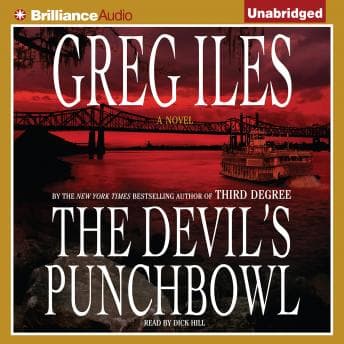

Look, I need to rant about something before we get into this. Twenty-four hours. This audiobook is twenty-four hours long, and Greg Iles decided that the appropriate way to spend a good chunk of that runtime is describing dogfighting in enough detail to make me physically ill. I listen to horror. I consume fictional violence like it's my breakfast cereal. But the animal torture scenes in Devil's Punchbowl hit different, and not in the way Iles probably intended. There's a line between using horror to illuminate something ugly and real versus using it to shock, and this book doesn't always know which side it's standing on.
Shirley (my cat) was unimpressed. I was genuinely nauseated.
Southern Gothic With a Casino Problem
Here's what Iles does well, and I want to be fair because the man understands the American South the way Shirley Jackson understood New England - with love and revulsion in equal measure. Natchez, Mississippi, as rendered here, is a character unto itself. The Magnolia Queen casino-steamboat is a fantastic setting: gaudy, decaying grandeur hiding blood sport and exploitation in its belly. It's the kind of metaphor for the South that writes itself, and Iles is smart enough to lean into it without over-explaining.
Penn Cage as a protagonist is interesting because he's basically a good ol' boy who became a lawyer who became a mayor, and he's in way over his head. The plot - casino corruption, dogfighting rings, shadowy mercenaries, a murdered friend - is dense and propulsive when it wants to be. When Iles is ratcheting up the paranoia, when Penn can't trust his own police force, when the surveillance tightens and the body count climbs, this is genuinely tense stuff. The conspiracy layers are real, and the stakes feel earned because Iles puts Penn's daughter and his father directly in the crosshairs.
But at 24 hours, the pacing sags. There are stretches in the middle where Penn is basically having the same tense phone conversation with five different people, each scene retreading ground we already covered. I found myself reaching for the 1.25x speed button around hour 12 and never looked back.
Dick Hill: Golden Voice With a Volume Knob Problem
So here's the thing about Dick Hill. The man has Audie Awards. AudioFile Magazine called him a Voice of the Century. And when he's locked in - when he's doing the menace of the villain or the weary determination of Penn - you can hear exactly why. His Southern accents have genuine texture. He differentiates between Natchez-born characters and the outsiders with subtle shifts that feel lived-in rather than performed.
But this recording has a serious technical issue that I can't ignore. Hill's volume drops dramatically during Penn's internal monologue and quieter dialogue scenes, then spikes during confrontations. I was listening in bed at 1 AM (as one does with a thriller about blood sport and corruption - don't judge my life choices), and I kept having to adjust the volume. Quiet Penn thinking to himself? I'm cranking it up. Suddenly someone's screaming? My neighbors now think I'm being murdered.
It's not just me being picky. This is a production-level problem. When a narrator's voice fades out during the protagonist's lines - the character we spend the most time with - that's a fundamental issue. It pulled me out of the tension repeatedly. And in a book this long, those interruptions accumulate. They erode trust. I stopped being immersed in Natchez and started being aware of my volume slider.
I'll say this: Hill's character work when the recording cooperates is strong. His take on the mercenary antagonist has a cold precision that genuinely unsettled me. But the inconsistency is maddening, especially coming from someone with his pedigree.
The Dread Underneath the Thriller
What keeps me from writing this off entirely is that Iles understands something about horror that a lot of thriller writers don't. The real terror in Devil's Punchbowl isn't the dogfighting or the murders - it's the institutional rot. The way power corrupts a small town. The way a mayor can know something monstrous is happening and still not have the authority to stop it. That helplessness? That's dread. That's the stuff that keeps you up after you turn the audiobook off. Lost Key taps into that same specific dread — the kind that comes not from monsters but from institutions failing the people they were built to protect.
Growing up in a small town, I know exactly how it feels when the systems that are supposed to protect you are the ones enabling the worst people. Iles nails that particular flavor of American horror. It's just buried under some pacing issues and a few too many subplots involving Penn's romantic entanglements that I could've done without.
Who Needs This (And Who Really Doesn't)
If you scare easily, skip - not because of the thriller elements but because of the graphic animal cruelty. That's not a content warning I give lightly. If you're deep into the Penn Cage series, this is essential. If you're starting fresh, maybe try The Turning Angel first - by most accounts (and I tend to agree), Hill's narration is tighter in that one. If you're an audiobook listener who's sensitive to volume inconsistency, honestly, you might want the print version instead.
For everyone else: there's a very good 16-hour thriller trapped inside this 24-hour audiobook. Speed it up, brace yourself for the rough content, and accept that you'll be fighting your volume controls.
The Light Switch Stays Off, But Barely
I listened in the dark. Mistake? Maybe. The paranoia scenes hit harder that way - there's a stretch where Penn is being surveilled and every creak in my apartment made me flinch. But the volume drops meant I kept grabbing my phone, breaking the spell. A frustrating listen wrapped around a genuinely effective thriller. My podcast listeners are going to have opinions about this one, and I suspect they'll be as divided as I am.