
What happens when a case hits too close to home for a detective who's already carrying more trauma than most people could survive?
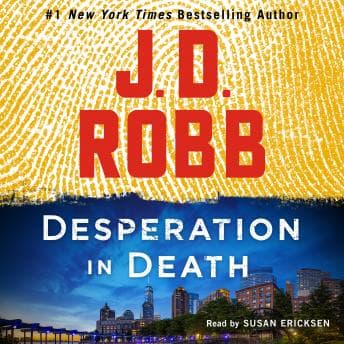
That's the question I kept circling back to while listening to Desperation in Death. And honestly? It's why the Eve Dallas series keeps pulling me back in, even though I swore I was done with long-running thriller series. (Don't tell my dissertation committee I'm spending my research time on book 55 of anything.)
The Psychology of Rage as Fuel
Here's what J.D. Robb understands that so many thriller writers don't: trauma doesn't make you noble. It makes you messy. Eve Dallas isn't a damaged detective who channels her pain into some kind of elegant justice. She's barely holding it together, and this case—trafficking young girls, breaking them down piece by piece—pushes her right to the edge of that control.
Eve exhibits classic hypervigilance patterns throughout, but what makes this compelling is how Robb doesn't let her off the hook. Eve's rage is a liability. It clouds her judgment. Roarke sees it, the reader sees it, and Eve herself knows it but can't stop. That's psychologically accurate in a way that most procedurals just... aren't.
The "Pleasure Academy" concept is horrifying in the way that real trafficking operations are horrifying—the investment, the grooming, the systematic destruction of identity. Robb did her homework. Or at least, she understands enough about coercive control to make it land. Mina and Dorian aren't just victims. They're case studies in survival responses. One fights, one freezes. Both make sense.
Susan Ericksen's Voice in My Head
I've listened to Ericksen narrate Eve for years now, and she's become the voice. Period. The energy she brings matches the intensity of the narrative—quick pacing, distinct character voices, emotional authenticity when it counts.
But. (And I say this as someone who genuinely enjoys her work.) There are moments where she pushes too hard. Some of the confrontational scenes tip into shrill territory when a colder, more controlled delivery might've hit harder. She's giving 110% when the scene only needed 90%. I get it—the material is intense. But sometimes restraint is more devastating than volume.
That said, her portrayal of the villain in this one? AudioFile wasn't wrong about the "venom." The coldness she brings to that character made my skin crawl during my morning jog. I actually stopped running at one point because I needed to just... process what I was hearing.
Eve and Roarke, Still Working
The pacing is classic Robb—fast enough to keep you hooked, but with enough breathing room for the character moments that actually matter. The relationship between Eve and Roarke continues to be one of the more believable partnerships in the genre. He's not just a billionaire deus ex machina (though he does solve some problems with money, let's be real). He's worried about her. He sees her spiraling. And he doesn't try to fix it—he just stays present.
That's... actually good relationship psychology? The research shows that trying to "solve" a partner's emotional crisis usually backfires. Presence matters more than solutions. Robb gets this.
The investigation itself is solid procedural work. Nothing groundbreaking if you've read the series, but competent. Litigators had that same competent-but-familiar procedural feel—reliable execution without reinventing the wheel. The real tension isn't "will Eve solve the case"—of course she will. It's "what will this cost her?"
Who This Is (and Isn't) For
I need to be direct here. This book deals with child exploitation, trafficking, and abuse. It's not gratuitous—Robb handles it with purpose rather than shock value—but it's heavy. If you're in a place where that content would be harmful rather than cathartic, skip this one. There are 54 other Eve Dallas books. Come back when you're ready.
But if you're someone who finds meaning in watching a survivor fight for other survivors? If you want a protagonist whose psychology actually tracks with someone who's been through hell? This delivers.
I found myself asking: why does Eve keep taking these cases? The ones that mirror her own history? And I think the answer is that she's still trying to save herself by saving others. It's not healthy, exactly. But it's human.
My therapist would have thoughts about this character. Many thoughts.
My Clinical Assessment
Probably not a comfort re-listen—but I'm glad I experienced it. Ericksen earned that AudioFile Earphones Award. The production is clean, the pacing works for long commutes, and the story does what good crime fiction should do: it makes you uncomfortable in ways that matter.
Just maybe don't listen while cooking. I burned my dal.