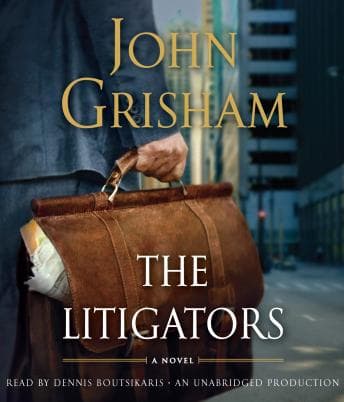

Look, I have a confession. I've been avoiding Grisham for years. Not because I don't respect the man—he basically invented the legal thriller genre—but because somewhere around my third year of grad school, I decided I was "too academic" for airport fiction. Though honestly, I've found that Grisham's work—even the lighter stuff like this—rewards the kind of close reading I bring to everything. I got similar character-driven satisfaction from Sycamore Row, which digs into legacy and consequence in ways that feel almost psychological. (Yes, I know. My therapist has thoughts about this too.)
But then I needed something light for my morning jogs through Cambridge, and The Litigators kept popping up. A story about burned-out lawyers chasing ambulances? About the psychology of desperation driving people to make increasingly terrible decisions? Okay, fine. I'm in.
And honestly? I had more fun than I expected.
The Psychology of Spectacular Failure
What makes this character study fascinating—and yes, I'm calling it a character study, fight me—is how Grisham nails the psychology of professional desperation. David Zinc doesn't just leave his fancy law firm. He implodes. Goes on a bender. Wakes up at the doorstep of the most pathetic "boutique law firm" in Chicago. The protagonist exhibits classic avoidance behavior mixed with what we'd call occupational burnout, and Grisham doesn't shy away from the messiness of it.
Oscar Finley and Wally Figg? They're the kind of case study I'd use in my behavioral psych classes. Twenty years of partnership has made them simultaneously codependent and resentful. They bicker like my parents over whose turn it is to call the cable company. And when they smell money—a class action lawsuit against a pharmaceutical giant—their decision-making goes completely off the rails. Greed as a motivator is nothing new, but watching these three convince themselves they can ride a Florida firm's coattails to riches without doing actual work? That's a masterclass in motivated reasoning.
The research actually shows that people under financial stress make increasingly risky decisions while simultaneously believing they're being conservative. Finley & Figg are textbook.
Dennis Boutsikaris and the Art of Not Trying Too Hard
Here's where I have to be honest about the narration. Boutsikaris brings what I'd call a "whimsical steadiness" to the whole thing. He's not doing theatrical voice acting. He's not giving you dramatic pauses before every revelation. He's just... telling you a story. Clearly. With good pacing.
And for this book? It works.
See, The Litigators isn't a dark psychological thriller. It's essentially a comedy about incompetent lawyers accidentally stumbling into a case that's way over their heads. Boutsikaris seems to understand this. He adds just enough lightness to signal that everything will probably work out—even when our heroes are making spectacularly bad choices. His character differentiation isn't going to blow your mind, and yeah, some listeners might find his uniform masculine tone a bit forgettable. But I'd argue that's almost the point. He's not competing with the story. He's serving it.
Though I will say—if you're coming from audiobooks with more dynamic narration, you might find yourself zoning out during the slower middle sections. I caught myself doing mental grocery lists around hour six. (In my defense, I really did need to buy more cumin.)
Where the Narrative Shifts
The thing about Grisham is he understands pacing even when the book itself runs a bit long. At eleven and a half hours, this isn't a quick listen. But the courtroom sequences? They fly. There's a deposition scene that had me genuinely laughing out loud on the Charles River Esplanade, which earned me some looks from the Harvard crew team.
What makes this character compelling is that David Zinc isn't just a straight man reacting to chaos. He's complicit in it. He knows Finley & Figg are in over their heads. He knows the Krayoxx case is shakier than they want to admit. And he stays anyway. Why? Because the alternative—admitting he destroyed his career for nothing—is psychologically unbearable. That's not just good plotting. That's accurate human behavior.
The pharmaceutical conspiracy angle is pretty standard fare, honestly. What kept me engaged was exactly what Grisham does best here—the character psychology over the plot mechanics. I found that same prioritization in Time for Mercy, where the legal machinery matters less than understanding why people make the choices they do. Big Pharma bad, lawyers greedy, justice complicated. You've seen it before. But Grisham keeps it entertaining because he's more interested in his characters' delusions than in the corporate villainy.
Would I Listen Again?
Probably not. But that's not an insult. This is exactly what it promises to be: a fun, light legal thriller with enough courtroom drama to satisfy genre fans and enough character work to keep a behavioral psychologist entertained on her morning runs.
If you're looking for deep psychological complexity or morally ambiguous protagonists that haunt you for weeks—skip this. Read something darker. But if you want to spend eleven hours with lovable idiots making terrible decisions while a steady narrator guides you through the wreckage? Boutsikaris and Grisham have you covered.
My mother would love this book. She'd also ask why I needed to analyze it instead of just enjoying it.
Fair point, Maa. Fair point.