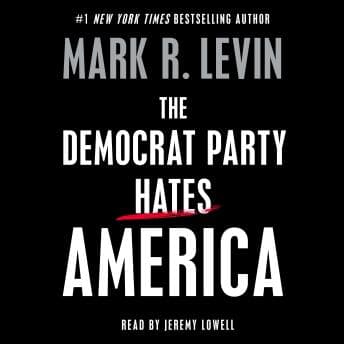

Had a long drive back from San Antonio last week - client meeting that ran three hours over schedule, which meant I had plenty of windshield time to burn through this one. Figured I'd finally give Levin's latest a proper listen. I'd heard the radio clips, seen the Fox segments. But eleven hours is a different commitment than a three-minute soundbite.
Let me cut to the chase: this is a partisan political argument dressed up as historical analysis. Whether that's a feature or a bug depends entirely on where you're standing.
The Argument Levin's Actually Making
Levin's core thesis - that the Democrat Party has functionally become the vehicle for Marxist ideology in America - isn't new territory for him. If you read American Marxism, you know the framework. What he's doing here is sharpening the target. He's not going after abstract ideology anymore; he's pointing directly at the party apparatus itself and tracing what he calls a deliberate, decades-long project to dismantle constitutional governance.
The historical sections are where this gets genuinely interesting, regardless of your politics. Levin digs into the party's pre-Civil War history, its relationship with segregation, its evolution through the New Deal era - and he's not wrong that a lot of this history gets glossed over in standard political coverage. The raw primary-source weight of that era hits differently when you've also sat with Narrative of the Life of Frederick Douglass - a man who lived inside that history and wrote about institutional betrayal with a clarity no modern commentator has matched. I've seen enough institutional behavior in my career to recognize that organizations do carry DNA from their founding decisions, even when they claim transformation. Whether his through-line argument holds all the way to the present is where reasonable people will split.
Here's my honest read: some of the historical groundwork is solid. Some of the contemporary extrapolation is the rhetorical equivalent of calling in an airstrike based on unconfirmed intel. He's connecting dots with a lot of confidence, and not all those connections survive scrutiny. The Thomas Paine comparison in the book description isn't subtle - Levin very much wants you to feel the urgency of a pamphleteer, not the measured pace of a historian. I kept thinking about Alexander Hamilton - Chernow actually shows you what it looked like when the founders argued these same structural questions without a predetermined conclusion already baked in.
I've seen this scenario play out in real life - the tendency to build a briefing that confirms the threat assessment you already believe. Good intelligence officers push back on that. Levin doesn't push back on himself much.
Jeremy Lowell and the Volatility Problem
Some listeners flagged Lowell's delivery as volatile, and I get it. There's a specific quality to his narration where the emotional register spikes unpredictably - he'll be cruising along at a measured pace and then suddenly he's reading like the building's on fire. For a book that's already operating at a high rhetorical temperature, that can tip from passionate into exhausting.
That said, his clarity is genuinely good. No mumbling, no swallowed consonants, no accent drift. At 1.25x - which is where I live - the volatility actually smooths out a bit because you're processing faster and the spikes feel less pronounced. If you're a 1.0x listener, I'd brace for some whiplash in the back half.
Production quality is clean. No background noise, no volume inconsistencies. Technical execution is not where this audiobook has issues.
Who This Is Actually For - And Who It Isn't
If you're already in Levin's camp, you'll consider this essential. He's preaching to the choir, and the choir will love it - there's enough historical texture here to make it feel substantive rather than just red-meat radio content.
If you're politically center-right and genuinely curious about the historical argument, there's material worth engaging with - just go in with your BS detector running. The author clearly did his homework on the historical sections. The contemporary political chapters are where the analysis gets thin and the rhetoric gets thick.
If you're not already sympathetic to the conservative framework, this isn't going to move you. It's not designed to. This is a rallying document, not a persuasion document. Levin says as much - he wants the Democrat Party "resoundingly conquered." That's not a historian's conclusion. That's a campaign speech.
Ranger fell asleep somewhere around hour six. I'll let you interpret that however you want.







![Steve Jobs [unabridged audiobook] audiobook cover](/_next/image?url=https%3A%2F%2Fcovers.audiobooks.com%2Fimages%2Fcovers%2Ffull%2F9788499923406.jpg&w=1920&q=75)