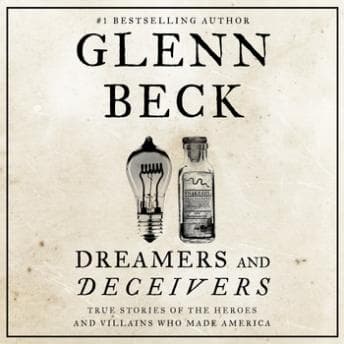

How well do you actually know the people whose names you throw around every day? You say "Ponzi scheme" without thinking twice, but could you tell me what Charles Ponzi's actual hustle looked like from the inside? Yeah, me neither. Not until this book, anyway.
I knocked this one out over a week of client site visits - three hours to Houston, three hours back, Ranger riding shotgun and snoring through the Alger Hiss chapter. Poor dog has no appreciation for Cold War espionage.
Ten Dossiers, Not One Long Lecture
Let me cut to the chase - Beck's approach here is basically the same playbook he used in Miracles and Massacres, and if you listened to that one, you know the format. Each chapter is a standalone story about a specific American figure, written more like narrative nonfiction than a textbook. Friday Night Lights works the same way - real people, real stakes, written like you're watching it happen rather than reading a report. You get Charles Ponzi's immigrant hunger and the mechanics of his postal reply coupon scam. You get Walt Disney's EPCOT vision - not the theme park that exists now, but the actual planned city he wanted to build, a functioning community of tomorrow that died with him in 1966. You get Alan Turing's code-breaking genius and the grotesque way his own government repaid him.
The strength is in the variety. Going from Steve Jobs' garage-to-empire arc to Alger Hiss's decades of deception keeps the listen from feeling like a slog. Beck frames these as "dreamers" and "deceivers," and while that binary is a little clean for my taste - most people are both, depending on the day - it gives the book a useful structure. You're constantly toggling between people who built something and people who burned it down.
Where it stumbles is pacing. A few of these stories overstay their welcome. The book runs about nine and a half hours, which is reasonable for ten stories, but a couple chapters feel like they're running on fumes by the end - circling back to make a point that landed five minutes ago. When you've got a format this episodic, each story needs to hit like a short mission brief: get in, deliver the intel, get out. A few of these needed a tighter extraction plan.
Jeremy Lowell Behind the Mic
Lowell's narration is... serviceable. I don't mean that as a backhanded compliment. He reads clean, keeps the pace steady, doesn't do anything that pulled me out of the story. But he also doesn't do anything that pulled me deeper in. With ten different historical figures spanning different eras and temperaments, there was room for a narrator to really differentiate the voices and tones chapter to chapter. Lowell plays it straight down the middle. Professional. Competent. Not memorable.
Compare that to something like a Scott Brick history narration where you can feel the narrator leaning into the drama of the material - Lowell stays at a respectful distance. For a book that's explicitly trying to make history feel alive and urgent, I wanted more fire behind the words. At 1.25x he sounded fine, kept the energy where it needed to be, but I wasn't rewinding to hear passages again.
The Beck Factor
Look, I know bringing up Glenn Beck's name in 2024 means half the room leaves before you finish your sentence. Here's my honest take: if you're expecting a political manifesto disguised as history, that's not quite what this is. Beck's editorial perspective shows up - it always does - but the stories themselves are grounded in actual historical record. The Ponzi chapter is genuinely interesting financial history. The Turing chapter handles a complicated legacy with more care than I expected. The Disney EPCOT material was the biggest surprise for me - I had no idea how ambitious and strange Walt's final vision actually was.
That said, the "untold stories" branding is a stretch. Most of this material is available in dedicated biographies of these figures. What Beck does well is package it into digestible, narrative-driven chunks for people who wouldn't otherwise pick up a 400-page Turing biography. It's history as entry point, not history as deep scholarship. And for windshield time? That works.
Who This Deploys For (And Who Should Stand Down)
If you liked Miracles and Massacres, this is the same unit, different mission. You'll feel right at home. If you're a history buff who wants serious academic rigor, this isn't your book - go read the primary sources. If you can't stand Beck's voice in public discourse, know that his editorial fingerprints are lighter here than you'd expect, but they're still present. If you just want interesting American stories told at a good clip while you're stuck on I-35? Worth your time.
Ranger slept through most of it, but he perked up during the Ponzi chapter. Even my dog knows a con when he hears one.
Mission status: accomplished, with minor delays.







![Steve Jobs [unabridged audiobook] audiobook cover](/_next/image?url=https%3A%2F%2Fcovers.audiobooks.com%2Fimages%2Fcovers%2Ffull%2F9788499923406.jpg&w=1920&q=75)