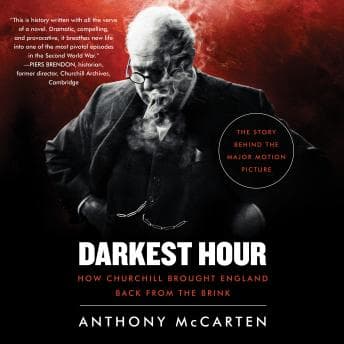

I have a complaint. Anthony McCarten wrote a book about Winston Churchill's first weeks as Prime Minister, and he had the audacity to make the man who saved Western democracy sound... uncertain. Plagued by doubt. Human. And honestly? It's the best thing about this book.
I finished Darkest Hour during a Sunday walk along the lakefront with Denise, and she had to pull me by the elbow at one crosswalk because I was so locked into Churchill's internal wrestling match that I'd stopped paying attention to traffic. Which feels appropriate, given that Churchill himself nearly sleepwalked Britain into negotiations with Hitler — or so McCarten argues.
The Man Behind the Growl
Here's what surprised me. I came into this expecting the Churchill Greatest Hits album — the speeches, the bulldog jaw, the "we shall fight on the beaches" bravado. And yes, those moments are here. But McCarten structures the book hour-by-hour through those terrifying weeks of May 1940, and what emerges is a portrait of a politician who wasn't yet the icon. He's a man scribbling drafts, second-guessing word choices, surrounded by colleagues — Halifax and Chamberlain chief among them — who genuinely believed suing for peace through Mussolini was the rational play. That tension between public performance and private collapse is something Dostoevsky spent his whole career mapping — and his Idiot puts a similarly contradictory man at the center of a room full of people who can't quite agree on whether he's brilliant or broken.
This reminds me of what Hemingway said about courage being grace under pressure. McCarten's Churchill has the grace, but he also has the sweat stains. The doubt. The 4 AM brandy. And that's where the book earns its keep — not in hagiography but in showing us a leader who chose defiance when surrender was the easier, arguably more sensible path.
At six and a half hours, it's lean. McCarten is a screenwriter by trade (The Theory of Everything, Bohemian Rhapsody), and you can feel that discipline. Scenes are tight. Dialogue gets deployed like stage direction. But occasionally that screenwriter's instinct works against him — some passages feel like they're setting up a camera angle rather than exploring an idea. You can practically hear Gary Oldman clearing his throat in the wings.
John Lee and the Problem of One Voice
Let's talk about John Lee. When he's channeling Churchill — the gravelly cadence, the theatrical pauses, the way he leans into Churchill's own sense of language as weapon — it's genuinely electric. Lee understands that pause is punctuation. He knows when to let a line breathe, particularly during the speech excerpts, and at 1.0x speed (the only civilized option, I maintain), those moments land with real weight.
But here's where it gets complicated. Lee narrates everything in a consistent British register, and while that's appropriate — this is Britain's story, after all — it means that when you move from Churchill to Halifax to Chamberlain to the general narration, the vocal texture stays pretty flat. Churchill gets the full performance. Everyone else gets... read aloud. Halifax should sound like cold marble. Chamberlain should carry the exhaustion of a man who knows he failed. Instead, they sort of blur together, and in a book that's fundamentally about political argument — about men in rooms disagreeing about the fate of millions — that's a real limitation.
I've heard people complain about Lee being "boring," and I think that's unfair. He's excellent at what he chooses to do. He just doesn't choose to do enough with the supporting cast. It's like watching a one-man show where the lead is brilliant but every other character is performed with the same cardigan energy.
The Screenwriter's History Book
McCarten calls this "revisionist," and I'd push back slightly. The idea that Churchill had doubts isn't exactly new — historians have been mining those War Cabinet minutes for decades. What McCarten does well is make those doubts dramatic, accessible, and paced like a thriller. He's writing history for people who watch movies, and I don't mean that as an insult. My students — the ones who actually do their reading — respond to narrative momentum, and this book has it.
What it doesn't have is much depth beyond the central question. If you want Churchill's interior life, his relationship with Clementine, the broader strategic picture — you'll need to go elsewhere. This is a book about a decision point, and McCarten keeps his lens tight. For six hours, that works. For a comprehensive understanding of the man? You'll want a longer commitment.
(If you loved the film and want the footnotes behind Gary Oldman's prosthetics, this is exactly what you're looking for. If you've already read Manchester's two-volume biography, this will feel like the CliffsNotes version. Both reactions are valid.)
Worth Pausing the Faculty Meeting For?
Here's the thing — I teach kids who think history is dead people doing dead things. This book is the antidote to that. It captures the terrifying aliveness of a moment when everything could have gone the other way. Churchill wasn't inevitable. Democracy wasn't inevitable. And McCarten, for all his screenwriter shortcuts, makes you feel that precariousness.
John Lee's Churchill is worth the listen alone. Just don't expect the rest of the cast to keep up. And for the love of all that is holy, listen at normal speed. The prose deserves to be savored, and that British accent turns to porridge at 1.5x.
My students would hate this. I love it. Well — I love about 80% of it. The other 20% I respect from a polite distance, like a colleague's budget presentation.








![Steve Jobs [unabridged audiobook] audiobook cover](/_next/image?url=https%3A%2F%2Fcovers.audiobooks.com%2Fimages%2Fcovers%2Ffull%2F9788499923406.jpg&w=1920&q=75)