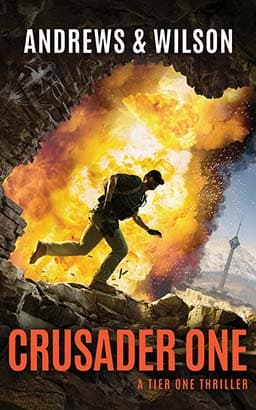

What happens when the guys writing your military thriller actually know the difference between a PETN charge and a plot device? You get something like Crusader One.
I picked this one up on a late-night drive back from a client site in Houston — two and a half hours of I-10 darkness, Ranger asleep in the back seat, and Ray Porter keeping me company at 1.25x. By the time I hit the Austin city limits, I'd burned through nearly three hours and genuinely did not want to stop the truck.
Andrews and Wilson Actually Served, and It Shows
Let me cut to the chase: Brian Andrews is a Navy vet, Jeffrey Wilson is a former Navy combat surgeon, and you can feel that in every operational detail. The radio calls sound right. The planning sequences for Dempsey's team feel like real mission briefs — fragmented, tense, people talking over each other about contingencies. When Ember spins up for their op into Tehran, the logistics of insertion, exfil planning, the argument about whether they even have an exfil — that's not something you pull from a Tom Clancy wiki page. That's lived experience filtered through fiction.
Dempsey himself is a solid operator protagonist. He's not some invincible action figure. The guy's running on grief and rage after losing his Tier One brothers, and the book lets that bleed into his decision-making without turning him into a liability. There's a stretch midway through where he's working alongside Israeli intelligence, and the friction between allied operators who don't fully trust each other — that dynamic rang completely true. I've been in rooms like that. Different flags, same mission, nobody quite willing to lay all their cards down.
The Iranian antagonist isn't a cartoon villain either. He's competent, ruthless, and operating within a system that has its own internal politics. When the book shifts perspective to show the Iranian side, it doesn't feel like filler. It adds genuine tension because you can see the collision coming.
Ray Porter Earns His Keep
I've listened to Porter on other stuff, and the man is consistent. Here he's doing something I really appreciate: he doesn't over-voice the military characters. Some narrators hear "Navy SEAL" and go full gravelly action-hero, which makes me want to throw my phone out the window. Porter keeps Dempsey grounded — controlled, clipped when the situation calls for it, but capable of real emotion when the story demands it. His voice for the Israeli operative Elinor has just enough accent work to sell it without veering into caricature.
The pacing of his read matches the book's structure — measured during the intelligence-gathering phases, then he ratchets up during the operational sequences. By the time Dempsey and his counterpart are going deep into Iran without backup, Porter's delivery had my hands tighter on the steering wheel than they needed to be.
Production quality is clean. No weird edits, no background noise, no sudden volume shifts. Professional throughout.
Where It Doesn't Quite Hit the Bullseye
This is where it lost me, at least partially: the geopolitical framing gets a little heavy-handed in spots. Missiles flying, countdown to World War III — the stakes escalation works in the moment, but some of the political dialogue at the higher echelons (NSC meetings, that kind of thing) felt more like a briefing PowerPoint than natural conversation. Characters explaining things to each other that they'd already know. It's a common problem in the genre, and Andrews and Wilson handle it better than most, but it still pulled me out a couple of times.
Also — and this is a series issue, not specific to this book — if you haven't read or listened to the first Tier One book, you're going to be confused. The emotional weight of Dempsey's vendetta depends on knowing what happened to his team. Don't start here. Go back to book one. Series continuity matters more in this genre than most — I made a similar mistake jumping into Tripwire out of order and spent the first hour playing catch-up instead of just being in the story.
The Debrief
Worth your time? Here's the debrief: if you want a military thriller written by people who've actually worn the uniform, with a narrator who knows how to get out of the story's way while still delivering real performance, Crusader One delivers. It's not reinventing the genre. It's executing within it at a high level. The Tehran operation sequence alone is worth the credit — tense, well-constructed, and honest about the cost of the kind of mission most thriller writers treat like a video game.
Skip this if you need standalone stories or if military acronyms and profanity bother you. (The profanity's accurate, by the way. That's how operators talk. If that offends you, you wouldn't last ten minutes in a TOC.)
Ranger slept through the whole drive home, but he perked up during the final act. Ranger approved this one. Mission accomplished.