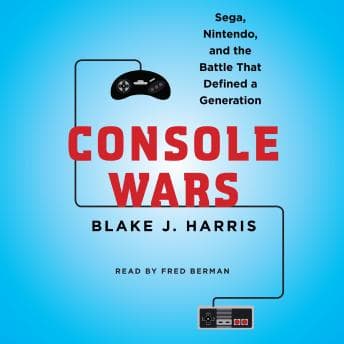

Everyone told me this was "Moneyball but for video games." And honestly? That comparison undersells it in some ways and oversells it in others. I started this one at 5:47 AM on a Tuesday after a particularly brutal on-call weekend where I'd been paged three times between midnight and 4 AM. Couldn't sleep, figured I'd burn through something light on the train. Twenty hours and forty-four minutes later, I'm genuinely surprised how much of a ride this was.
The Tom Kalinske Deploy Strategy
Here's what got me hooked: Tom Kalinske walks into Sega in 1990 knowing literally nothing about video games. Zero. The guy came from Mattel — he was a toy executive. And Blake Harris frames his entire arc as this outsider pattern-matching from adjacent industries to disrupt an incumbent monopoly. If you've ever watched a new VP join your org and somehow ship the thing everyone said was impossible because they didn't know it was supposed to be impossible? That's Kalinske's whole deal.
It's the same outsider-executive energy Fred Berman brought to Walking Dead: The Road to Woodbury — different genre, same instinct for making someone new to a world feel immediately legible.The best parts are the tactical marketing battles. Sega bundling Sonic with the Genesis, undercutting Nintendo on price, running the "Genesis does what Nintendon't" campaign — Harris reconstructs these decisions with boardroom-level detail from 200+ interviews. There's a scene where Kalinske's team is literally debating whether to go scorched-earth on Nintendo's reputation in front of Congress during the violent video games hearings, and you can feel the "do we really want to do this" tension. That section alone was worth three commute legs.
But here's my issue: Harris reconstructs dialogue. A LOT of dialogue. And some of it is clearly dramatized to the point where Japanese executives sound like they're in a bad movie. There's a conversation between Sega of Japan leadership that feels so Hollywood-ified I actually paused and Googled whether this was based on transcripts or memory. (It's memory. Obviously.) The book leans hard into making Sega the scrappy underdog protagonist, and Nintendo barely gets a fair shake. It's like reading a post-mortem where only one team wrote their section.
I had the exact same one-sided feeling with This Is the Day — occasionally charming, occasionally way too much, never neutral.Fred Berman: The Polarizing Deployment
Okay, so Fred Berman. I need to talk about this because the internet is deeply divided and I get why.
He's good. He's genuinely good at the core job — pacing a 20-hour business narrative so it doesn't feel like a 20-hour business narrative. His energy carries you through sections that would absolutely drag in print. The comedic timing on the marketing war anecdotes had me doing that thing where you laugh on the train and everyone looks at you like you're unhinged.
BUT. His Japanese character voices made me wince more than once. There's an exaggerated quality to the accent work that sits somewhere between "earnest attempt" and "uncomfortable stereotype," and at 1.5x speed it gets more pronounced, not less. And — this is the one that will bother gamers — he mispronounces Mario's name in spots. MAR-ee-oh. In a book about the console wars. Between Mario and Sonic. Come on.
The thing is, his American executive voices are genuinely distinct. You can tell Kalinske from his marketing team from the retail partners. When he's doing the Sega of America crew riffing off each other, it actually does feel like eavesdropping on a conference room. So it's not a bad narration — it's an uneven one.
Could've Been a Blog Post? Not This Time
I was fully prepared to bump this to 1.75x after the first hour because business books are notorious for padding. But Harris earns the runtime, mostly. The schoolyard culture war stuff — kids literally arguing Sega vs Nintendo on playgrounds as a proxy for the corporate battle happening above them — adds this human layer that pure business books miss. And the Sega Scream marketing moment is genuinely hilarious in audio form.
Where it drags: the Japan-side corporate politics in the back third. There are about 90 minutes of Sega of Japan vs Sega of America internal conflict that could've been condensed significantly. I caught myself zoning out around hour 16, which on a packed Caltrain at 6 PM means I missed my stop. (Kevin had to pick me up from Sunnyvale. He was not thrilled.)
The book is basically a well-documented case study in how insurgent market strategy works — and then how internal politics can murder momentum even when you're winning. As someone who's watched reorgs kill perfectly good engineering projects, that second half hit different.
Who Gets the Most ROI
Perfect for: anyone who grew up in the 90s gaming era, startup/business strategy nerds, people who like their business books with actual characters instead of frameworks. If you enjoyed Creativity Inc. or Shoe Dog in audio form, this scratches a similar itch.
Skip for: anyone sensitive to exaggerated accent work in narration, people expecting a balanced Nintendo-and-Sega account (this is Sega's story, full stop), or anyone who needs their business books under 10 hours.
The ROI on this audiobook is solid but not spectacular. It's a 20-hour commitment that probably should've been 15, with a narrator who's polarizing but mostly effective. Berman fans should also check out Falling Kingdoms, which shows off his dramatic range without the accent landmines. I finished it in about 8 commutes at 1.5x and don't regret a single one — but I also won't be relistening anytime soon.
Ship It, But Check the Logs First
TL;DR: Worth your commute if you've got patience for dramatized dialogue and a narrator who occasionally overextends on accents. The business strategy content is genuinely excellent, the 90s nostalgia is a bonus, and the core story of how Kalinske turned Sega from a punchline into a contender is legitimately fascinating. Just know what you're getting: it's a Sega memoir wearing a balanced history's clothes.