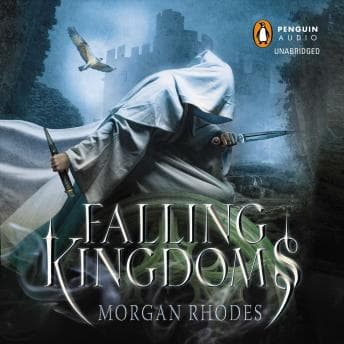

Falling Kingdoms is Game of Thrones for the YA crowd, and I mean that as both a compliment and a warning.
I started this one during a late-night coding session — I was supposed to be debugging a procedural terrain generator for my thesis, but by chapter three I'd closed my IDE and was just staring at the ceiling letting Morgan Rhodes ruin my productivity. Dr. Patel, if you're reading this, I was doing research on multi-POV narrative structures. Definitely thesis-related.
Three Kingdoms, Four POVs, One Big Fantasy Chess Board
So here's the setup: three kingdoms — Auranos (rich and soft), Paelsia (poor and angry), and Limeros (cold and ruthless) — and four protagonists whose lives are on a collision course. Cleo's the sheltered princess who gets dragged into a quest for lost magic. Jonas is the revolutionary with a personal vendetta that becomes something bigger. Lucia is the adopted royal hiding a supernatural secret. And Magnus — oh, Magnus — is the prince whose emotional repression could power a small city.
The world-building is... look, it's not Sanderson-level. Let me be honest. The magic system is more "vaguely prophesied ancient power" than hard magic with rules you can map out. If you need your magic systems to have thermodynamic constraints, this isn't your book. But the political landscape? The way Rhodes sets up the domino chain of events where one act of violence in a wine market cascades into full-scale war? That's where the world-building earns its keep. My D&D group would love this as campaign inspiration — the three-kingdom power dynamic is basically a ready-made geopolitical sandbox. The closest audiobook I've found to that same sandbox energy lately is Wolves of Midwinter: The Wolf Gift Chronicles, which builds its world through faction tension in a way that made me want to pull out a whiteboard and map the power structures.
The pacing runs hot. At 11 and a half hours, it doesn't have the luxury of a 40-hour Sanderson slow burn, and Rhodes knows it. She cycles through POVs fast, sometimes almost too fast. You'll get invested in Jonas's revolutionary rage and then — cut to Cleo being naive in a palace. It keeps the pages turning but there were moments I wanted to sit with a character longer before getting yanked away.
Fred Berman and the Staccato Problem
Okay, Fred Berman. This is where it gets complicated. The guy clearly did his homework — he's got distinct accents for the three kingdoms, and his voice for Magnus in particular has this cold, clipped edge that nails the character's whole repressed-prince-of-a-frozen-kingdom deal. When he's narrating prose and moving between viewpoints, it's smooth. You always know where you are and who's talking.
But the dialogue delivery? There's this staccato quality to his character lines that drove me slightly nuts. It's like every sentence gets chopped into short, punchy bursts — which works for tense confrontations but sounds weird during quiet conversations. When two characters are having a vulnerable moment and the delivery still sounds like someone reading a telegram, it undercuts the emotion. Compare that to someone like Steven Pacey, who could read you a grocery list and make you feel the weight of every item on it. Berman's got the range for voices but not always the restraint for tone.
I also caught a couple of location name mispronunciations that pulled me out of the world for a second. Minor, but when you're trying to keep three kingdoms straight in your head, consistency matters.
Who's Rolling Initiative on This One
If you grew up on Tamora Pierce or Kristin Cashore and you're looking for your next YA fantasy with political teeth, this is a solid pickup. It's got the betrayals, the morally gray royals, the simmering revolution — all the good stuff. If you're coming from adult epic fantasy expecting the depth of a Hobb or an Abercrombie, recalibrate your expectations. This is a setup book. Book one of six. It's laying groundwork, and some of that groundwork involves characters making decisions that feel a little tropey before they grow into something more complex.
Skip it if: you need hard magic systems, you can't handle YA romance subplots woven into your political intrigue, or staccato narration is a dealbreaker for you.
Worth Burning Thesis Time For?
I read this instead of writing my thesis, and I don't fully regret it. It's not going to reshape your understanding of fantasy — but it's a fun, fast-moving political fantasy that sets up what sounds like a gnarly series arc. The progression is satisfying enough that I've already got book two queued up. Rhodes knows how to end a book on a gut punch, and Berman — staccato issues aside — makes juggling four POVs feel manageable. It's YA fantasy comfort food with enough sharp edges to keep you honest. Not every book needs to be a 1,200-page doorstopper. Sometimes you just need kingdoms to fall.