
There are books you finish and think, I'm glad I experienced that. And then there are books you finish and sit in silence for twenty minutes, staring at the lake while Denise asks if you're okay and you say yes but you're lying.
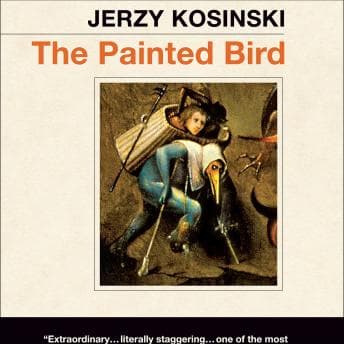
The Painted Bird is the second kind.
The Book That Made Me Cancel a Podcast Episode
I was supposed to record an episode of The Annotated Life about Kosinski last weekend. Had my notes, had my coffee, had my little outline about the controversy surrounding the novel's autobiographical claims. Couldn't do it. Not because I didn't have things to say — I had too many things to say and none of them felt adequate. Kosinski published this in 1965, and sixty years later it still has the power to make a grown man with twenty years of literary training feel like he's encountering something he doesn't have the vocabulary for.
Here's what The Painted Bird does that almost no other war novel does: it refuses to give you the architecture of atrocity. There's no geopolitical framing, no generals moving pins on maps, no grand narrative of liberation. There's just a boy — dark-haired, dark-eyed, maybe Roma, maybe Jewish, we never quite know — wandering from village to village in Eastern Europe during World War II. And each village is its own circle of hell. The cruelty isn't Nazi cruelty, mostly. It's peasant cruelty. Superstition cruelty. The kind that exists in the absence of ideology, which is somehow worse.
My students would hate this. I love it. But I say that with the full understanding that "love" is a strange word for a book where a boy watches a miller gouge out a man's eyes with a spoon at the dinner table. Kosinski writes these scenes with an almost clinical detachment — the boy observes, the boy survives, the boy moves on — and that flatness is what makes it unbearable. There's no melodrama to hide behind.
Fred Berman's Soft Polish Accent Is Doing More Work Than You Think
Let's talk about what the narrator is really doing here. Fred Berman reads this in a soft Polish accent, and at first I thought it was a stylistic choice — atmospheric, sure, nice touch. But about three hours in, I realized it's doing something much smarter. The accent places you geographically without the text ever naming a country. Kosinski deliberately stripped all proper nouns from the landscape. No Poland, no Germany, no specific anything. But Berman's voice puts you there anyway, in that unnamed Eastern European countryside, and the effect is almost subliminal.
The narration is intimate — a storyteller by a fire, not a performer on a stage. There's no character voicing to speak of, no distinct voices for the parade of farmers and priests and soldiers the boy encounters. And honestly? That's the right call. Giving Lekh or Olga or the carpenter distinct vocal personalities would've domesticated them, made them characters in a story instead of what they are: forces of nature that the boy passes through. Berman keeps everything close, almost whispered, like someone telling you a secret they're not sure you can handle.
Michael Aronov reads what I believe is the introduction or supplementary material — the production splits duties — and the transition is smooth enough that I didn't feel jarred. But Berman carries the novel itself, and he carries it well. The AudioFile Earphones Award was deserved.
The narrator understands that pause is punctuation. There are moments — after the painted bird scene itself, after the boy falls into the pit of manure — where Berman lets a beat of silence sit. Not long. Half a second, maybe. But in audio, half a second is an eternity, and he uses it.
Who This Is For (and Who Should Think Twice)
I need to be direct. The content warnings on this audiobook exist for a reason — violence, sexual abuse, cruelty to animals, cruelty to children. This isn't darkness for shock value; Kosinski is doing something deliberate about how innocence metabolizes horror, about how a child builds a worldview from the worst possible raw materials. But knowing that doesn't make it easier to listen to while grading sophomore essays at 11 PM. I had to stop twice. Not because of the narration. Because of the book.
If you loved Cormac McCarthy's Blood Meridian or Tadeusz Borowski's This Way for the Gas, Ladies and Gentlemen, this is their spiritual successor — or maybe their ancestor. It occupies that same territory where literature forces you to look at things you'd rather not see and asks you what you're going to do with that knowledge.
This is not background listening. This is not a commute book. This requires your full, undivided, possibly uncomfortable attention. I'll be honest — I made the mistake of treating Paris Apartment as background noise once, and even a far lighter book deserves better than half your attention.
The Annotation I'd Write in the Margins
This is why we still read the classics — not because they're comfortable or canonical or assigned, but because some books are doing something to the reader that no summary can replicate. The prose deserves to be savored, even when — especially when — what it describes is monstrous. Berman's narration honors that paradox. Ten hours and fifteen minutes. Worth every difficult second.