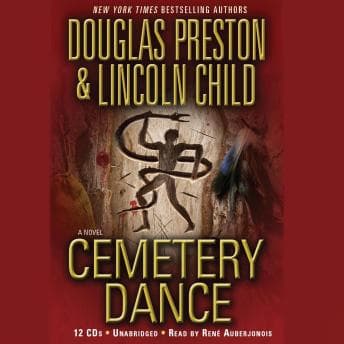

Everyone raves about Rene Auberjonois in this series. The internet practically genuflects. So I went in expecting to be swept away, and instead I spent the first two hours wondering if I was listening to the same audiobook everyone else was.
Let me back up.
I started Cemetery Dance at 11 PM on a Tuesday, which was a mistake. Not because of the vodou cult or the dead-man-walking murder mystery — I can handle that. But because I was mid-way through making dal makhani (my mother's recipe, which takes forever and requires constant stirring), and this book does not tolerate divided attention. I burned the dal. The book won.
The Dead Neighbor Problem and Why Pendergast Gets Away With Everything
The setup is genuinely interesting from a psychological standpoint. A man who is confirmed dead — buried, mourned, done — shows up on security footage murdering his neighbor, journalist William Smithback. The protagonist exhibits classic cognitive dissonance: you know what you're seeing, but your brain refuses to process it. Preston and Child understand that the scariest thing isn't the supernatural event itself. It's the moment rational people have to confront something that breaks their model of reality.
What makes Pendergast compelling is that he doesn't have this problem. He's already operating outside conventional frameworks. Where Captain Laura Hayward runs the investigation by the book — literally, procedurally, bureaucratically — Pendergast treats the whole thing like an intellectual puzzle with no rules. I found myself asking: why does D'Agosta really follow this man? It's not just loyalty. It's that Pendergast gives him permission to think the way he secretly wants to think. That's a fascinating case study in how charismatic authority figures recruit followers. (My therapist would have thoughts about this character. Many thoughts.)
But here's where I diverge from the fan consensus: the pacing is uneven. The first third crackles with tension — the attack scene, the impossible evidence, the early cult investigation. Then the middle section drags into exposition about the Ville, the secretive Obeah community hidden in Manhattan. The authors want you to feel the creeping dread of approaching something ancient and dangerous, but what I actually felt was impatience. There's a difference between slow-burn suspense and a book catching its breath for too long.
And the ending? Psychologically, this doesn't track. Without spoiling it, the resolution felt like the authors wrote themselves into a corner and chose spectacle over the kind of careful character logic they'd built in the first half. The cult itself — which should have been the psychological centerpiece — gets reduced to atmosphere rather than given real motivational depth. Why do these people believe what they believe? What keeps them in? The research actually shows that cult psychology is far more interesting than "they're scary and secretive," and I wanted more. For a case study in how someone actually gets pulled into that kind of loyalty and moral compromise, How I Helped O. J. Get Away With Murder delivers the psychological depth this book's cult members deserved.
Auberjonois: The Voice That Giveth and Taketh Away
Okay, so about that narration everyone loves.
Rene Auberjonois is genuinely excellent at character differentiation. His Pendergast has this precise, almost surgically detached quality — clipped, aristocratic — while D'Agosta sounds like exactly the kind of New York cop who's seen too much and talks too fast to process it. You always know who's speaking. That's not nothing. In a 13-hour mystery with this many characters, confusion would kill the experience.
But — and this is the thing nobody warned me about — there's a recurring vocal effect he uses for a particular entity ("the it," as some listeners call it) that involves this guttural, gurgling vocalization. First time? Genuinely unsettling. Effective horror. By the fifth or sixth occurrence, I was wincing. Not from fear. From fatigue. It's the audio equivalent of a jump scare that keeps using the same trick. Compare this to his Audie Award-winning work on Dance of Death, where the intensity felt more controlled, more varied. Here, it occasionally tips from "mesmerizing" into "okay, I get it."
That said — his handling of the suspense scenes? The cult investigation sequences where Pendergast and D'Agosta are literally walking into territory no outsider has survived? Auberjonois drops his voice to this quiet, measured pace that made me stop stirring and just stand there in my kitchen, wooden spoon dripping. He knows when to pull back. I just wish he'd applied that restraint more consistently.
Who Gets Invited to This Dance
If you're already invested in the Pendergast series, this is a solid entry — not the best, not the worst. If you love procedural mysteries with a supernatural twist and you don't need the paranormal elements to be rigorously explained (I did, and I was disappointed), you'll have a good time. If uneven pacing and a somewhat deflating third act bother you — or if guttural sound effects on repeat make you want to fast-forward — temper your expectations.
This is not a background listen. You will miss plot threads. You will confuse characters. Give it your full attention or don't bother.
The Case File, Closed
I wanted to love this more than I did. The psychological scaffolding is there — the impossible crime, the rational vs. irrational tension, a protagonist who functions like a walking Rorschach test for everyone around him. But Preston and Child chose atmosphere over psychological depth with their cult, and the ending traded earned resolution for something flashier. Auberjonois carries it further than the text probably deserves. I finished the dal the next night. It was better the second time. The book, I suspect, wouldn't be.