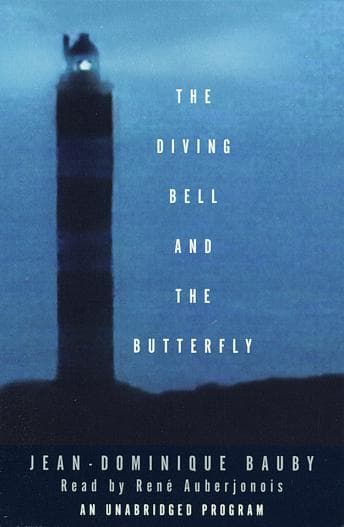

Look, I have a complaint. This book is 2 hours and 9 minutes long. That's barely one direction of my commute. I started it somewhere around Millbrae, and by the time I hit Mountain View I was sitting in the parking lot with my engine off, staring at my steering wheel, trying to remember how to be a functioning human. Two hours. Bauby wrote the whole thing by blinking his left eyelid - one letter at a time, someone reciting the alphabet over and over - and he packed more life into those two hours than most authors manage in twenty.
And honestly? That's the thing that wrecked me. Not the locked-in syndrome itself, though that's horrifying enough. It's that this man, paralyzed from head to toe except for one eye, dictated a book that's genuinely funny. Like, laugh-on-the-train-and-get-stared-at funny. He describes imagining elaborate meals while being fed through an IV tube, and the specificity of it - the sausage, the way he mentally constructs the textures - it's so vivid it borders on cruel. He writes about his kids visiting and the way his son's hair smells, and then pivots to a sardonic observation about hospital bureaucracy, and you're whiplashing between devastation and this weird, defiant joy.
The Man Who Debugged His Own Prison
Here's the engineering metaphor I can't stop thinking about: Bauby's brain is a fully operational system trapped behind a completely failed interface layer. Every input/output channel is dead except one blinking eye. And instead of just... existing in that, he reverse-engineers a communication protocol. Letter by letter. The French alphabet, rearranged by frequency (E-S-A-R-I-N-T first, because of course), blinked out to a transcriber who had to read his eye movements. The entire book was composed this way. Every sentence you hear cost him thousands of blinks.
Knowing that changes how you listen. When Bauby describes imagining himself walking through the streets of Paris, or lying next to a woman he loves, or traveling to Lourdes - these aren't just pretty passages. Each one was painstakingly extracted from his mind at a rate that would make dial-up internet look fast. The ROI on every single word is... I don't even know how to quantify it.
Auberjonois Found the Frequency
René Auberjonois (yes, Odo from Deep Space Nine - my brain kept doing that thing where you picture a shapeshifter reading a French memoir, which is deeply unhelpful) does something really specific here that I want to call out. He doesn't perform pity. A lesser narrator would've leaned into the tragedy, given you that soft, hushed "isn't this sad" voice for two hours straight. Auberjonois reads it the way I think Bauby intended - with this dry, warm wit that cracks open only when the emotion genuinely demands it. When the tone shifts from Bauby's mischievous fantasy sequences to the quiet devastation of hearing his elderly father's voice cracking over the phone, Auberjonois doesn't signal the shift with vocal fireworks. He just... lets the words do it. The restraint is what makes you feel it.
That said - and the research backs this up - this is NOT a multitasking audiobook. One reviewer admitted being confused through a lot of it because they were multitasking. I believe it. The chapters are short, almost vignette-like, and Bauby jumps between memory, imagination, and present-tense hospital reality without much warning. At 1.5x it's manageable but tight. I wouldn't go faster. This is one of the rare books where I actually dropped to 1.25x because I wanted to sit inside the sentences.
Who This Is For (and a Real Warning)
Perfect for: a dedicated listen when you need perspective. Not "productivity podcast" perspective. Actual, bone-deep, "my on-call shift isn't that bad" perspective. Skip for: background listening, gym, anything where your attention is split.
If you've seen the Julian Schnabel film, the audiobook apparently diverges in how it handles Bauby's personal relationships - listeners who've compared the two say the book is more honest, less cinematic. Makes sense. This wasn't written for an audience. It was blinked out of a body that had become a diving bell, by a mind that refused to stop being a butterfly. (That metaphor is his, and it's earned.)
Bauby died two days after the French publication. Two days. I keep circling back to that. He never heard this audiobook. He never knew Auberjonois would narrate it with exactly the right mix of wit and weight. He just blinked his book into existence and then he was gone.
The Shortest Audiobook That'll Ruin Your Week
TL;DR: Worth your commute. It's barely one commute long, and it'll haunt you for the rest of them. The ROI on this audiobook is immeasurable - not in productivity terms, but in the "remember what your functioning body can do" terms. I finished it, walked into the office, and just sat at my desk for a minute before opening my laptop. A Street Cat Named Bob hit me with that same unexpected gut-punch of gratitude, though obviously from a very different angle. Two hours. One eye. Every word earned.
(Kevin asked why I was quiet at dinner. I said "a French magazine editor who could only blink." He didn't ask follow-up questions. Smart man.)