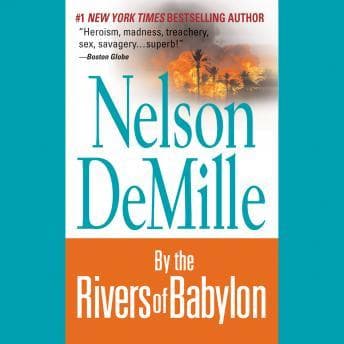

Someone told me this book was boring. Exact quote from a review I read: "I'd rather sit and watch my bananas ripen." And I get it. I genuinely do. But here's the thing - I teach high school English in Chicago, and I've spent twenty years watching teenagers dismiss anything that doesn't deliver a dopamine hit every thirty seconds. Patience with a slow build is a dying art. DeMille's first major novel demands that patience, and whether it earns it is a fair question. But boring? No. Not quite.
I started this one on a Saturday morning walk along the lakefront with Denise. By the time we looped back to Montrose Harbor, we were deep into the setup - two Concordes leaving Lod Airport, the political machinery grinding behind a peace conference, the interpersonal chess between hawks and doves sharing cabin space. Denise, who tolerates my audiobook habit the way you tolerate a spouse's harmless vice, actually asked me to keep playing it in the car on the way home. That almost never happens.
DeMille Before He Became DeMille
This is a 1978 novel, and you can feel it. The Cold War thriller DNA is all over the structure - the meticulous geopolitical staging, the omniscient narrator hopping between a dozen perspectives, the almost clinical attention to weaponry and tactical positioning. This reminds me of what Hemingway said about writing - that the dignity of movement of an iceberg is due to only one-eighth of it being above water. DeMille gives you the whole iceberg here. Every eighth. All of them. For seventeen and a half hours.
That's both the book's greatest strength and its most obvious liability. When the two Concordes crash-land at the ancient site of Babylon - and yes, the biblical resonance is absolutely intentional, practically load-bearing for the novel's themes - DeMille doesn't rush to the gunfire. He builds the geography. He establishes sightlines, water sources, the crumbling infrastructure of a civilization that died millennia ago. It's a siege novel, and he treats the terrain as a character. If you loved James Clavell's way of making setting feel like fate, this is its spiritual successor in a very different sandbox.
But here's my honest take: the middle third tests you. The parallel narrative of the Israeli rescue operation creates necessary tension on paper, but in practice it fragments the momentum right when the people on the ground are getting interesting. I was grading a stack of junior essays on "The Great Gatsby" around hour nine, and I realized I'd been half-listening for twenty minutes. That's a pacing problem. The prose deserves to be savored when DeMille is writing about desperate people improvising defenses from ancient stone - less so when he's walking you through military bureaucracy for the fourth time.
Scott Brick Does the Heavy Lifting
Brick is the right narrator for this. His delivery is measured and clear, which matters enormously when you're juggling Israeli military officials, Palestinian commandos, diplomats, pilots, and assorted civilians - many with names and titles that would blur together in lesser hands. One reviewer noted that Brick's narration helped them track characters and foreign terminology, and I felt that too. He doesn't showboat. He reads with the precision of someone who respects that the author put those words in a specific order.
I don't have specifics on distinct character voices - the research came up empty there - but what I noticed was Brick's tonal shifts between the ground-level survival scenes and the political maneuvering chapters. The Babylon sequences carry a kind of grim weight in his delivery. The bureaucratic sections get a drier, more clipped treatment. It's subtle work. The narrator understands that pause is punctuation, and Brick uses silence well during the moments when DeMille lets the ancient setting speak for itself.
I remember that same deliberate silence in I, Robot, where Brick gave Asimov's logical puzzles an almost meditative quality.At 1.0x speed (because I'm apparently ancient and proud of it), seventeen hours felt earned if occasionally indulgent. I could see a case for 1.15x during the rescue operation chapters specifically, though I'd never actually do it.
Who's Going to Love This (And Who Should Watch Their Bananas Instead)
If you want a modern-paced thriller with chapter-ending cliffhangers every fifteen minutes, this will frustrate you. Full stop. DeMille wrote this like a literary novelist who happened to be writing a thriller - big themes about peace and violence, about what it means to stand on the ruins of Babylon and fight for a future. My students would hate this. I love it. Mostly.
It's ideal for listeners who appreciate the architecture of suspense rather than just the payoff. People who've enjoyed DeMille's later work - "The General's Daughter," "The Gold Coast" - should hear where he started, even if the craft isn't as polished. I felt a similar ambition in Panther, though his pacing had sharpened by then. And if you're a sucker for settings that carry symbolic weight the way I am, the Babylon location elevates what could've been a standard hostage thriller into something stranger and more ambitious.
But I won't pretend the seventeen-hour runtime doesn't occasionally feel like seventeen hours.
Worth Pausing the Faculty Meeting For? Almost.
DeMille's debut is a flawed, ambitious, occasionally brilliant siege novel wrapped in Cold War thriller mechanics. Scott Brick gives it the steady, intelligent reading it needs. It's not DeMille's best work - it's his first, and you can tell - but there's something admirable about a thriller that trusts you to sit with the weight of its setting and its questions about whether peace is something humans actually want or just something they perform. That's a question worth seventeen hours. Just maybe not every one of them.