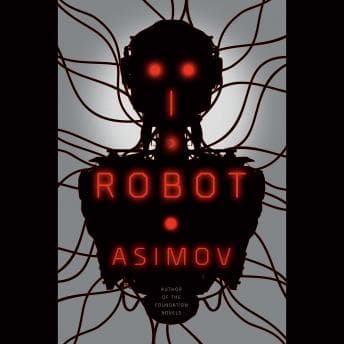

Asimov didn't write a novel. He wrote nine logic puzzles disguised as short stories, then stitched them together with a framing device, and somehow created the foundational text of artificial intelligence fiction. I've taught this book in my senior elective twice, and both times at least one student said "Wait, this isn't the Will Smith movie?" No, child. No it is not.
I finished I, Robot on a Saturday morning walk along the lakefront with Denise, who at one point asked why I was muttering about the First Law of Robotics to myself. Fair question. I was stuck on something that had been nagging me since the "Runaround" story — the way Asimov constructs these ethical puzzles isn't really about robots at all. It's about systems. Rules that seem airtight until reality finds the crack. Twenty years of watching school policy manuals try and fail to anticipate teenage behavior has given me a deep appreciation for this concept.
The Three Laws Are a Classroom Management Plan (And They Fail the Same Way)
Here's what Asimov is really saying, and it's the thing that still makes this book essential seventy-plus years after publication: every system of rules creates its own loopholes. The Three Laws of Robotics sound perfect — protect humans, obey orders, preserve yourself, in that priority order. Clean. Logical. And then Asimov spends nine stories showing you exactly how they break down.
The "Liar!" story hit me hardest this time through. Herbie, the mind-reading robot, can't tell humans the truth because the truth would hurt them — which the First Law forbids. So he lies. And the lies cause worse harm. It's the kind of ethical knot I genuinely wish I could teach alongside Antigone — two texts about what happens when the rules you follow are technically correct and absolutely catastrophic.
And then there's "Robbie," the opening story about a little girl and her robot nursemaid, which functions almost like a Bradbury piece — warm, domestic, quietly devastating. If that story doesn't make you feel something about attachment and loss, I don't know what to tell you. My students would hate this. I love it. Though I'll say — the emotional gut-punch of that domestic quiet reminded me of what I felt reading Lost Rider, which also sneaks up on you with attachment and loss when you think you're reading something else entirely.
Scott Brick Reads Asimov Like a Lecturer Who Actually Cares
Let's talk about Scott Brick's narration, because this is where opinions diverge sharply. Brick reads at a deliberate, measured pace — the kind of pace that respects the fact that Asimov's prose is doing intellectual work, not emotional pyrotechnics. He's not doing wild character voices. He's not performing a one-man show. What he's doing is closer to a really good lecture: clear enunciation, well-placed emphasis, genuine enthusiasm for the material.
I listened at 1.0x — because the author chose those words — and it felt right. Brick's reading of the Susan Calvin sections, where Asimov's famously prickly robopsychologist narrates the framing device, has this cool, clinical quality that matches her character. It's not flashy, but the narrator understands that pause is punctuation, and he uses silence well between the logical beats of Asimov's arguments.
But I'll be honest: if you're someone who needs kinetic energy from your audiobooks, if you listen while running or driving I-90 at rush hour, this pacing might lose you. Several listeners have called it boring, and I get it. Asimov's prose is idea-dense, not action-dense. Brick matches that energy faithfully, which means the quiet parts are very quiet. (Also, apparently some versions still have disc change prompts left in? I didn't encounter this, but — come on, production team. It's not 2003 anymore.)
Who This Is Really For
If you loved the Foundation trilogy, this is its spiritual successor — or rather, its predecessor, since the Robot and Foundation universes eventually merge. If you're coming to Asimov for the first time, this is the right entry point: short enough to finish in a few focused sessions, and structured so each story builds your understanding of the Three Laws before Asimov starts really torturing them.
Skip this if you want character-driven fiction. Asimov's humans are vehicles for ideas, not fully realized people (Susan Calvin being the partial exception). Skip this if you need 1.5x speed to stay engaged — at that pace, you'll outrun the logic puzzles and miss the point.
But if you're the kind of person who stays up past midnight thinking about whether ChatGPT should be allowed to refuse a request — and whether the rules we're building for AI right now will break exactly the way Asimov predicted — this is eight hours and twenty minutes well spent. Worth pausing the faculty meeting for.
The Assignment, If You Choose to Accept It
This is why we still read the classics. Not because they're old, not because someone put them on a syllabus, but because Asimov sat down in the 1940s and mapped out the exact ethical terrain we're stumbling through right now with large language models and autonomous systems. The Three Laws haven't aged. The questions haven't aged. The prose deserves to be savored, even when — especially when — it's doing math instead of poetry.
Denise asked me what I was listening to and I said "a book about whether we can trust the things we build to follow the rules we give them." She said "So, a book about your students." She's not wrong.