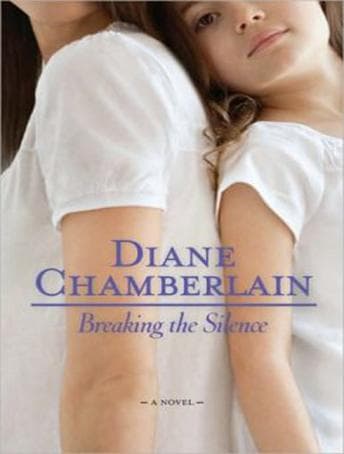

What happens when the scariest thing in a story isn't a ghost or a monster but the very real, very human capacity to destroy someone under the guise of helping them?
I was shelving returns at the library last Thursday - late shift, fluorescent lights buzzing that specific frequency that makes everything feel slightly wrong - when I decided to start this one through my earbuds. Diane Chamberlain's Breaking the Silence had been sitting in my queue for weeks, and something about the quiet of a nearly empty branch felt right for it. I was wrong about that, but in a good way.
The Horror That Wears a Lab Coat
Let me be clear: this is not horror in the genre sense. But it traffics in something I find genuinely more disturbing than most of what crosses my desk. Chamberlain builds two parallel timelines - Laura Brandon navigating her husband's suicide and her daughter Emma's subsequent selective mutism, and Sarah Tolley's memories of a past tangled up in psychiatric experimentation. The Sarah thread is where Chamberlain earns her keep. We're talking about the kind of institutionalized cruelty that actually happened - patients subjected to experimental "treatments" that amounted to torture, all sanctioned by people in positions of authority. Shirley Jackson walked so this author could run, at least in the sense that both understood how institutions designed to care for people can become their prisons.
The connections between the timelines unfold slowly. Like, slowly. The first few hours are mostly setup - Laura grieving, Emma not speaking, the mystery of why Laura's dying father sent her to visit a stranger with Alzheimer's. If you need a body by chapter three, this isn't your book. But if you've got the patience for it, the payoff when these threads start braiding together is genuinely unsettling. Not jump-scare unsettling. The kind where you stop what you're doing and think about the systems we trust with vulnerable people. That same queasy reckoning with institutional rot and the people caught inside it runs through I Know a Secret in ways that kept me up later than I'd like to admit.
I will say the modern-day storyline occasionally dips into melodrama. The "Emma's real father" reveal is telegraphed early and the romantic tension between Laura and this man she barely knows sometimes feels like it belongs in a different, lighter book. Chamberlain is strongest when she's excavating the past, weakest when she's engineering the present.
Justine Eyre's Whisper Problem
Here's the thing about Justine Eyre's narration: she commits to the mood. That's rare. Her voice is soft - almost a whisper at points - and she leans into the somber weight of this story like she's reading it to you in a confessional. For the Sarah Tolley sections, this works beautifully. There's a hush to those memories that feels appropriate, like someone telling you a secret they've carried for decades.
But - and this is a real but - that same approach nearly lost me in the first two hours. Laura's grief is already heavy on the page, and Eyre's delivery pushes it into territory that felt almost narcotically depressing. I caught myself zoning out twice during the opening chapters, not because the writing was bad but because the narration created this fog that made it hard to track what was actually happening. I actually bumped my speed to 1.25x and it helped considerably. Gave the performance a little more energy without sacrificing the tone.
Eyre is a classically trained actress with an Audie Award, and you can hear the craft. She knows what she's doing. But I think she made a choice to prioritize atmosphere over clarity, and for a book that requires you to track multiple timelines and a slowly assembling mystery, that's a trade-off that doesn't always pay off.
Who Needs This (And Who Should Walk Away)
If you're a Chamberlain fan, you probably already know what you're getting - dual timelines, family secrets, emotional gut punches rooted in real history. This is solid mid-tier Chamberlain. Not her best (I'd point people to The Secret Life of CeeCee Wilkes first), but the historical thread about psychiatric abuse gives it a weight that elevates it above pure domestic thriller territory.
Skip this if you scare easily in the wrong direction - the content warnings here are real. Suicide, institutionalized torture, Alzheimer's. It's not gratuitous, but it doesn't flinch either. Also skip if you need your narrators to project. Eyre's whisper-soft approach is a genuine barrier to entry.
But if you're someone who - like me - finds the horror in what humans do to each other more frightening than anything supernatural? And if you're willing to push through a slow, occasionally uneven first act? There's something here. I finished it on my drive home that night, parked in my driveway with the engine off, Shirley (my cat) watching me through the window like I'd lost my mind. Maybe I had. The final connections Chamberlain draws between past and present, between silence as protection and silence as prison - that stuck with me.
Finally, horror that respects the genre. Even when it doesn't know it's horror.
Cataloged Under: Worth the Patience, Not the Full Price
The story earns a solid recommendation, but Eyre's narration - while atmospheric - creates enough of an accessibility issue that I can't call this a must-buy at full credit. Borrow it. Listen at 1.25x. And maybe don't start it under fluorescent lights in an empty building. Or do. I'm not your librarian. (I mean, I am a librarian, but you know what I mean.)