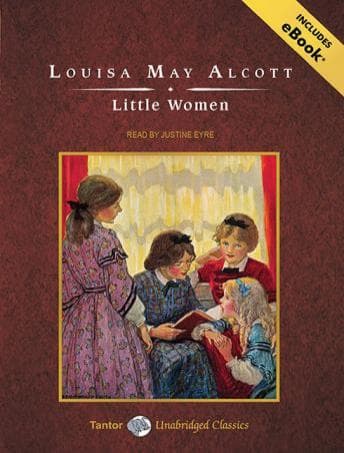

Look, I need to lodge a formal complaint with whoever decided to categorize this as a "girl's book." Seventeen and a half hours into the March family's Civil War era struggles, and I'm genuinely annoyed that generations of boys were steered away from what is essentially a masterclass in family systems psychology. I was chopping onions for chana masala - already emotional, fine - when Beth's illness arc hit, and I had to sit down on my kitchen floor. The onions were burning. I didn't care.
Alcott understood something that took psychology another century to articulate: identity formation happens in the crucible of family dynamics. The research actually shows that sibling position profoundly shapes personality development, and watching Jo struggle against her designated role as the "difficult" middle child while Amy weaponizes her baby-of-the-family charm? A fascinating case study in birth order theory before birth order theory existed.
The Four Case Studies Masquerading as Sisters
What makes these characters compelling is that Alcott refuses to flatten them into archetypes. Jo exhibits classic approach-avoidance conflict - she desperately wants independence but can't tolerate the guilt of wanting it. Beth's "tragically frail" characterization initially made me skeptical (the Victorian dying-angel trope, my therapist would have thoughts), but Alcott subverts it. Beth isn't passive; she's made a conscious choice about the scope of her world. That's not weakness. That's radical acceptance.
And Amy. Amy is the character everyone loves to hate, and I found myself asking: why does she really provoke such strong reactions? Because she's honest about her ambitions in ways the others aren't. She wants money, beauty, social position - and she says so. The cognitive dissonance she creates in readers tells us more about our own discomfort with female ambition than about Amy herself.
Meg is the control in this experiment. The one who follows the expected path. And Alcott is smart enough to show that the expected path has its own quiet devastations.
Justine Eyre's Restraint as a Feature
I've listened to overwrought Victorian narrations before - all heaving bosoms and trembling declarations. Eyre doesn't do that. Her approach is what I'd call emotionally calibrated. She differentiates ten-plus characters without turning any of them into caricatures, which is harder than it sounds. The classical piano punctuation between sections feels era-appropriate rather than intrusive.
Here's the thing: this restraint works because Alcott's prose already carries significant emotional weight. You don't need a narrator sobbing through Beth's death when the text itself is doing that work. Eyre trusts the material. I appreciated that.
Psychologically, this tracks with research on emotional processing - sometimes less performative delivery actually allows deeper listener engagement. Your brain does the emotional labor instead of outsourcing it to the narrator.
The Marmee Problem (And Why It's Actually Fine)
Marmee is almost too good. I kept waiting for the crack in her saintly facade, some moment where she'd snap at her daughters or reveal hidden resentment about her absent husband. It never comes. And initially, this felt like a characterization flaw.
But then I remembered: this is semi-autobiographical. Alcott is writing her mother as she experienced her - as the steady center around which chaos orbited. The idealization isn't a failure of craft; it's a daughter's tribute. Once I reframed it that way, Marmee's perfection became poignant rather than annoying.
Who This Is (and Isn't) For
If you need constant plot acceleration, this isn't your book. Seventeen hours is a commitment, and the pacing is - let's be honest - leisurely. This is domestic fiction. People get sick, recover or don't, fall in love badly, make terrible financial decisions, and slowly figure out who they are. If that sounds boring to you, skip it.
But if you're interested in how families actually work? How siblings negotiate love and rivalry and the finite resource of parental attention? How women in restrictive eras carved out space for ambition? Essential listening.
I'd recommend it for long cooking sessions, road trips, or - and I mean this seriously - anyone in therapy working through family-of-origin stuff. Raising Good Humans explores similar territory about breaking inherited family patterns, though from the parent's perspective rather than the child's. It's a surprisingly useful mirror.
The Prescription I'm Writing Myself
I'm going to relisten to this. Not immediately - I need some emotional recovery time - but eventually. Because here's what I realized somewhere around hour twelve, stirring that chana masala I'd completely over-spiced: Alcott wasn't just writing about her family. She was doing what all of us who study human behavior are trying to do. Asking why people hurt each other, why they sacrifice for each other, why they can't stop trying to become themselves even when it costs them everything.
The protagonist exhibits classic developmental struggle - but so do we all. That's the point.
My mother still wouldn't understand why I need this audiobook when I already have the physical copy. But some stories need to be heard out loud, in real time, while you're living your own messy life alongside them.