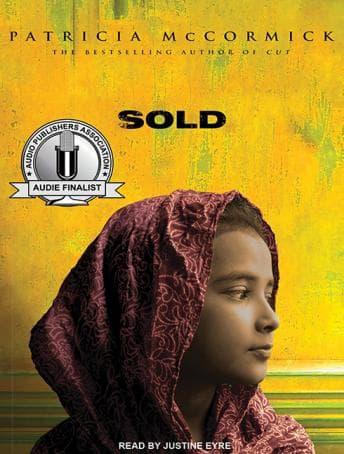

I was sitting at the kitchen table last Saturday morning, coffee going cold, half-heartedly sorting through a stack of sophomore essays on To Kill a Mockingbird — most of them opening with "Since the beginning of time, racism has existed" — when I pressed play on Sold. Three hours and forty-three minutes later, the essays were untouched, my coffee was ice cold, and I was staring at the wall trying to remember how to breathe normally.
This is a book that will gut you. And it should.
Vignettes as Blade Edges
Patricia McCormick doesn't write chapters. She writes vignettes — some barely a page long, many just a handful of sentences. And this structural choice, which could feel gimmicky in lesser hands, is exactly right for Lakshmi's story. Because when you're a thirteen-year-old Nepali girl who's been trafficked into a brothel in India, your world shrinks to fragments. Moments. The texture of a new dress that turns out to be bait. The arithmetic of debt that's designed never to reach zero. McCormick was a journalist before she was a novelist, and you can feel that discipline here — she doesn't editorialize, doesn't pad, doesn't soften. She trusts the spare language to carry impossible weight.
This reminds me of what Hemingway said about the iceberg theory — the dignity of movement is due to only one-eighth of it being above water. McCormick is doing something similar. The prose is simple enough that my freshmen could read it. The emotional architecture underneath is devastating enough that I, a grown man who has read Beloved and The Road and thought he was tough, had to pause and walk around my kitchen for a minute.
And here's the thing — in audio, those vignettes hit differently than on the page. Each one lands like its own small detonation, with silence between them. The brevity becomes rhythm. The white space becomes held breath.
Justine Eyre Knows When Not to Push
The best thing I can say about Justine Eyre's narration is what she doesn't do. She doesn't perform grief like a Broadway audition. She doesn't voice Lakshmi as a trembling waif. There's a steadiness in her reading — quiet desperation held together by a girl's stubborn refusal to disappear — that honors McCormick's restraint. The narrator understands that pause is punctuation, and Eyre uses silence the way a good musician uses rests.
I'll be honest: I don't have granular detail on how she differentiates every character voice. The research is thin there. But what comes through clearly is tone — the cold transactional cruelty of Mumtaz, the fragile solidarity between the girls at Happiness House. Eyre keeps Lakshmi's internal voice anchored even when the world around her is chaos. That's not easy. Narrating trauma without tipping into melodrama is a high-wire act, and she stays on the wire.
The AudioFile Earphones Award and Audies finalist nod feel earned here. This isn't flashy narration. It's the kind that disappears into the story, which — for this particular story — is exactly right.
The Book I'd Teach If the School Board Would Let Me
Here's my professional confession: I've wanted to teach Sold for years. It's the kind of book that could change a sixteen-year-old's understanding of the world in ninety minutes of reading. McCormick based it on actual interviews with trafficking survivors in Kolkata. The specificity — Lakshmi counting the days on a stolen pencil stub, the way she measures time by the sounds from the street — that's journalism turned into art.
But I also know my district. I know the content warnings here are real and earned. Violence. Abuse. Sexual exploitation of a child. McCormick handles it without being gratuitous — she's more suggestive than explicit, which somehow makes it worse because your imagination fills in what she leaves out. My students would hate this. Not because it's boring — because it's unbearable in the way truth is unbearable. And I love it for that.
If you loved A Little Life for its unflinching look at survival, or if The Kite Runner wrecked you, this is their spiritual successor — smaller in scope, sharper in focus, aimed younger but no less serious. I'd put Jane Eyre in that same lineage too — a girl stripped of power by the world around her, surviving on sheer interior stubbornness — though McCormick's prose is starker, the stakes more immediate, and the violence less gothic.
Who This Is For (and Who Should Steel Themselves)
Anyone who believes fiction's job is to make us look at what we'd rather not see. Parents of teenagers who want to start hard conversations. Book clubs that are tired of safe picks. If you can handle the subject matter, the audio format actually intensifies the intimacy — Lakshmi's voice in your ear, close as a whisper, for under four hours.
But if you're looking for something to half-listen to while cooking dinner or zoning out on the treadmill — this isn't it. This demands your full attention. And probably a quiet room afterward.
At 3 hours 43 minutes, it's a single-sitting listen. I'd almost say it has to be. Stopping and starting would break the spell, and McCormick's cumulative structure — vignette stacking on vignette like stones on a cairn — needs that unbroken momentum to land its final punch.
The Annotation in the Margin
I went back to those sophomore essays eventually. And I graded them more gently than I might have otherwise. Because after spending a morning inside Lakshmi's head, the fact that my students are sitting in warm classrooms writing clumsy thesis statements about justice felt like its own kind of miracle. This is why we still read the classics — and why we need to keep making room for the books that haven't aged into "classic" status yet but absolutely will.
The prose deserves to be savored. Even when it hurts. Especially when it hurts.